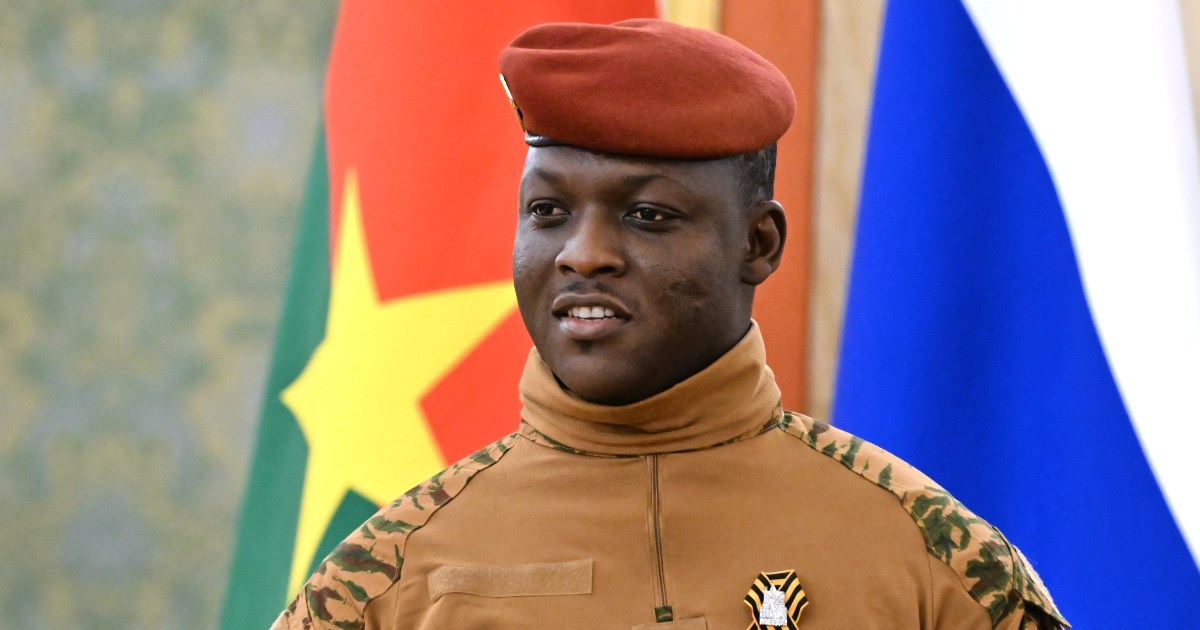

Once backed by influential Muslim scholars, Burkina Faso’s military leader is now facing a growing rift over arrests, new legislation and his campaign against what he describes as religious extremism.
Burkina Faso’s transitional leader, Captain Ibrahim Traore, has sharply escalated his confrontation with influential Muslim scholars, declaring that what he calls “radical Islam” has no place in the country and warning that “the battle has begun” against those he accuses of promoting religious extremism.
Addressing scholars whom he accused of spreading extremist ideas, Traore declared: “If this is your Islam, we will fight it. Extremists must change. If they do not, the battle has begun.”
His remarks underscore a widening rift between the government and parts of Burkina Faso’s Muslim community. Once an important source of support for the military leader, several influential Sunni scholars are now at odds with the authorities over the Religious Freedoms Law, the detention of prominent imams and the government’s campaign against religious extremism.
Traore argued that religion should spread through example rather than coercion or violence. He also questioned why some Muslims opposed the new legislation and warned that imams who use sermons to promote extremist ideas would be suspended.
At the same time, he pledged state support for scholars who advocate what he described as a peaceful interpretation of Islam, while accusing foreign powers of exploiting religion to destabilise Burkina Faso.
Advertisement
Students studying abroad
Traore also announced plans to recall Burkinabe students studying Islamic law in Arab countries, claiming that more than 800,000 were pursuing religious education abroad without acquiring practical professional skills.
He warned that those who refuse to return could risk losing their Burkinabe citizenship.
The announcement followed a government directive issued in late June requiring students seeking to study abroad to obtain prior approval from the Ministry of Higher Education.
Authorities said the measure was intended to ensure overseas study programmes better align with the country’s development priorities.
The tighter controls on religious education came as Burkina Faso’s transitional parliament unanimously adopted the Religious Freedoms Law on June 20.
The government says the legislation is intended to reinforce the state’s secular character. It introduces prison terms and fines for practices that authorities classify as religious abuses, including the forced begging of children and breaches of financial transparency rules by religious organisations.
From ally to adversary
The law deepened already growing tensions between the government and sections of the Muslim community.
In late May, Imam Mohamed Ishaq Kindo, one of Burkina Faso’s most prominent Sunni scholars, was arrested after criticising the draft legislation.
Referring to the arrest and the protests that followed, Traore dismissed the unrest as the work of “a small minority of extremists”.
After worshippers gathered to demand Kindo’s release, authorities closed the largest Sunni mosque in the capital, Ouagadougou, citing public order concerns.
Agence France-Presse (AFP), citing a security source, reported that about 100 of the imam’s supporters were transferred to a military camp for what officials described as “civic training”.
Kindo’s arrest followed the mid-April detention of Imam Mahmoud Barro in Bobo-Dioulasso under similar circumstances. According to the Timbuktu Institute, a Dakar-based think tank specialising in peace and security issues, Kindo’s whereabouts have not been disclosed since the protests were suppressed.
According to the institute, the confrontation extends beyond the Religious Freedoms Law. It marks the breakdown of the tacit understanding that had developed between Traore’s government and influential Muslim scholars, whose backing helped bolster his standing after he seized power.
By turning against former allies, the institute argues, Traore risks weakening an important source of political legitimacy without resolving the security crisis that his government has used to justify its increasingly assertive measures.
Advertisement
An Israeli dimension
Alongside the domestic tensions, Traore recently received Israel’s new ambassador to Burkina Faso, Simon Seroussi, in Ouagadougou to present his credentials.
![Traore receives the credentials of the new Israeli ambassador to Burkina Faso, Simon Seroussi [File:Handout/Burkinabe Presidency]](https://www.aljazeera.com/wp-content/uploads/2026/07/730917702-1784616685-1784719349.jpeg?w=770&resize=770%2C510&quality=80)
The meeting followed a report by Africa Intelligence, a Paris-based publication specialising in African political and business affairs, that the ambassador’s accreditation request, submitted in the summer of 2025, had remained pending before being quietly approved.
Traore’s public reception of the ambassador appears to mark a shift from the caution previously shown by his inner circle, which had sought to preserve his anti-Western image. It also comes as Israeli security agencies expand cooperation with members of the Alliance of Sahel States (AES), the bloc formed by Burkina Faso, Mali and Niger, whose governments have expressed interest in Israeli security technology.
As Traore declares that “the battle has begun” against what he describes as religious extremism, while the Religious Freedoms Law takes effect and the fate of detained scholars remains unclear, a broader question emerges: will the government’s efforts to assert greater control over sources of public legitimacy strengthen its authority, or deepen its confrontation with one of Burkina Faso’s most influential social forces?
Related News
‘Maximum use’: Iran boosts military strength during ceasefire with US
Syria explosion live: Blast rocks Damascus as authorities investigate cause
Russia touts ‘war with NATO’ amid losses in Ukraine