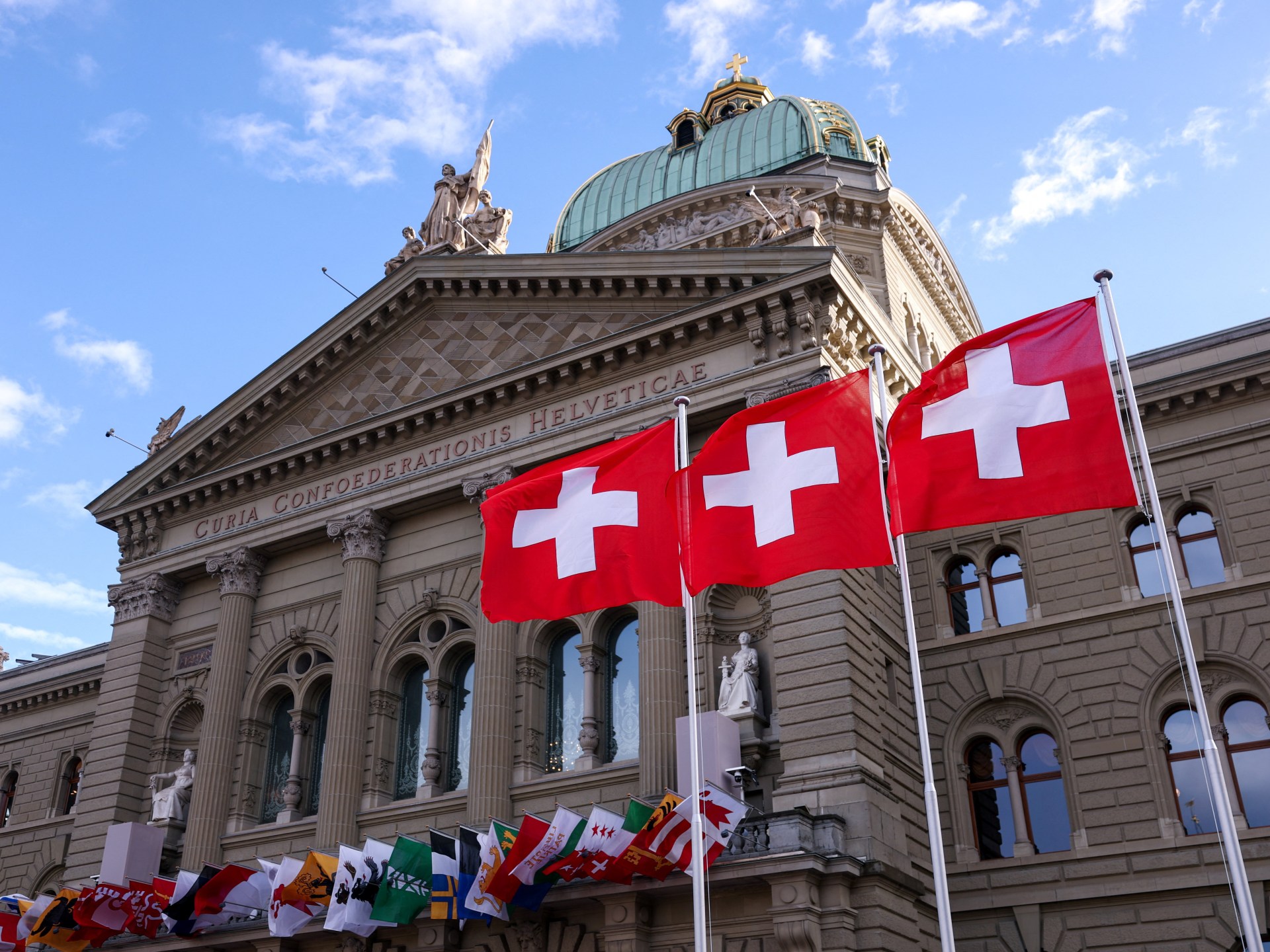

Opponents say amendments to existing law could increase risk of Swiss-made weapons being used in conflicts.
Switzerland is holding a referendum on easing restrictions on weapons exports as the country grapples with balancing its tradition of neutrality against changing security needs in Europe.
Sunday’s vote concerns amendments to the War Materiel Act, approved by parliament last year with the backing of the government, which argues that Russia’s full-scale invasion of Ukraine in 2022 has fundamentally altered Europe’s security environment.
Recommended Stories
list of 4 items
- list 1 of 4Switzerland halts US arms exports amid Iran war, citing neutrality
- list 2 of 4Iran’s Araghchi slams European powers for ‘irrelevance’ in nuclear talks
- list 3 of 4Why has North Korea expelled a Swiss diplomat from Pyongyang?
- list 4 of 4Trump’s latest wave of Iran sanctions: Which 60 entities are targeted?
end of list
Left-wing parties and humanitarian organisations secured a referendum under Switzerland’s system of direct democracy, warning that the reforms could undermine the country’s neutrality and increase the risk of Swiss-made weapons being used in conflicts.
Polling stations open at 10am (09:00 GMT) and close at noon (11:00 GMT) on Sunday with initial results expected shortly afterwards. Most people voted beforehand by post.
Opinion polls published on November 18 indicated a narrow lead for supporters of the reforms, according to the AFP news agency.
Amended legislation
The legislation would allow Switzerland to supply military equipment to 36 designated partner countries involved in armed conflicts, provided the exports comply with its neutrality obligations and foreign and security policy interests.
The countries include members of the European Union, the United Kingdom, the United States, Australia and Japan.
Purchasing countries would also no longer automatically be required to obtain Switzerland’s permission before transferring Swiss-made weapons to third countries although existing commitments would remain binding.
Advertisement
All exports would remain subject to government approval, according to Switzerland’s State Secretariat for Economic Affairs.
Neutrality under pressure
Supporters of the legislation argue that existing restrictions have put Swiss defence manufacturers at a competitive disadvantage and threaten the country’s access to international military supply chains.
Germany has excluded Swiss companies from some defence procurement contracts while Denmark and the Netherlands have suspended orders.
Swiss arms exports rose by 43 percent in 2025 to 948.2 million Swiss francs ($1.13bn), and Germany was the largest recipient, according to figures cited by AFP.
Opponents, including humanitarian organisations and left-wing politicians, argue that relaxing export controls would increase the risk of Swiss weapons reaching countries involved in conflicts or accused of human rights violations.
The referendum comes two months after Swiss voters rejected a separate initiative seeking to enshrine a stricter interpretation of neutrality in the constitution. More than 70 percent voted against it.
Despite Russia’s war on Ukraine being a major driving force behind the reforms, direct weapons exports to Kyiv would remain prohibited under Switzerland’s neutrality laws.
Indirect transfers would also remain subject to restrictions.
Swiss voters will also decide on three other proposals on Sunday, covering pension funding, restrictions on fireworks and changes to the taxation of married couples.
Related News
Trump calls Iran war ‘effectively over’ after talks with Qatar PM
Deadly Egypt train collision prompts calls for political accountability
Russia and Ukraine report overnight attacks amid US diplomatic push