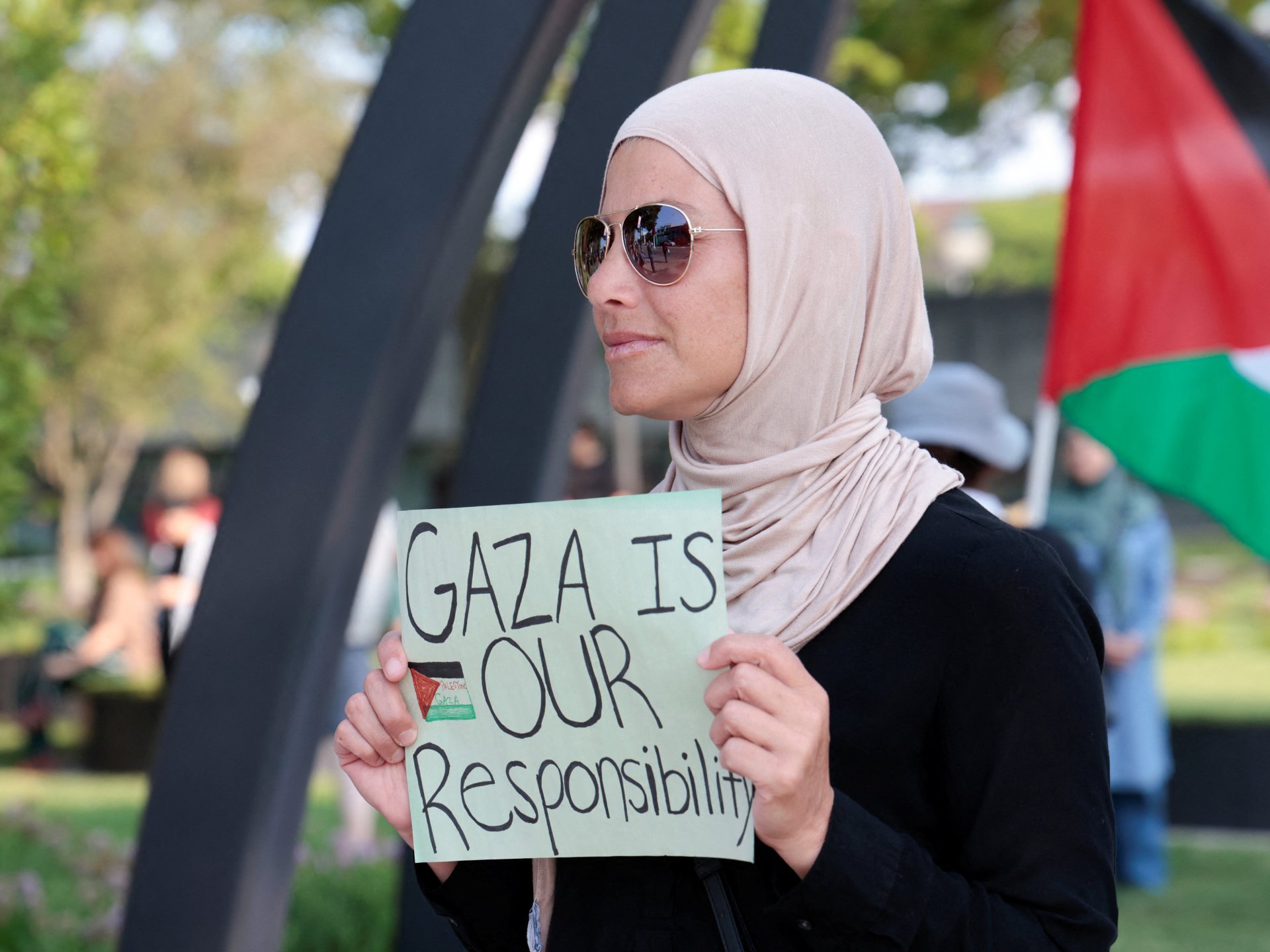

Most United States Democratic voters in states that will play a key role in choosing the party’s nominee in the 2028 presidential election oppose providing aid and weapons to Israel, a new poll suggests.
The survey, released late on Monday by the IMEU Policy Project, a think tank that supports Palestinians’ human rights, is the latest indication of Israel’s dwindling popularity in the US, especially among Democrats.
Conducted by the research firm YouGov, the poll found that the majority of voters in South Carolina, Nevada, New Hampshire, New Mexico, Michigan and Virginia believe Israel is committing genocide in Gaza.
These states will hold the first primary contests in the 2028 elections and play an outsized role in choosing the Democratic nominee and possibly the next US president.
In Michigan, 80 percent of respondents, including 91 percent of voters under the age of 45, answered “yes” to the question “Do you believe Israel is committing genocide against Palestinians living in Gaza?”
A majority of 52 percent of respondents in South Carolina, which will hold the first Democratic primary of the 2028 campaign, said they oppose selling arms to Israel, which would amount to an arms embargo on the US ally if put into practice.
Respondents across all six states also showed support for imposing sanctions on Israel and enforcing the International Criminal Court’s arrest warrant against Israeli Prime Minister Benjamin Netanyahu.
Hamid Bendaas, a spokesperson for IMEU Policy Project, said a key takeaway from the survey is that support for Israel in the Democratic base has become negligible.
Advertisement
For example, in South Carolina, only 2 percent of respondents said they favour military support for Israel.
Bendaas also noted that voters back strong policies against Israel, such as sanctions, that are seen as unrealistic by the mainstream media.
“These things when they’re discussed, it’s often as ‘This is something that is out of the mainstream’, but they’re overwhelmingly supported by the voters who are probably going to be pretty decisive in deciding the next nominee for president in the Democratic Party,” Bendaas told Al Jazeera.
The Democratic Party finalised its 2028 primary calendar this month and made South Carolina the site of its first nomination contest on January 22, followed by weekly elections in the five remaining states.
These first primaries will likely give enormous momentum to the top finishers and weed out contenders who fail to make a mark early on.
The vote is still 16 months away, but the IMEU findings, which match the data of other polls, could play a role in shaping the platforms of Democratic candidates on the issue.
Israel has been rapidly losing support among Democrats for years, a trend that was accelerated by its genocidal war on Gaza, which began in October 2023.
But the Democratic leadership has maintained its backing of Israel. The US, under former Democratic President Joe Biden, who described himself as a Zionist, provided Israel with tens of billions of dollars as it turned nearly all of Gaza into rubble.
Current Senate Minority Leader Chuck Schumer and Hakeem Jeffries, the top Democrat in the House of Representatives, are also staunch supporters of Israel.
Still, cracks in the decades-long bipartisan support for Israel in Washington have been widening in recent years. In July, more than 100 Democrats in the House – nearly half of the party’s caucus – voted to block weapons to Israel.
And with progressive critics of Israel winning Democratic congressional primaries across the map, policy on Israel-Palestine is likely to play a key role in the presidential primaries in 2028.
This month, Abdul El-Sayed stunned the Democratic establishment when he overcame more than $60m in campaign spending by his pro-Israel opponent to win the party’s nomination for a US Senate seat in Michigan.
Bendaas said the 2028 presidential race could further close the gap between public opinion and the Democratic Party’s policies, arguing that any candidate vying for the presidential nomination would need to align with voters on the issue.
“When that happens, when you have a new leader who takes a new position, that really does help parties shift more rapidly,” he told Al Jazeera. “Unfortunately, the current leadership as it stands in the Democratic Party has been people who have a very status quo view about the US-Israel relationship. And so, what ultimately needs to happen is the party just needs a new leader who actually reflects its voters.”
Advertisement
Related News

EU remains divided over trade sanctions on illegal Israeli settlements

EU condemns Serbia’s ministers for attending funeral of war criminal Mladic

At least eight killed as Nepal flash flood damages roads, energy facilities