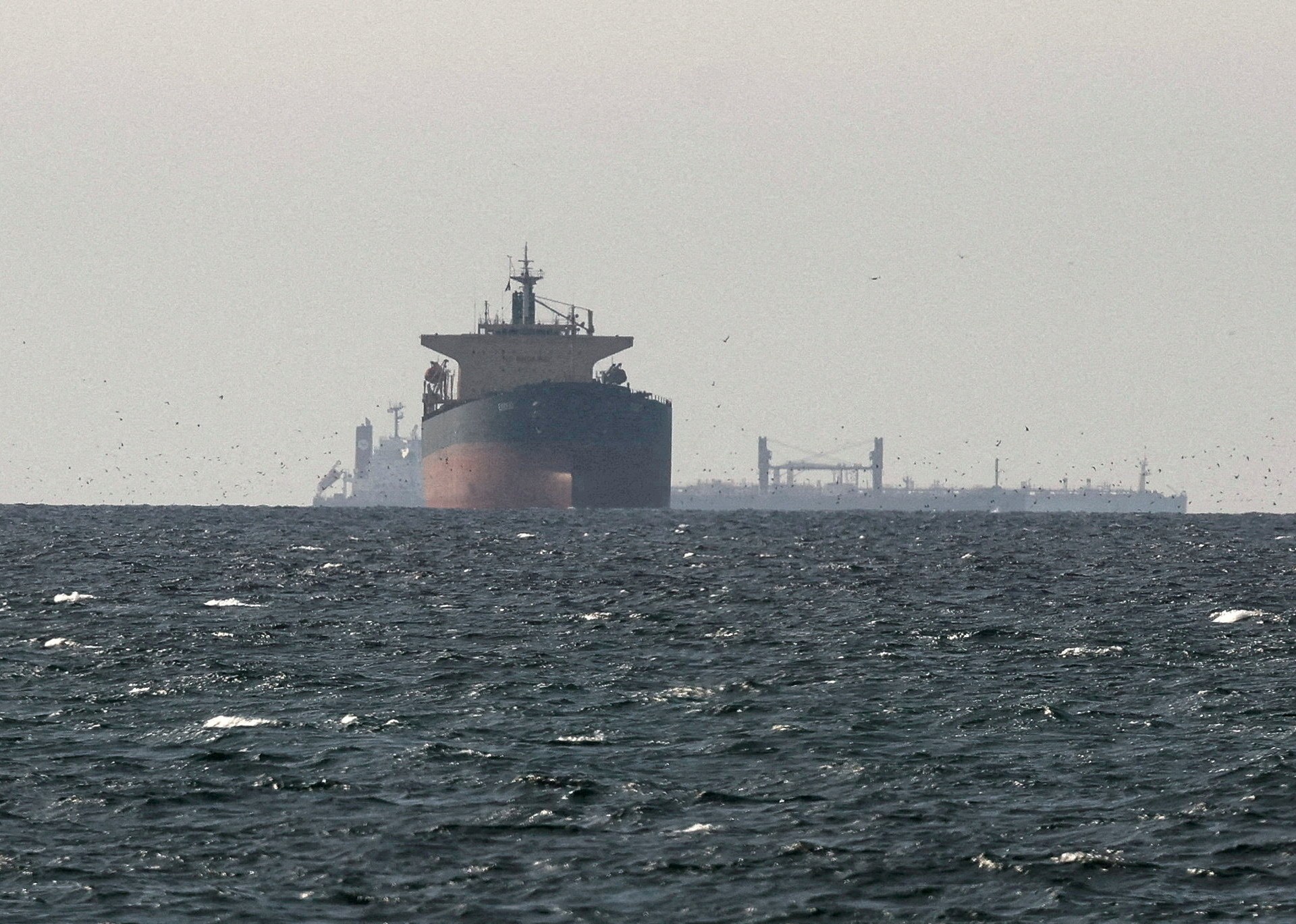

The control of the Strait of Hormuz has triggered a cycle of tit-for-tat strikes between Iran and the United States, threatening to push their fragile memorandum of understanding (MoU) to a breaking point.
Both sides blamed each other as they justified the weekend exchanges – the first since the MoU was signed on June 15.
- list 1 of 3Iran attacks Kuwait and Bahrain in response to US strikes
- list 2 of 3Iran war day 121: IRGC hits Kuwait, Bahrain after US attacks near Hormuz
- list 3 of 3Gulf countries attacked after US launches second round of strikes on Iran
end of list
The two sides also accused the other of violating the terms of the MoU, including Article 5, which calls for safe passage for commercial ships through the Strait of Hormuz.
The fighting has erupted over control of the narrow waterway, which Tehran has used as geostrategic leverage at the negotiating table. Iran’s de facto blockade of the strait, through which a fifth of global oil supplies passed before the US-Israel war on Iran began on February 28, triggered a global energy crisis.
The interim agreement between Iran and the US calls for the opening of the strait, but Tehran has pushed back against Washington’s attempt to create alternative routes closer to the Omani side of the waterway.
The latest escalation began on Friday when a ship trying to transit the Strait of Hormuz was hit by a projectile. The US hit Iran in response although Iran never claimed the attack.
So what caused the latest attacks, and are the two sides interpreting the text of the MoU differently?
What does Article 5 of the MoU say?
The fifth point agreed to the reopening of the strait and the immediate recommencement of commercial traffic.
Hundreds of ships have been stranded after Tehran announced the blockade of the waterway shortly after the US-Israeli attacks on Iran began.
Advertisement
“Iran will make arrangements using its best efforts for the safe passage of commercial vessels with no charge for 60 days only from the Persian Gulf to the Sea of Oman and vice versa,” Article 5 says.
It also calls for the removal of “technical and military obstacles” and demining by Iran within 30 days.
It goes on to say that “Iran will conduct dialogue with the Sultanate of Oman to define the future administration and maritime services in the Strait of Hormuz in discussion with other Persian Gulf littoral states in line with the applicable international law and the sovereign rights of coastal states of the Strait of Hormuz.”
The issue about control of the strait has been a major sticking point in peace negotiations. Iran has also talked about charging tolls for vessels, but the US and Gulf nations, whose exports pass through the waterway, have rejected the proposal.
“The Strait of Hormuz remains under the total oversight and management of Iran through the 30 coming days, and after all obstacles are removed, the total capacity of the waterway will be restored. This is what we are working on,” Iranian Foreign Minister Abbas Araghchi said during a visit to Baghdad, the capital of Iraq.
“This responsibility rests on the Islamic Republic of Iran. There is no other party or state in this respect. This is totally clear under the memorandum of understanding, and any intervention or any unilateral action will result in exacerbating the situation and also delay the reopening of the strait.”
Are the two sides interpreting the MoU differently?
Hassan Ahmadian, an associate professor at the University of Tehran, says Washington is going back on the deal it signed on June 15.
“The United States wants different arrangements in place as opposed to the MoU that it itself signed,” he said.
“What we see is the United States trying to find its way out of this memorandum of understanding while obliging Iran to its end of the terms.”
The US has done the same in Lebanon by brokering a new framework agreement between Israel and the Lebanese government, he told Al Jazeera.
Tehran-based political analyst Abas Aslani said Iran views the Strait of Hormuz as a deterrent against future US attacks.
“Iran sees [the strait] as leverage to stop the repetition of any new round of aggression against the country,” he told Al Jazeera, adding that any attempt to change the situation there “by force” is “unacceptable for Tehran”.
Wolfgang Pusztai, a Vienna-based defence analyst, said Iran insists on control of the Strait of Hormuz while the US and Arab states insist on the freedom of shipping through the Strait of Hormuz.
Advertisement
“In order to underline its point of view, Iran has now twice attacked ships, and it doesn’t really come as a surprise that the US retaliated,” Pusztai said.
“But the scale of the retaliation of Iran and also the scale of the American attacks doesn’t really indicate that both sides are for full escalation. So to me it seems to be there is still a chance for a peaceful settlement of this question.”
The US attempt to push transit of vessels in coordination with Oman and the International Maritime Organization (IMO) did not go down well with Tehran. Last week, Tehran warned against creating new routes.
Iran’s Islamic Revolutionary Guard Corps (IRGC) on Thursday warned ships transiting the Strait of Hormuz that the only “authorised route” was the northern corridor in Iranian territorial waters. It forced four tankers transiting along the southern route in Oman’s territorial waters to turn back on the same day, according to Windward AI, a maritime traffic monitor.
Three other tankers changed course but ultimately completed their transit, Lloyd’s List said, including one that switched from the southern route to the northern route.
On Friday, the Singapore-flagged Ever Lovely was hit by a drone, and the Panama-flagged Kiku was struck on Saturday.
The threats and attacks have seen traffic drop from 70 transits on Wednesday to 54 on Thursday. On Saturday, the number dropped further to 40 transits, Windward AI reported.
What have the US and Iran said on the latest attacks?
Iran’s Ministry of Foreign Affairs has condemned the US strikes on Friday and Saturday, calling them “a blatant violation” of the United Nations Charter as well as a “clear breach of Paragraph 1 of the memorandum of understanding”.
“These brutal attacks … show that the US does not place the slightest value and credibility on its commitments,” the Foreign Ministry said.
The IRGC said it launched ballistic missiles and drones at US forces at Kuwait’s Ali Al Salem Air Base and the US Fifth Fleet headquarters in Bahrain in response to US strikes on five coastal locations in Iran.
The IRGC has accused the US of violating commitments under the MoU in its latest attacks, adding that the agreement gives Tehran control over ships transiting the Strait of Hormuz.

In a post on his Truth Social platform, US President Donald Trump announced on Sunday that US forces struck “Iranian missile and drone storage locations, and coastal radar sites, for violating the Cease Fire Agreement, AGAIN!”
“There may come a point when we are no longer able to be reasonable, and will be forced to militarily complete the job that we very successfully started,” he wrote.
“If that happens, the Islamic Republic of Iran will no longer exist.”
The US military’s Central Command (CENTCOM) said it carried out more attacks after Iran targeted the tanker Kiku on Saturday, a day after the Ever Lovely was hit and triggered the first US attacks.
Advertisement
“CENTCOM forces launched strikes today in direct response to continued Iranian aggression against commercial shipping,” it said in a post on X on Saturday.
US Vice President JD Vance on Saturday said: “Iran signed a ceasefire agreement. We have honoured it. … But violence will be met with violence.”
Bahrain and Kuwait have condemned Iranian attacks for the second consecutive day.

Related News
Who is Wassim al-Assad, sentenced to death for Syria war atrocities?

Bolsonaro’s son begins Brazil presidential bid with Netanyahu, Milei kudos
UN urges support for Afghan women’s aid five years into Taliban rule