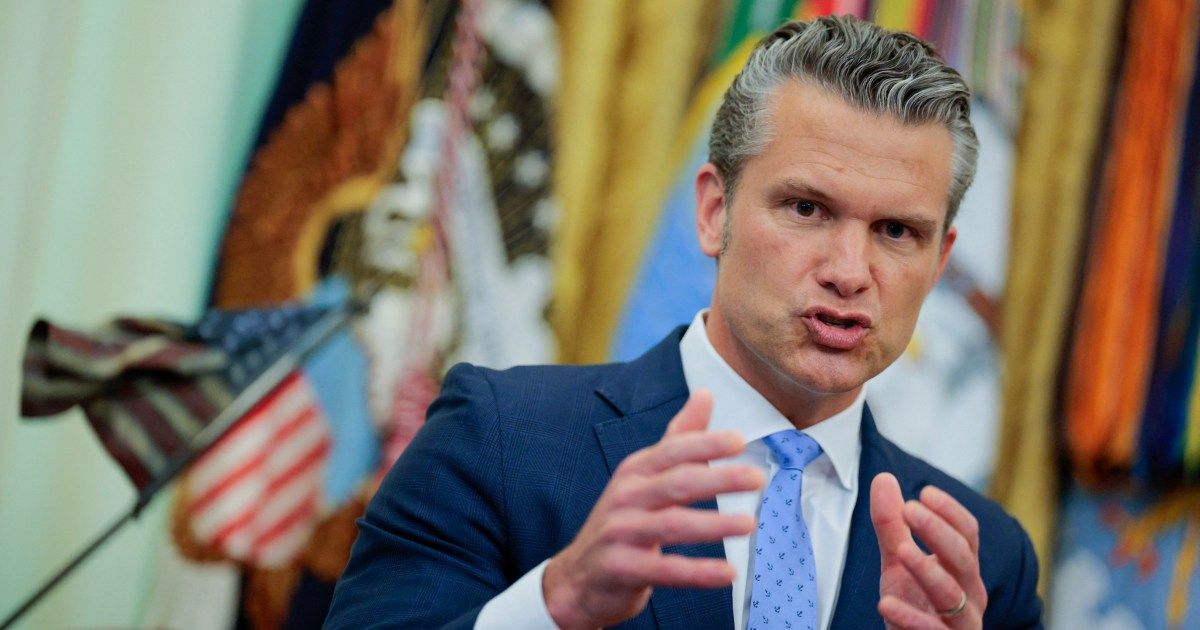

The Republican Party’s confidence in United States Defense Secretary Pete Hegseth appears to be waning, amid growing frustrations over the war with Iran dragging on with no end in sight.
“I don’t have any confidence in him anymore. I think he’s all over the place,” Senator Thom Tillis said of Hegseth in an interview with US newspaper The Hill last week. “I think he’s got a massive insecurity complex, he has a lack of experience in large organisations, he micromanages too much.”
- list 1 of 3‘The show must go on’: Trump returns to rescheduled White House press gala
- list 2 of 3Why has the US halted its bombing of Iran?
- list 3 of 3Trump expresses frustration with Netanyahu before White House meeting
end of list
Tillis spoke of a growing crisis of confidence in Hegseth’s leadership within the Senate, as the US and Iran appear no closer to a lasting peace deal despite the soaring costs of the war that the US and Israel launched on Iran on February 28.
“I have heard out of the Pentagon that there’s a loss of confidence – within the Pentagon,” the senator said. “And of course then everyone here on [Capitol Hill] hears those same concerns.”
Why are Republicans criticising Hegseth?
Several Republicans have expressed declining confidence in Hegseth, but the reasons for dissatisfaction differ.
Hegseth’s decision to nominate General Christopher LaNeve for US Army chief of staff this week was just the latest source of friction between party members and the administration of President Donald Trump.
Iowa Senator Joni Ernst and others put forward their objections to the nomination, which required unanimity to be endorsed, US media reported. LaNeve faced criticism for lacking experience when he was appointed as acting army chief of staff in April, when Hegseth fired General Randy George without explanation.
Advertisement
Senator Roger Wicker, who serves as chairman of the Senate Armed Services Committee, also questioned LaNeve’s nomination to be the army’s top officer. Last year, after Trump ordered US forces to strike small boats in the Caribbean that he claimed were trafficking drugs, Wicker and Democratic Senator Jack Reed requested that Hegseth clarify the legal basis for mandating the strikes, which experts have questioned.
The senators also requested a list of designated “terrorist” organisations and drug trafficking organisations against whom lethal military force is permitted to be used, which was not provided by the administration.
Other Republicans are questioning some of Hegseth’s decisions beyond his sweeping overhaul of military leadership.
In May, Senator Mitch McConnell, chair of the Senate Appropriations Subcommittee on Defense, objected to key parts of the Pentagon’s $1.5 trillion budget request for 2027, including the so-called Golden Dome defence system, a much-lauded multi-layered missile shield system modelled on Israel’s Iron Dome.
Speaking to a panel hearing, McConnell raised concerns about how the defence budget had been structured to request part of the funds through “reconciliation”, a process that allows bills to pass the Senate with a simple majority vote (51 votes) instead of the usual 60 votes.
McConnell also criticised Trump’s administration over his strained ties with traditional US allies including NATO, which he said “only serves our adversaries’ interests and limits our capacity and deterrent power globally”.
Who is Pete Hegseth and why was he appointed by Trump?
Hegseth, a military veteran who served in Afghanistan and Iraq, was a Fox News host before being picked by Trump to lead the world’s most powerful military.
The 46-year-old developed a friendship with Trump when the US president made regular appearances on his Fox News show. The US president nominated him for the role of head of the Department of Defense – renamed “Department of War” by Trump – in 2024, describing him as “tough, smart and a true believer in America First”.
While Hegseth has served in the military, Democrats have criticised his appointment as he lacks senior military or national security experience.
His conservative agenda put him on a collision course with Charles Q Brown, the former chairman of the US Joint Chiefs of Staff, whom he accused of “pursuing the radical positions of left-wing politicians”. Like Trump, Hegseth is stridently opposed to “woke” programmes that promote equity and inclusion in the military.
Advertisement
Hegseth said he left the military in 2021 after being sidelined because of his political and religious views by an army that did not want him any more. “The feeling was mutual – I didn’t want this Army anymore either,” Hegseth wrote in his 2024 book, The War on Warriors.
What has Hegseth done as defence secretary?
Hegseth has drawn criticism during his tenure as secretary of defence – or, as Trump calls him, “secretary of war”.
In early 2025, Hegseth came under fire for disclosing classified information about upcoming attacks in Yemen in messaging chats with journalists and other unauthorised individuals, which he claimed had been done inadvertently.
In September, the US military began conducting lethal strikes on small civilian boats operating in or near Venezuelan waters, claiming without providing evidence that the vessels were being used for drug smuggling and “terrorism”.
These incidents brought scrutiny to Hegseth’s orders, with some legal experts claiming war crimes had been committed.
Hegseth has also been charged with keeping the Iran war in a protracted limbo despite promising a swift resolution. He has been repeatedly questioned by the Senate over the White House’s expenses for the war and its requests for supplemental funds.
Last month, such questioning ended in a shouting match between Hegseth and Democratic Senator Gary Peters, who called the defence secretary a “failure” and criticised his administration for creating another “forever war”.
Related News

Why is Saudi Arabia forming a coalition to protect the Red Sea?
Hamas leadership run-off expected between Meshaal and al-Hayya

New investigation shows how an Israeli settler escaped justice