
Ukraine’s military Starshield satellite connection has been restored, a Ukrainian Ministry of Defence source says, just days after the United States reportedly restricted the service.
The Reuters news agency, quoting a source, reported that Kyiv is still seeking clarifications from Starshield’s parent company, SpaceX, as to why its service was disrupted between Tuesday and Wednesday.
- list 1 of 4Russia says Ukraine resumes attacks on oil refineries
- list 2 of 4How six Ukrainian divers could have blown up Russia’s $20bn pipelines
- list 3 of 4Russia attack hits Kyiv after reported intelligence lapse
- list 4 of 4US inflation rises before midterm elections, fuelling rate hike fears
end of list
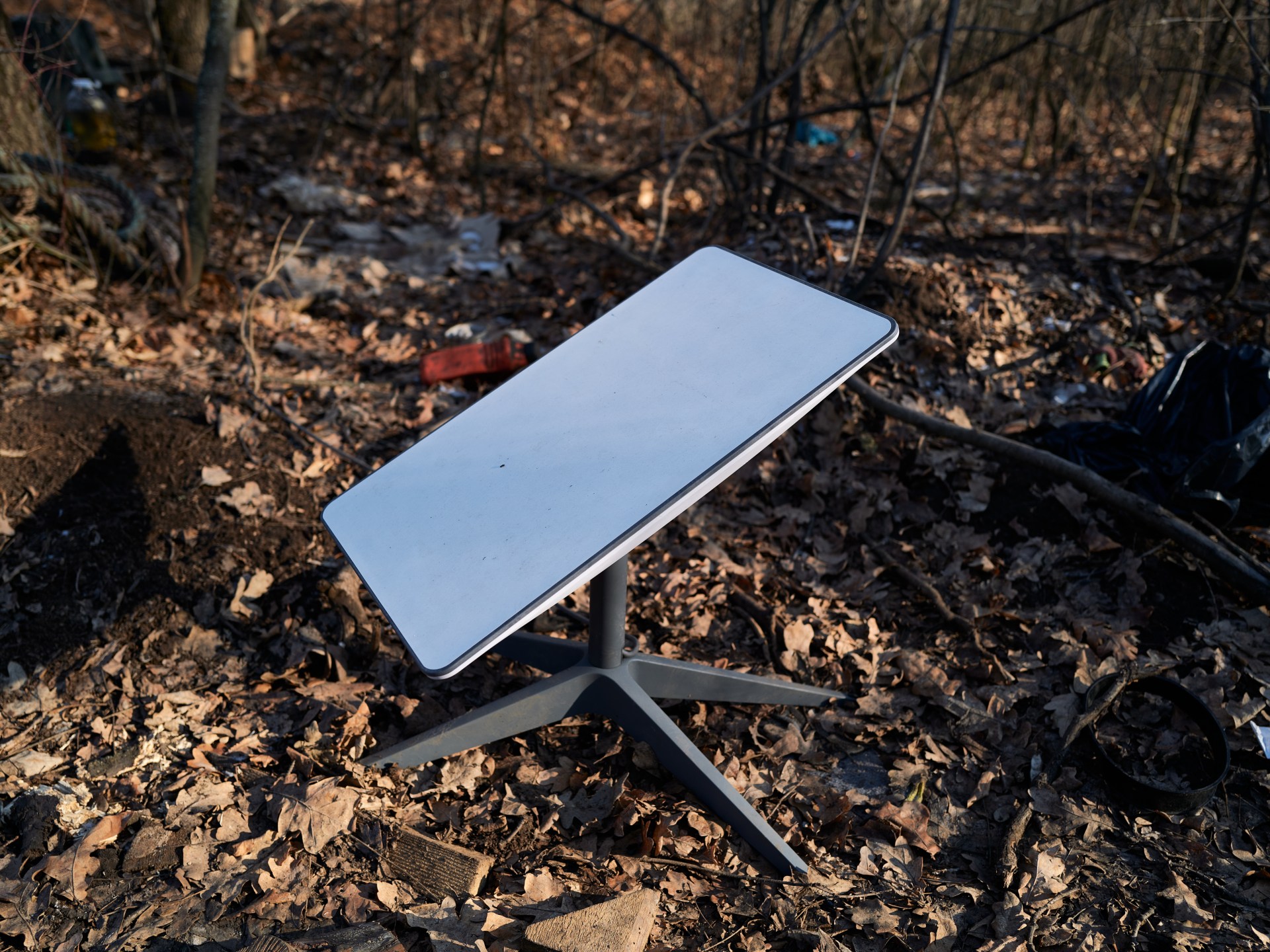
Ukraine relies on Starshield, the military-grade version of SpaceX’s internet service, Starlink, to provide intelligence amid its war with Russia.
SpaceX CEO Elon Musk has denied the company’s involvement and suggested only the US government could have disrupted it, despite President Donald Trump’s insistence that Washington is still sharing intelligence with Kyiv.
Here’s what we know:
![Residents collect things from a house destroyed in a Russian air strike, on the outskirts of Dnipro, Ukraine, October 15, 2026 [Reuters]](https://www.aljazeera.com/wp-content/uploads/2026/10/2026-10-15T090628Z_240345379_RC2L3OAMDT4L_RTRMADP_3_UKRAINE-CRISIS-ATTACK-DNIPRO-1792058416.jpg?w=770&resize=770%2C513&quality=80)
What is Starshield?
Starshield is a sister service to Starlink, an array of 11,000 satellites placed by SpaceX into Earth’s low orbit to provide high-speed internet connectivity even in remote areas.
Starshield, launched in 2022 and provided to the US government, is designed for military use as it allows for deeper encryption to process sensitive information. SpaceX says it is primarily used by US defence agencies and other “government partners”.
Ukraine’s military relies on Starshield, especially to guide its drones, on which it relies heavily to attack Russia.
What happened to Ukraine’s access to Starshield?
On Tuesday, Ukrainian defence officials said they had lost access to important satellite-based communications and that the disruptions had affected military missions. This came in the wake of heavy Russian strikes, which hit the country with more than 100 drones and five ballistic missiles, for which Ukraine said it had received no prior warning.
Advertisement
“Intelligence on Russian ballistic missile launches helps save lives, and this is one of the most critical issues. This is precisely what helps prevent people from being killed – when there is an early warning about ballistic missiles,” President Volodymyr Zelenskyy wrote on X. “Regarding this strike, unfortunately, there was no warning from partners.”
Serhiy Beskrestnov, a defence adviser to Zelenskyy, posted on Telegram that SpaceX had also “implemented a speed limit” on Starlink terminals, capping internet speeds at 100mph (160km/h).
That meant any drones or missiles flying at more than 100mph lost their guidance connection.
“Our armed forces did not receive a warning about these restrictions, and this led to the failure of a number of missions,” he said, adding that this was clearly “related to the current political situation”.
Officials said the restrictions also reduced capabilities for front-line logistics, reconnaissance and relaying signals.
Who controls Starshield?
On Wednesday, Musk denied any involvement in the incident, insisting that the service is “controlled by the US government”.
Responding to a post on X by Ukraine’s former Defence Minister Mykhailo Fedorov, who said the speed limits were being lifted and demanded unrestricted internet speed, Musk wrote, “Starshield systems are owned and controlled by the US government.”
“Any limits on speed or usage are decided by the US military and ultimately POTUS,” he said, referring to the US president.
Musk further clarified that Starlink is for “civilian or defensive activities and cannot be used for offensive military action, as doing so would be inappropriate for a commercial company” – an apparent attempt to differentiate it from Starshield, which Kyiv also deploys but is not allowed to use for offensive operations.
Last year, Starlink cut off access for Russian troops who were covertly using the service on the battlefront in Ukraine.
Is Musk supportive of Ukraine?
The SpaceX boss has shown an active interest in the Russia-Ukraine war since it began, but has not been particularly favourable towards Kyiv. In 2022 – just after Russia invaded Ukraine – he proposed a “peace plan” under which Kyiv would end its claim to Russia-occupied Crimea and would drop hopes for joining NATO. Zelenskyy criticised Musk’s comments, and tensions between the two have remained.
On Sunday, the billionaire, who is also the CEO of Tesla and owns X, said Zelenskyy “has gone too far”, in a response to Trump’s comments that the Ukrainian president should leave office.
Advertisement
On Wednesday, Musk appeared to blame Zelenskyy for deaths in the war. “And so the slaughter continues,” he wrote on X. “Time for Zelensky to go.”
Does Ukraine blame the US for restricting intelligence?
Ukrainian officials have complained that the country received no warning in advance of Russian ballistic missile strikes on Tuesday and Wednesday. Usually, the US provides crucial early-warning alerts that allow Kyiv to issue evacuation orders.
Zelenskyy said in an interview with the Financial Times on Thursday that US military officials had earlier warned Kyiv that Washington would block intelligence unless attacks on Russian energy infrastructure stop.
The Ukrainian leader added that he did not accept suggestions that the Starshield incident could have been a glitch. “It was not a technical problem; it was the will,” he said.
Why might the US restrict intelligence from Ukraine?
Tensions between Kyiv and Washington have been building since Trump took office last year over a host of issues, including weapons transfers and the US’s increasing closeness to Russia.
In recent weeks, Washington has pressured Ukraine to stop attacks on Russian oil refineries to allow more oil into global markets. In particular, Trump has sought to blame Ukrainian attacks on Russian diesel facilities for the rising price of the fuel globally ahead of November midterm elections.
Trump said last week he had agreed to a deal with President Vladimir Putin to release Russian diesel stocks into the US and global markets, despite existing sanctions on Russian oil.
Zelenskyy criticised the move and said it would embolden Putin.
Over the weekend, Trump unilaterally announced an “energy ceasefire” between Russia and Ukraine, apparently without consulting Zelenskyy, who told reporters the deal was “news to me”. Russia also did not confirm it. Angered, Trump called for Ukraine to replace its president and blamed Ukraine’s attacks on Russian oil infrastructure for global energy disruptions.
Ukraine said it had, in fact, refrained from attacking Russian refineries and would continue to do so if Russia did the same. However, Russian strikes have continued. On Wednesday, Zelenskyy said strikes on Ukraine’s energy infrastructure had caused blackouts affecting 600,000 people.
“We’re done,” the Ukrainian president said in the FT interview, confirming that Kyiv had subsequently resumed attacking Russia’s oil infrastructure.
Related News
Israeli attacks across Gaza kill at least four Palestinians

Morocco’s youth take Gen Z protest demands to the polls
Oval Office spat to public rebukes: A timeline of Trump-Zelenskyy ties