US and Ivory Coast sign $480m deal as part of ‘America First’ aid strategy
 30 December 2025
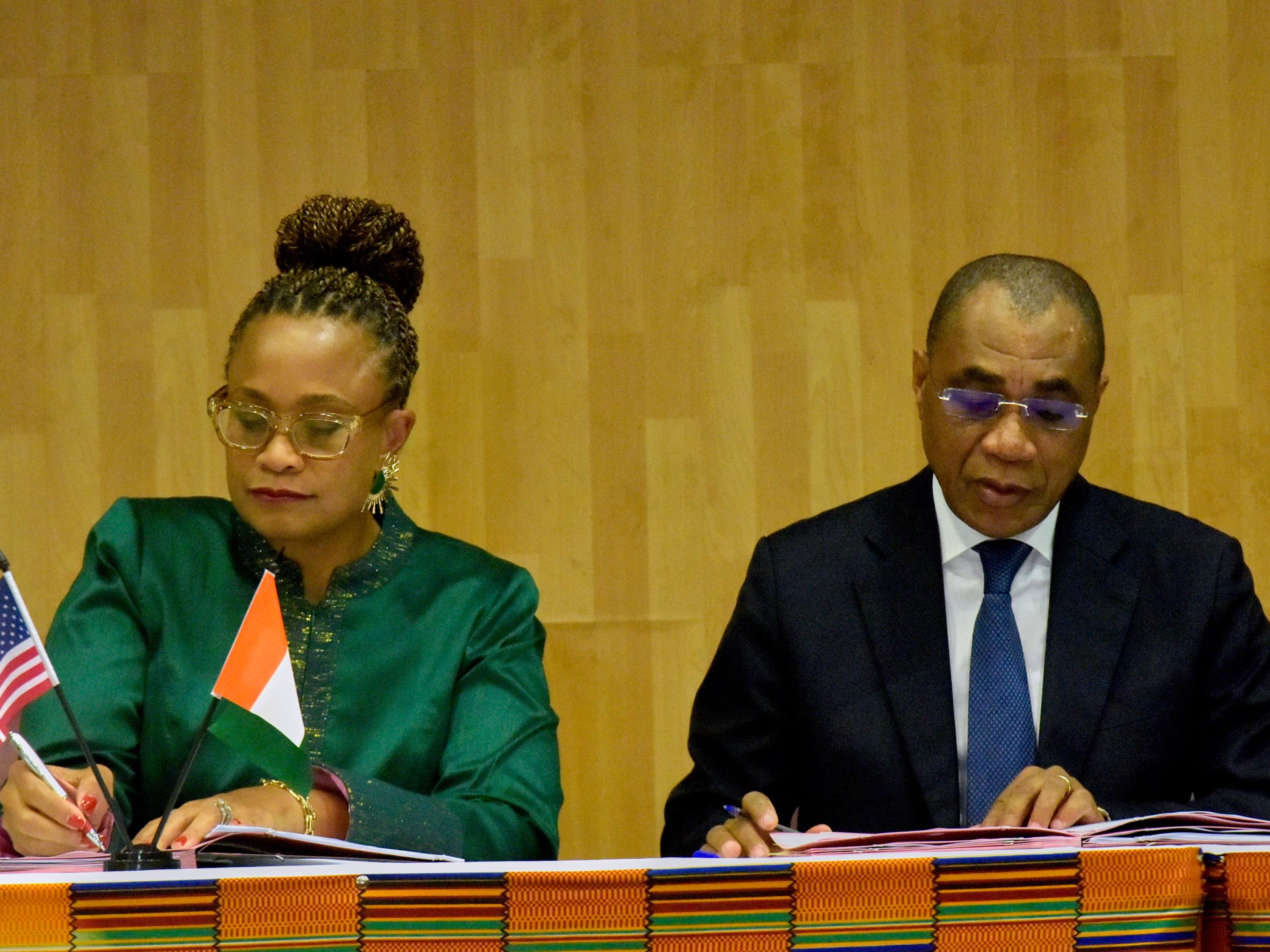

The administration of United States President Donald Trump has signed a deal committing $480m in public health aid to the Ivory Coast.
The agreement, signed in the West African nation’s capital, Abidjan, on Tuesday, is the latest turn in the Trump administration’s America First Global Health Strategy.
- list 1 of 3USAID cuts strand rural women seeking maternal healthcare in Malawi
- list 2 of 3Five key takeaways from US State Secretary Rubio’s year-end briefing
- list 3 of 3US slashes UN humanitarian aid to $2bn, huge cut as Trump demands reforms
end of list
The plan envisions forging bilateral agreements with dozens of countries to receive US health assistance in the wake of the administration’s gutting of the US Agency for International Development (USAID).
The Trump administration has maintained that US foreign aid policy has been inefficient and wasteful, saying that the bilateral agreements will create more accountability, oversight and eventual self-sufficiency.
Experts have questioned the efficacy of the approach and raised alarm over its transactional nature.
At the signing ceremony on Tuesday, the US ambassador to the Ivory Coast, Jessica Davis Ba, said the US government is moving “beyond the traditional aid approach toward a model focused on trade, innovation, and shared prosperity”.
“Today, our bilateral cooperation is entering a new phase. We are implementing the America First Global Health Strategy,” the ambassador said.
As part of the agreement, the Ivory Coast committed to eventually providing up to $292m to health funding by 2030, Ivorian Prime Minister Robert Beugre Mambe said.
The deal is the largest of the more than a dozen other arrangements the Trump administration has reached so far under the new strategy.
Deep USAID cuts earlier this year have disrupted public health services across the world, with Africa particularly hard-hit.
Advertisement
That has sparked concerns about the potential increase of the spread of HIV on the continent, declines in maternal and child healthcare, spikes in Malaria cases, and reduced early detection of new infectious diseases.
While the Ivory Coast deal and other new bilateral agreements seek to address these areas, public health experts have been wary about the administration’s approach.
An analysis by the Center for Global Development earlier this month said that the new strategy outlines several potentially beneficial changes to foreign health assistance delivery.
However, these changes “carry tremendous risks to service delivery and hard-won public health gains”, senior analyst Jocilyn Estes and policy fellow Janeen Madan Keller wrote.
The pair identified several potential areas of risk, including public health priorities possibly being shaped by “transactional pressures”, questions over oversight, and a lack of clarity on how services will be protected if a partner country is unable to meet its commitments.
The experts further questioned what the strategy would mean for aid in areas where there is no “credible or stable government”.
“Operationalising a reconfigured approach to US global health assistance – particularly direct government assistance – at this scale and speed is unprecedented”, they wrote, adding that “each potential point of failure risks lives”.
Related News

Trump unveils ‘Trump-class’ battleships for US Navy’s ‘Golden Fleet’
How Netanyahu’s push for another Iran war clashes with Trump’s agenda
Belgium joins South Africa’s genocide case against Israel at ICJ