
There has been embarrassment, confusion, and unease in Japan after US President Donald Trump used the Pearl Harbor attack during World War II to justify his secrecy before launching the war on Iran.
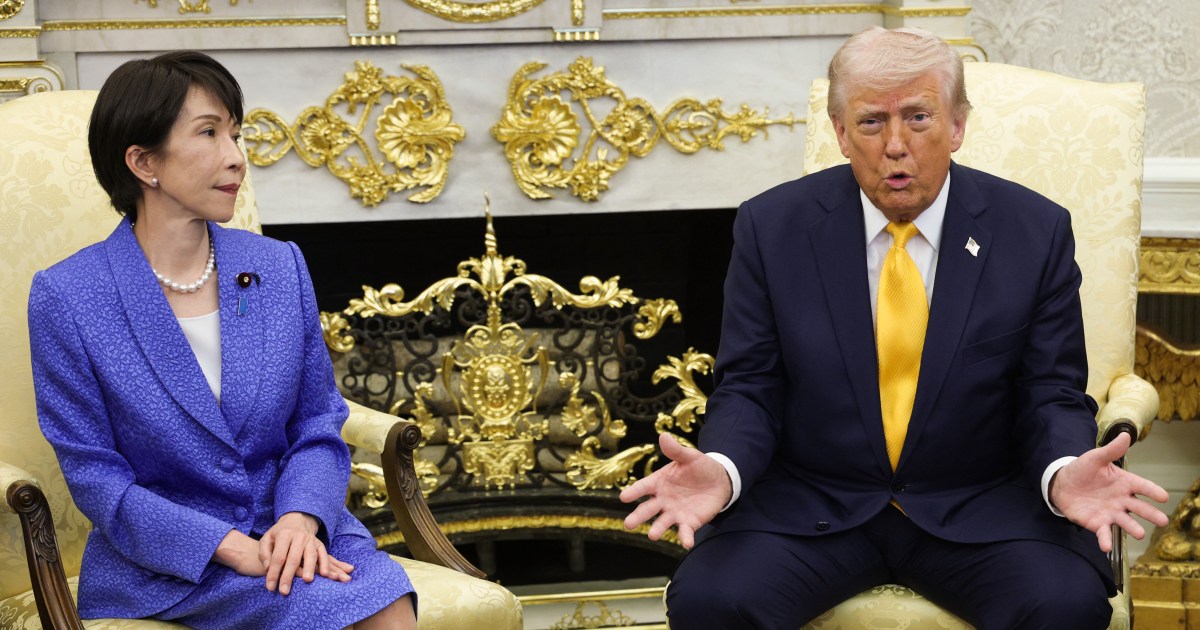
Trump was asked by a reporter why he did not tell allies in Europe and Asia in advance of the US-Israel attack on Iran during a news conference with Japanese Prime Minister Sanae Takaichi at the White House on Friday.
- list 1 of 4Trump references Pearl Harbor during meeting with Japanese PM on Iran war
- list 2 of 4Trump compares Iran strikes to Pearl Harbor as he meets Japan’s PM
- list 3 of 4Iran war: What’s happening on day 22 of US-Israel attacks?
- list 4 of 4Iran says US and Israel attacked Natanz nuclear facility
end of list
Trump cited Pearl Harbor to defend his decision saying, “Who knows better about surprise than Japan? Why didn’t you tell me about Pearl Harbor, OK?”
Following the remarks, social media reaction has ranged from accusations of ignorance and rudeness by the US president to claims that he does not see Japan as an equal partner. There were calls for Japan to protest Trump’s comments.
Tsuneo Watanabe, a senior fellow at the Sasakawa Peace Foundation, said in an opinion piece in the Nikkei newspaper on Saturday that the remarks signalled Trump is “not bound by existing American common sense”.
“I get the impression that the comment was intended to bring the Japanese reporter [who asked the question] or Ms Takaichi into complicity in order to justify his ‘sneak attack’ on Iran during diplomatic negotiations and without telling allied countries,” Watanabe wrote.
There is also a feeling that an unspoken understanding exists between United States and Japanese leaders to tread carefully on the subject.
Both sides need each other, with Washington relying on Japan to host 50,000 troops and an array of powerful hi-tech weapons, and Japan relying on the US nuclear umbrella to deter hostile, nuclear-armed neighbours.
Advertisement
Japan’s post-World War II constitution bans the use of force except for its self-defence, but Takaichi and other officials are now seeking to expand the military’s role.
Takaichi, a hardline conservative, was praised by some for not reacting to Trump’s comments, letting them pass with a roll of her eyes and a glance at her ministers seated nearby.
The goal of her summit was to deepen ties with her most important ally, and she arrived shortly after Trump suggested Japan was among the nations that did not quickly join his call to help protect the Strait of Hormuz.
Some, however, criticised Takaichi for not speaking up.
Hitoshi Tanaka, a former diplomat and a special adviser at the Japan Research Institute think tank, wrote on X that he felt embarrassed to see Takaichi flattering Trump.
“As national leaders, they are equals … To make an equal relationship is not to flatter,” he said. “Just doing what pleases Trump and calling it a success if you are not hurt is too sad.”
Initially, social media placed some of the blame on the Japanese reporter who asked the question that prompted Trump’s Pearl Harbor comment.
The reporter, Morio Chijiiwa with TV Asahi, later said on a talk show he asked the question to represent the feelings of Japanese who are not happy about Trump’s one-sided attack on Iran, and because other countries, including Japan, are now being asked to help out after the US and Israel started the war.
“So that’s why I asked the question. I was meaning to say, ‘Why didn’t you tell us, why are you troubling us?’” he said.
“Then President Trump hit back with the Pearl Harbor attack … I found it extremely awkward for him to change the subject.”

Related News
What’s happened in Gaza and the West Bank since the start of the Iran war?
Colombia elects Congress, chooses presidential candidates amid US tensions
Zelenskyy says Ukraine wants timeline for next round of Russia talks