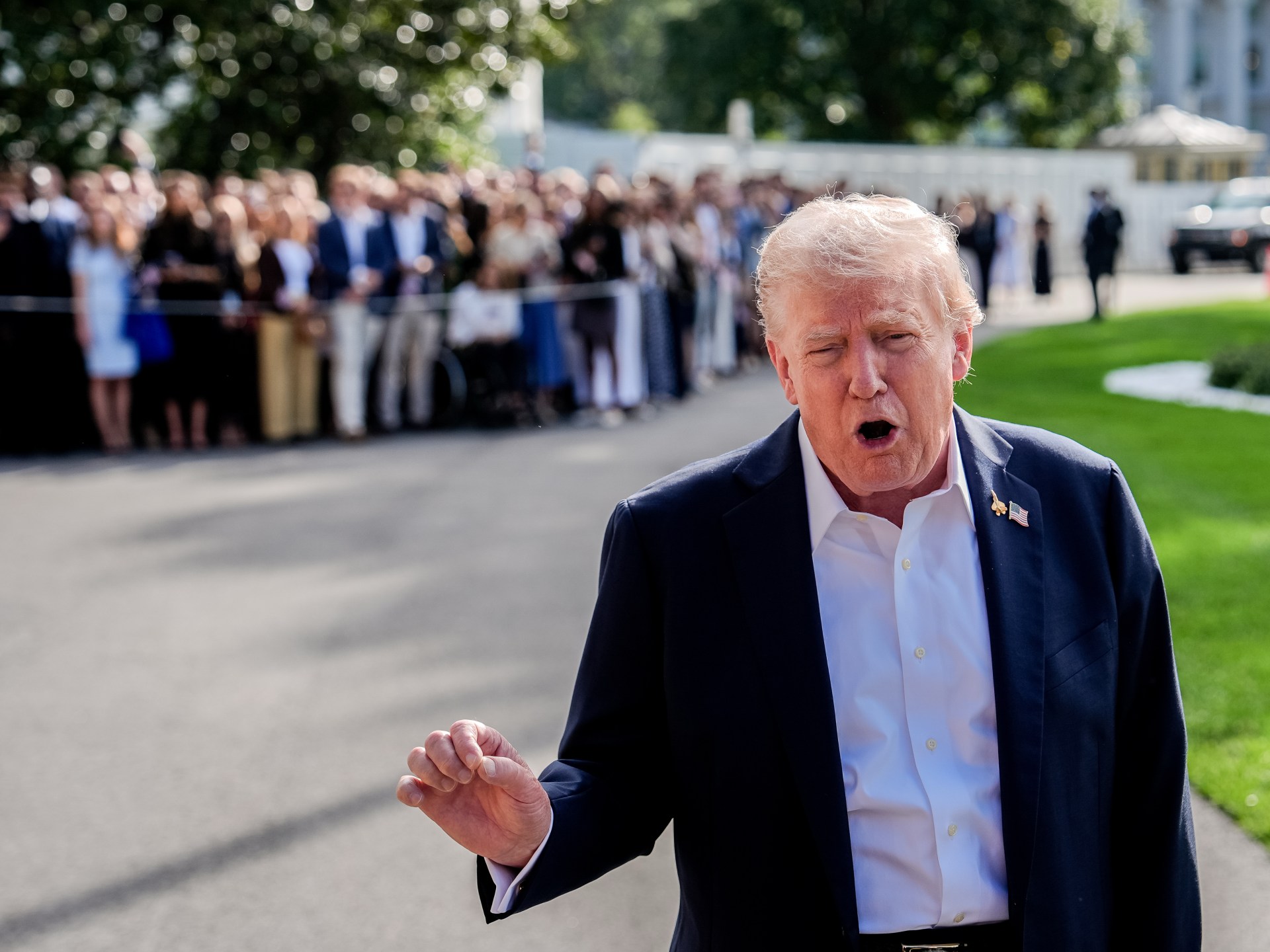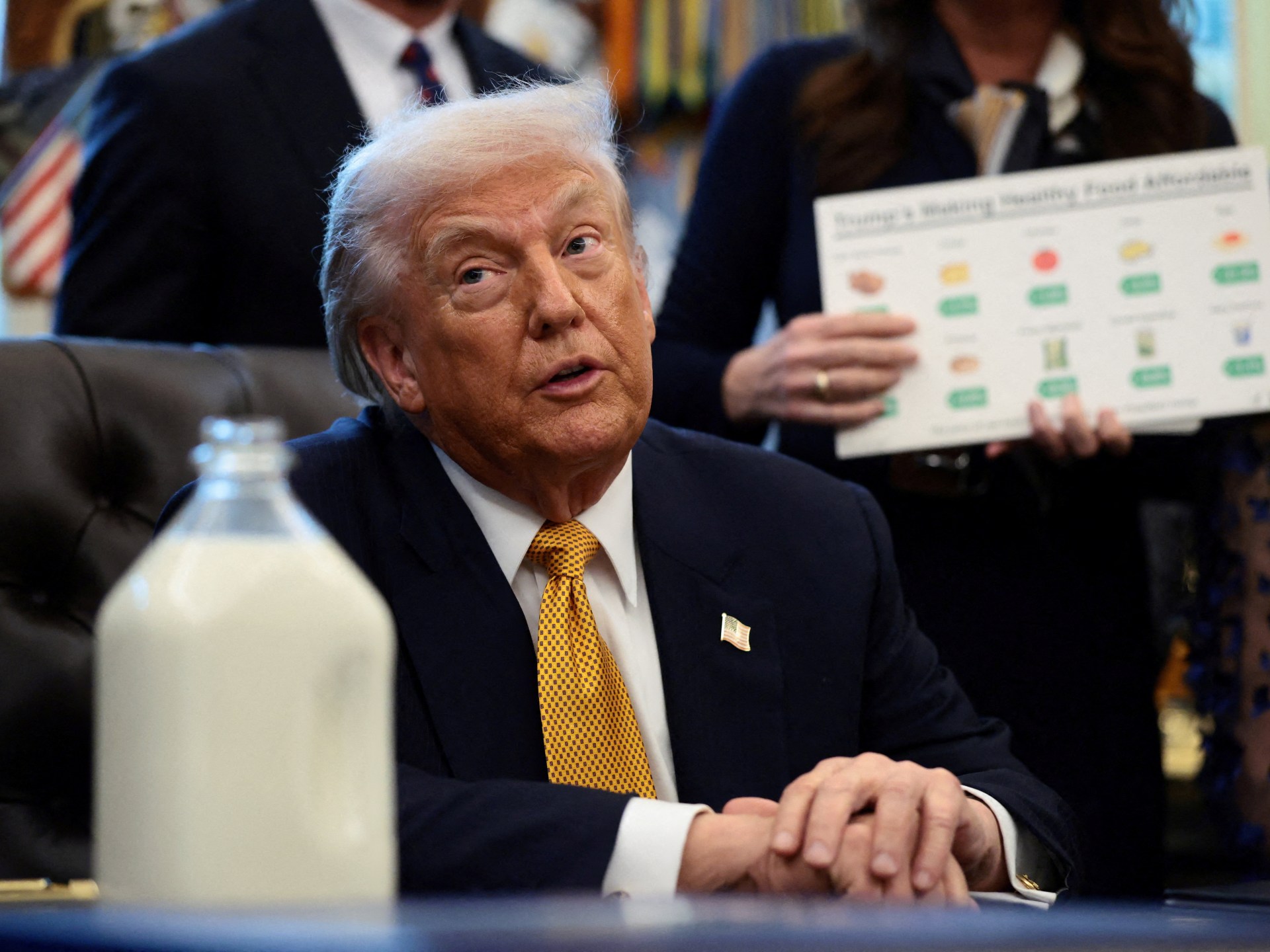

United States President Donald Trump says that the killings of antigovernment protesters in Iran have stopped, signalling a more measured approach to the crisis after threatening to attack Iran in response to the crackdown on demonstrators.
Trump told reporters on Wednesday that he had been told that the killings of protesters in Iran have stopped and that plans for executions were halted, hours after the US began to withdraw some personnel from an airbase in Qatar amid growing fears of a renewed US-Iran conflict.
- list 1 of 3Funerals in Iran for civilians and security forces killed during protests
- list 2 of 3Trump’s neo-con turn on Iran
- list 3 of 3Iran, Gaza and the politics of counting the dead
end of list
Asked by journalists in Washington, DC, who had told him that the killings had been halted, Trump described them as “very important sources on the other side”.
Trump also said he is “going to watch” how the crisis in Iran develops, suggesting he would adopt a wait-and-see approach, although he did not rule out potential US military action.
“We are going to watch what the process is”, he said, before noting the US administration received a “very good statement” from Iran.
Reporting from Washington, DC, Al Jazeera’s Mike Hanna said that the president’s comments on Wednesday signalled a softening of his tone towards Iran.
“It does appear that he’s still mulling over various options; he’s been briefed by his national security council, but these statements we’ve just heard do indicate a potential cooling down of the situation and President Trump backing away from the precipice of imminent action, which he has been threatening,” he said.
Sina Toossi, a senior non-resident fellow at the Center for International Policy, told Al Jazeera that Trump’s claim that he had received information indicating killings in Iran had stopped appears, on the surface, to be a “face-saving way” to avoid military intervention, though it does not entirely rule out such a conflict.
Advertisement
“It’s hard to take what Trump says seriously, but we do know that he’s had an aversion to getting sucked into big, open-ended military conflicts, and with Iran that risk was on the table,” Toossi told Al Jazeera.
“This remark today suggests he’s looking for a face-saving way out, but I wouldn’t take it as 100 percent ruling that out,” he said, adding that Trump has a track record of negotiating with Iran while simultaneously threatening military action.
Trump has threatened Iran with military strikes in the past as a means of pressuring Tehran into greater alignment with US demands, and has said during the last week that a harsh response by Iranian authorities to the country’s protesters could result in US attacks.
Barbara Slavin, a distinguished fellow at the Stimson Center in Washington, DC, told Al Jazeera that Trump is “probably torn” when it comes to deciding what action to take against Iran.
She said that while the US president would like “another quick victory, I don’t think he wants to be involved in a protracted conflict in the Middle East that goes against all his instincts”.
She added that she expects Trump to carry out limited strikes that enable him to claim he fulfilled his pledge to “help” the Iranian people, without triggering “a wider escalation”.
Earlier on Wednesday, Britain and the US withdrew some personnel from an airbase in Qatar after a senior Iranian official said Tehran had warned neighbours it would hit US bases if Washington strikes. A number of countries have also issued advisories for protecting their citizens in the region, amid fears of a wider regional escalation.
Iran has said it is prepared to retaliate in the event of any US intervention.
The commander of the Islamic Revolutionary Guard Corps (IRGC), Mohammad Pakpour, has said that Iran is ready to respond “decisively” to its foes, Israel and the United States, which he accused of being behind the protests sweeping the country.
IRGC is at “the height of readiness to respond decisively to the miscalculation of the enemy”, said Pakpour in a written statement quoted by state television.
Pakpour went on to accuse Trump and Israeli Prime Minister Benjamin Netanyahu of being the “murderers of the youth of Iran”.
Iran’s Foreign Minister Abbas Araghchi also told US broadcaster Fox News that his government is in full control after a deadly crackdown on protests that had spread across the country since January 8.
“After three days of terrorist operation, now there is a calm. We are in full control,” Araghchi told Fox News’ Special Report programme on Wednesday.
Advertisement
Reporting from Tehran, Al Jazeera’s Tohid Asadi said that people in the city and across the country are anxious because they have psychologically felt the shadow of war since the 12-day conflict with the US and Israel in June.
“Many people feel it, and it is creating anxiety about a possible new round of escalation, which would tangibly impact people’s everyday lives,” he said.
The protests started in December when shopkeepers took to the streets to protest a fall in the value of the local currency and the soaring cost of living, and quickly escalated into widespread antigovernment demonstrations. Iranian state television has acknowledged reports of a high death toll during the nationwide protests, quoting the head of the Martyrs Foundation as saying “armed and terrorist groups” are to blame.
More than 100 security personnel have been killed in two weeks of unrest, Iran’s state media reported, while opposition activists say the death toll is higher and includes thousands of protesters. Al Jazeera has not been able to independently verify these figures.
The country is also facing an internet blackout, with monitor NetBlocks reporting on Wednesday that a near-total telecommunications shutdown in Iran has now surpassed 144 hours.
Related News
Scientists confirm 2025 as third-warmest year ever recorded
UN’s Albanese: Israel treats storm-hit Palestinians of Gaza as ‘expendable’
Sudan in need of urgent aid as it marks 1,000 days of war: NGOs