
Canadian Prime Minister Mark Carney said the quiet part out loud at the World Economic Forum: what many call the global rules-based order was either collapsing or had collapsed already.
In the last few weeks, the United States, whose military and financial heft underpinned much of that order, has invaded Venezuela, has threatened to invade the European territory of Greenland, and has promised to levy tariffs on any of its Western allies that might oppose it.
- list 1 of 4US allies unite against Trump’s threats to take over Greenland at Davos
- list 2 of 4Fact-checking Trump’s speech marking one year in office
- list 3 of 4Can Europe break with Trump? A tale of energy, defence, economic dependence
- list 4 of 4Greenland’s strategic position in seven maps: Why Trump wants the island
end of list
Moreover, in place of the United Nations, the organisation intended to embody the modern world order, US President Donald Trump is pushing what he has hinted may be its successor, the “Board of Peace“.
Speaking in the Swiss town of Davos on Tuesday, Carney accepted that, in light of the behaviour of the US – most recently in its push to take Greenland – the rules-based order was essentially over.
In its place, he said, was the coming era of great power rivalry, where the comfortable “fiction” of the past withered in the unforgiving light of day.
“The system’s power comes not from its truth, but from everyone’s willingness to perform as if it were true, and its fragility comes from the same source,” he told world leaders. “When even one person stops performing … the illusion begins to crack.”
“We participated in the rituals, and we largely avoided calling out the gaps between rhetoric and reality,” Carney added. “This bargain no longer works. Let me be direct. We are in the midst of a rupture, not a transition.”
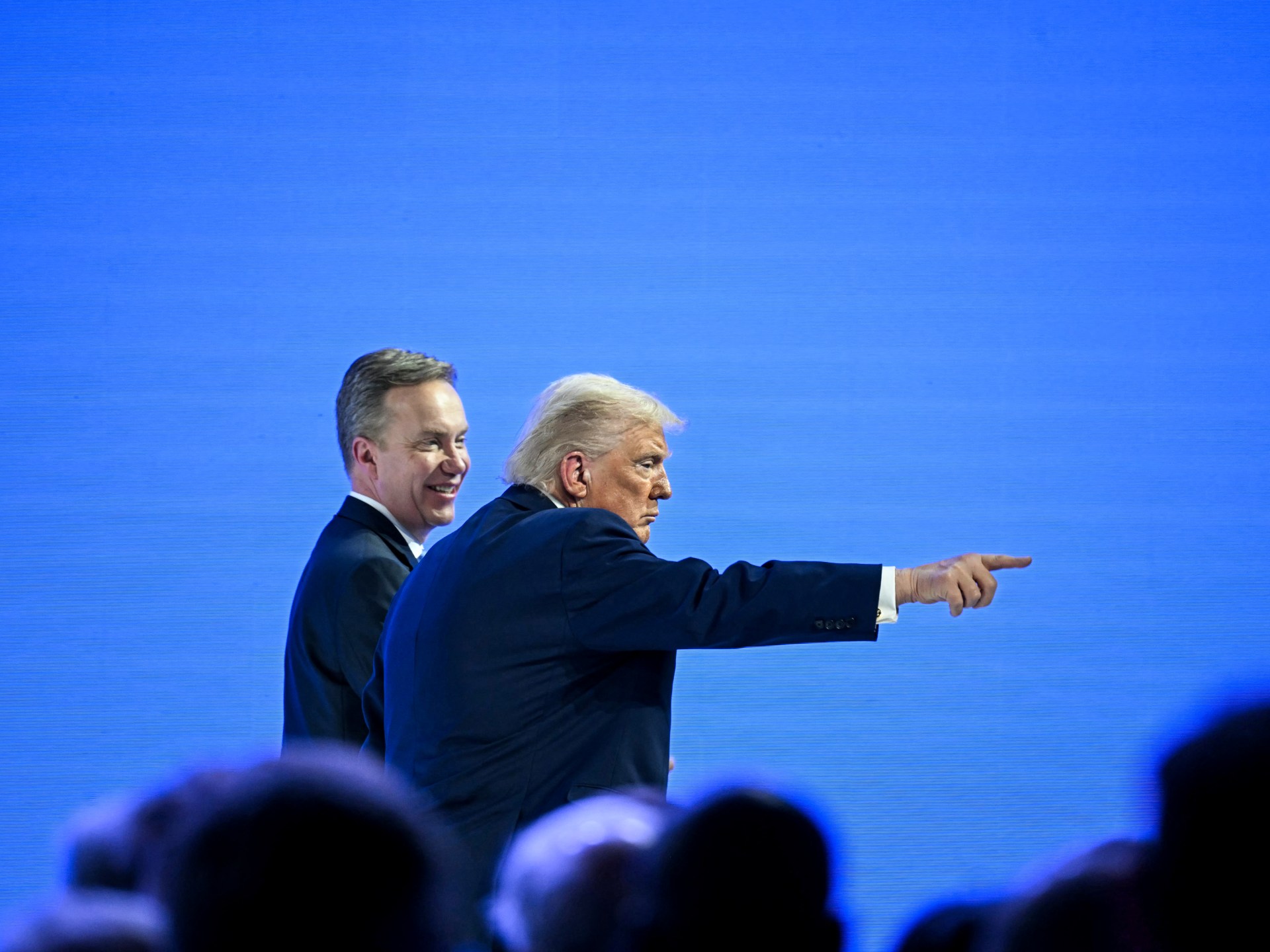
In Trump’s speech in Davos the following day, the US president made clear that times had changed. He nodded to Venezuela, where his forces conducted a raid to abduct the country’s President Nicolas Maduro earlier this month. He criticised Europe, calling the countries there weak.
Advertisement
And he constantly referenced his desire to take Greenland, no matter what Greenlanders, or Denmark – the country they are part of – think.
“We want a piece of ice for world protection. And they won’t give it,” Trump said. “So they have a choice. You can say yes, and we will be very appreciative. Or you can say no, and we will remember.”
Trump has made clear that the old way of doing things does not interest him. The post-World War II rules-based order concepts of sovereignty, and the resolution of disputes through negotiations, no longer mattered.
Not an ally but a predator
The actions of Trump and his administration have forced lawmakers across Europe and the West to confront their reliance upon the US and weigh the difficulties of confronting the world’s most significant superpower, which NATO’s former deputy allied commander for Europe, Richard Shirreff, described on Tuesday as having turned from “ally” to “predator”.
Limited attempts on the part of Europe to counter US ambitions in Greenland have seen the deployment of a token number of troops to the island, only to be met by American fury and the immediate threat of tariffs.
“The rules-based order is over, and its ending reflects the decades-old fallacy that European and US values and security interests were the same,” said Geoffrey Nice, a human rights lawyer and former lead prosecutor in the war crimes trial of Serbia’s former president, Slobodan Milosevic.
Over the years, the US has exempted itself from numerous international treaties, such as the International Criminal Court, whose warrant against Russian President Vladimir Putin was actively pursued by former US President Joe Biden, despite Washington’s refusal to accept the jurisdiction of the court itself.
Similarly, when the International Court of Justice ruled against the US in a 1986 case on Washington’s support for rebels in Nicaragua, the US simply dismissed the ruling. Other international obligations, such as those on climate, or commitments to Iran to ease sanctions in return for greater transparency of its nuclear programme, have been similarly shrugged off.
“The reality has been that, time and again, the US has placed its own interests and its own sovereignty first. The United States’ interest in international law, going back to the Nuremberg, has always been ad hoc rather than treaty based,” Nice told Al Jazeera, referring to the Nuremberg trials of Nazi leaders after World War II. “What’s compounded this is that, for over 80 years, Europe and others have deluded themselves that this isn’t the case.”
![Protesters take part in a a demonstration march ending in front of the U.S. consulate, under the slogan, Greenland belongs to the Greenlandic people, in Nuuk, Greenland, March 15, 2025. [Christian Klindt Soelbeck/Ritzau Scanpix/via Reuters]](https://www.aljazeera.com/wp-content/uploads/2026/01/2025-03-15T171551Z_996838961_RC2QDDAQMMC6_RTRMADP_3_GREENLAND-PROTEST-1768930265.jpg?w=770&resize=770%2C514&quality=80)
Hypocritical order
Longstanding criticisms of the so-called rules-based order have grown increasingly marked over the last few decades.
Advertisement
Perhaps most notable for many was continued Western support for Israel despite its genocidal war on Gaza, in which it has killed more than 71,550 Palestinians in the last two years. Western leaders have largely ignored the International Criminal Court’s arrest warrant for Israeli Prime Minister Benjamin Netanyahu, raising questions about whether international law matters for some, but not for others.
“The idea of holding to a singular — and often deeply hypocritical — rules-based order is finished, to the extent it ever truly existed,” said HA Hellyer of the Royal United Services Institute for Defence and Security Studies in London.

“The recognition of that reality by the Canadians and Europeans is landing very differently across the world. For some, similar to Europe and Canada, it feels like a shocking collapse,” Hellyer said. “For others, it’s simply the moment when a system that never protected Black and brown populations, or the ‘Global South’, is finally being named for what it was.”
“It’s telling that the supposed breaking point for the rules-based order is really the threat to Greenland, not the devastation of Gaza, or other examples before now,” Hellyer added. “The cases are not identical, and I’m not equating them — but it’s difficult to argue that talk of annexation is more offensive to international norms than the destruction of an entire people and territory. But in the case of Israel, the main underwriter of the rules-based order – i.e., the US – did not only work to ensure no accountability for the violation of international law, but actively emboldened and empowered those violations.”
There is nothing new about Western commentators claiming that events on their own doorstep define the state of the world, regardless of conditions elsewhere, said Karim Emile Bitar, a professor of international relations at the Saint Joseph University of Beirut.
“This is why we see such a stark contrast between Western attitudes toward Gaza as opposed to Western attitudes when a blue-eyed, blonde Ukrainian lady arrives as a refugee,” he said.
“When a territory that is part of the ‘European Union’ is under threat, they completely shift course and no longer try to use the usual mendacious justifications that were used for decades and decades.”
For smaller countries that have been forced to rely upon alliances rather than rules for decades, or much of the Global South, the collapse of the rules-based order will mean little. For those in the Global North and their representatives at Davos, it represents a seismic shift.
Related News
Drone hits Aleppo governorate building after Syrian army declares ceasefire

More than 100 vehicle pile-up leaves US motorists stranded in snowstorm

Australian writers’ festival boss resigns after Palestinian author axed