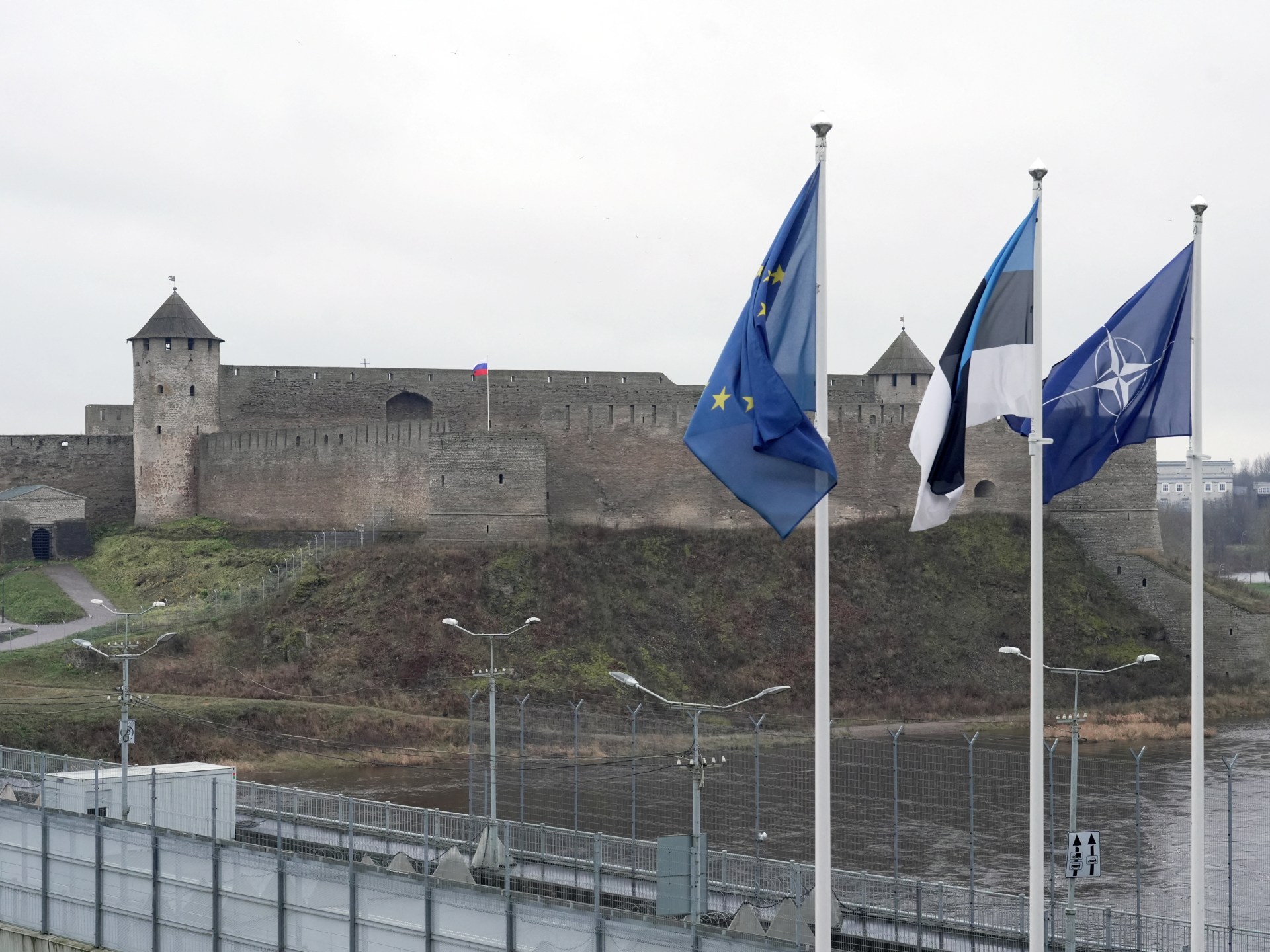

Moscow accuses Tallinn of ‘hostile actions’ including border closure, allowing Ukraine to launch attacks from its territory, and discrimination against Estonia’s ethnic Russian population.
Russia has accused Estonia of carrying out numerous “hostile actions” and threatened “open war” against the neighbouring Baltic state.
Russia’s Ministry of Foreign Affairs on Monday accused Tallinn of a range of hostile actions, asserting that the NATO and European Union member state is “on the verge of triggering open war”.
- list 1 of 3Finland detects strike on Russian warship as Zelenskyy meets US envoys
- list 2 of 3Why is Ukraine attacking Russian warships in the Baltic Sea amid talks?
- list 3 of 3Estonia to close border crossings with Russia after attack on drone maker
end of list
The outburst comes after Estonia announced the planned closure of its border with Russia, and a Ukrainian attack on a Russian ship in the Baltic Sea.
The ministry set out its accusations in a statement after summoning Estonia’s charge d’affaires in Moscow, Marek Uhtegi, to issue a formal protest over Tallinn’s decision to close the border.
“The Estonian diplomat was once again told that such provocative and extremely dangerous actions are on the verge of triggering open war with Russia,” it said, adding that Estonia is displaying “Russophobic” tendencies.
Among a list of additional accusations, the ministry said Estonia had “tacitly allow[ed] its airspace to be used by Ukrainian drones for attacks on northwestern Russia”. Tallinn was swift to deny the claim.
It also accused Estonia of trying to obstruct the movement of Russian cargo ships in the Baltic Sea, banning the transit of Russian and Belarusian grain, seeking a ban on the Russian language and threatening to close the Russian Orthodox Church.
“The Russian side reserves the right to take comprehensive political and diplomatic measures aimed at protecting Russia’s national interests and the legitimate rights of its citizens,” the ministry said.
Advertisement
Estonia is host to a sizeable ethnic Russian population, which Moscow has often claimed is subject to discrimination.
Russia’s incursions into eastern Ukraine in 2014 were based on claims of suppression of Russian speakers’ rights in the region.
Earlier this month, Estonia said it would close border crossings with Russia from December 1 for at least six months, having accused the Kremlin’s security services of staging an attempted arson attack on an Estonian defence company.
This marked a sharp escalation in tensions between Estonia and Russia, which Tallinn – Kyiv’s ally – sees as part of a broader campaign of hostile activity linked to Moscow’s war in Ukraine.
Russia has denied any involvement in the attack. Closing the border, the ministry said, “will inevitably backfire – not only on Tallinn itself but also on its allies within the EU and NATO”.
In a statement, the Ministry of Foreign Affairs of Estonia did not respond to all of the allegations but denied that it allows its territory to be used for Ukrainian military operations.
“While we generally do not comment on or engage with Russian propaganda narratives, in this case we can reiterate that Estonia has never allowed, and will never allow, its territory to be used for military operations by another country,” it said.
“Other countries in our region have also made this position clear,” it added.
Russia has long accused Estonia and other NATO states in the Baltic region of allowing Ukrainian drones to use their airspace. Ukrainian drones have frequently entered NATO airspace, but Kyiv says this is a result of Russian signal jamming.
NATO countries have repeatedly denied intentionally allowing drones to use their airspace, and blamed Russia for the incursions.
NATO Secretary-General Mark Rutte, speaking in Berlin, said the alliance was monitoring the situation in Estonia, along with an incursion last week by Russian missiles into Poland, adding that NATO had options available to respond.
“We see situations in Poland and Estonia, etc ,” Rutte said. “When it comes to the military domain, we will always make assessments of our deterrence and defence and make updates where necessary.”
Related News
How cuts under Colombia’s de la Espriella threaten a key human rights court
Hundreds of men march in Switzerland to protest violence against women
US appeals court lets Trump end TPS deportation protections for Venezuelans