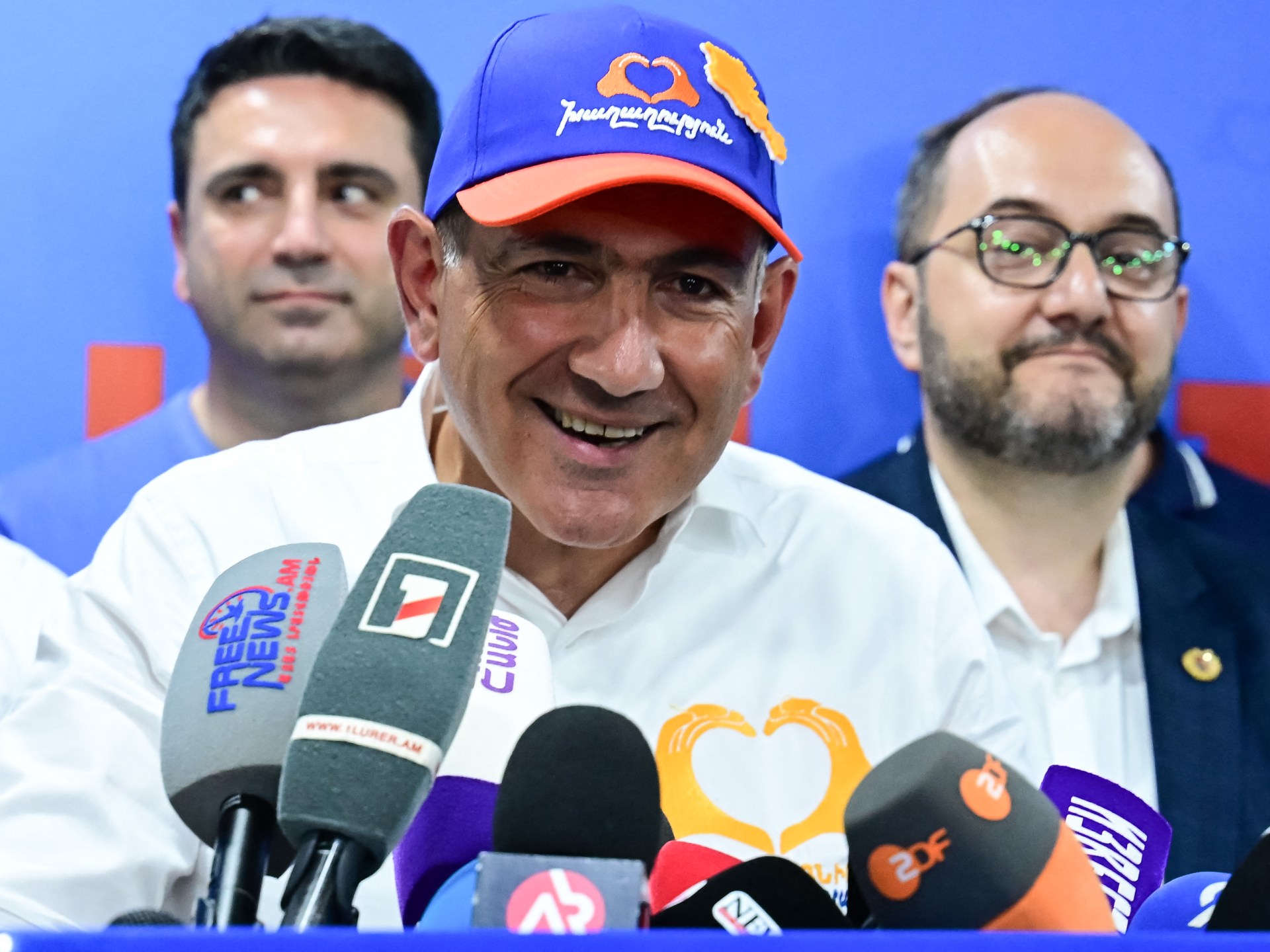

Prime Minister Nikol Pashinyan’s party has won Armenia’s parliamentary election, preliminary results suggest.
Pashinyan’s Civil Contract party secured 49.81 percent of the vote, the country’s Central Election Commission (CEC) said on Monday, with an alliance led by the main opposition party Strong Armenia a distant second with 23.29 percent.
- list 1 of 3Armenia signs strategic partnership deal with US as election approaches
- list 2 of 3Armenian PM rejects Russia’s demand for EU referendum as relations nosedive
- list 3 of 3Armenia votes in test of PM’s pivot to Europe amid Russian pressure
end of list
Turnout in the landlocked country of three million was more than 58 percent of eligible voters, the CEC said.
The prime minister is seeking a mandate to reorient the country’s geopolitics, distancing former imperial ruler Russia and pushing to join the European Union.
Pashinyan claimed a “historic victory that will ensure Armenia’s eternity and development”. He pledged to “continue the course of rapprochement with the West” while also developing Armenia’s relations with Russia.
The second-placed Strong Armenia bloc is led by Samvel Karapetyan, a Russian-Armenian billionaire who made his fortune in Russia and is under house arrest for allegedly advocating for the government’s overthrow. He has rejected the charge as politically motivated.
Karapetyan called the elections “shameful” and denounced alleged violations and repression, saying dozens of his campaign staff had been arrested. Armenia’s Investigative Committee said it had opened 59 criminal cases over alleged electoral violations and detained nine people.
Two other opposition forces – former President Robert Kocharyan’s Armenia alliance and the Prosperous Armenia party – also cleared the electoral threshold to get into parliament, winning 9.9 percent and 4 percent of the vote respectively, the CEC said.
Pashinyan fell short of securing the two-thirds majority in parliament, necessary to call the constitutional referendum demanded as part of a peace deal with Azerbaijan, which has been intermittently at war with Armenia since the late 1980s, and to normalise relations with Turkiye, a key ally of Azerbaijan. The final distribution of parliamentary seats is not yet clear.
Advertisement
Pashinyan has frozen participation in a Russia-led security bloc while deepening ties with the EU and the United States, and set Armenia on a path towards possible EU membership. Moscow has bristled at the possible loss of yet another ally in its back yard.
Last May, Russian President Vladimir Putin said, “We all see what is happening with Ukraine now … How did it all begin? With Ukraine’s attempt to join the EU.”
EU chief Ursula von der Leyen congratulated Pashinyan on the victory, hailing “a democratic Armenia that is drawing ever closer to Europe”.
French President Emmanuel Macron said this result would shift Armenia’s “momentum toward closer ties with Europe”.
Related News
Iran war: What is happening on day 92 as Trump weighs Iran deal
What is the Lobito Corridor, cited by US Africa envoy as model for ties?

Philippines earthquake kills 15, prompts tsunami fears: All to know