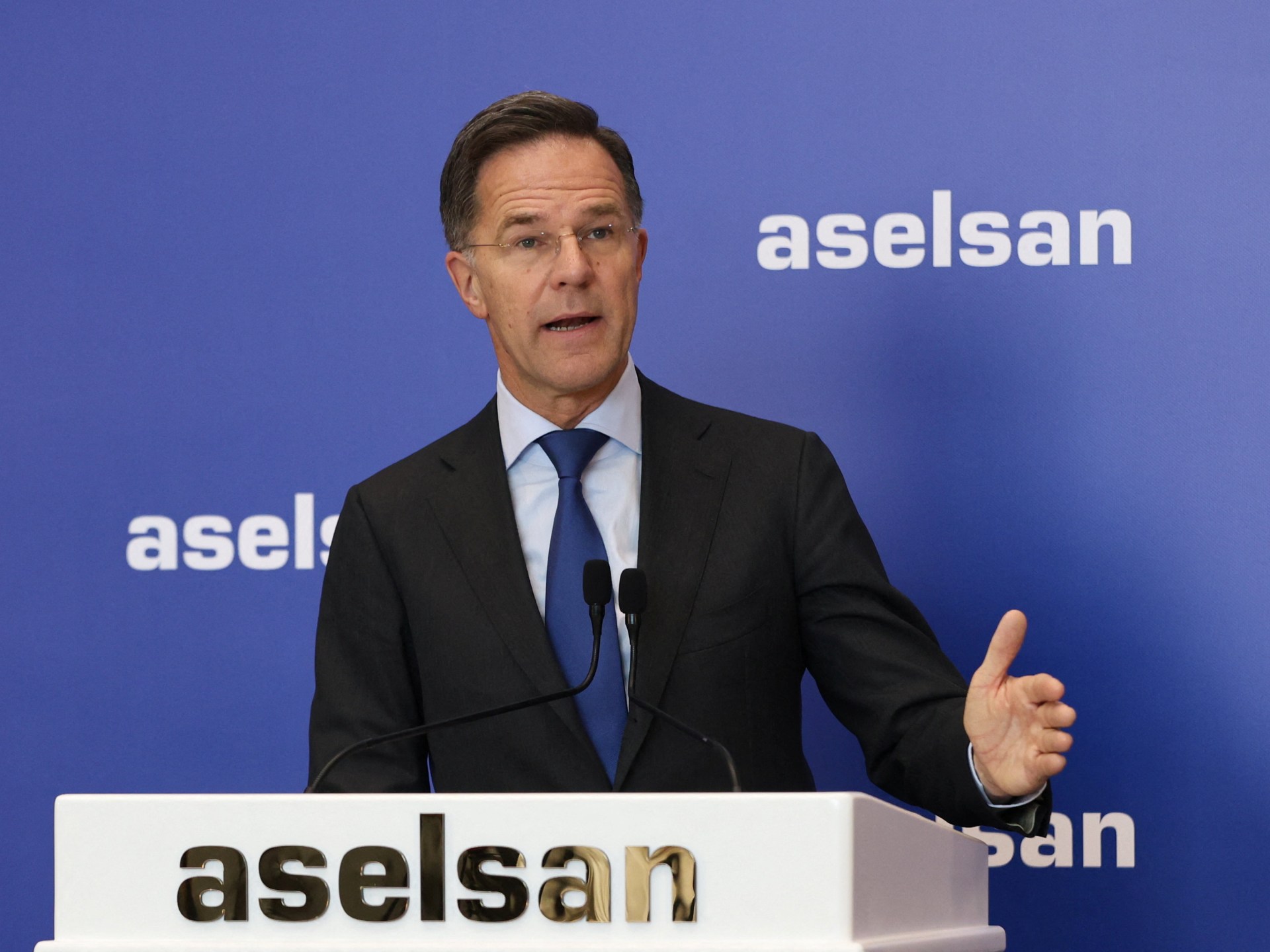

NATO Secretary-General Mark Rutte says European leaders have “gotten the message” after United States President Donald Trump announced plans to withdraw 5,000 soldiers from Germany.
Trump has grown increasingly frustrated with NATO allies, accusing them of not doing enough to support the US-Israel war on Iran. Speaking on Monday, Rutte acknowledged “disappointment from the US side”.
- list 1 of 3Russia has given Iran something more important than weapons
- list 2 of 3Trump’s threat: Why cutting US troops in Europe won’t be easy
- list 3 of 3Zelenskyy has no cards to play against Russia or the West
end of list
“European leaders have gotten the message. They heard the message loud and clear,” Rutte said before a European Political Community meeting in Armenia.
“Europeans are stepping up, a bigger role for Europe and a stronger NATO,” he added.
The Pentagon announced the troop withdrawal from Germany on Friday, days after German Chancellor Friedrich Merz said Iran was humiliating the US during the negotiations aimed at ending the war.
The European Union’s top diplomat, Kaja Kallas, called the announcement’s timing a “surprise”.
“I think it shows that we have to really strengthen the European pillar in NATO, and we have to really do more,” Kallas said while stressing that “American troops are not in Europe only for protecting European interests but also American interests.”
Over the weekend, NATO spokesperson Allison Hart said officials in the 32-nation military alliance “are working with the US to understand the details of their decision on force posture in Germany”.
‘Dangerous military intervention’
European criticism of the war on Iran has mounted in recent weeks as the conflict sends shockwaves through the global economy due to the continued disruption to shipping in the Strait of Hormuz.
Advertisement
Last week, Merz compared the war to previous military quagmires, such as the US invasions of Iraq and Afghanistan.
“It is, at the moment, a pretty tangled situation,” he said. “And it is costing us a great deal of money. This conflict, this war against Iran, has a direct impact on our economic output.”
Spain has refused to let the US launch attacks on Iran from its airspace or military bases. Prime Minister Pedro Sanchez has condemned the war as “unjustified” and a “dangerous military intervention” outside the realm of international law.
In response, Trump called Spain “terrible” and threatened to end all trade ties.
Despite this, Rutte said “more and more” European nations were now pre-positioning assets such as minehunters and minesweepers close to the Gulf to be ready for the “next phase” in the war.
He provided no details, and European nations have previously insisted they would not help to police the Strait of Hormuz until the war is over.
Increased defence spending
Many European countries have committed to ramping up defence spending in the face of fears over Trump’s commitment to NATO and Russia’s assault on Ukraine – a push underscored by several leaders in the Armenian capital.
“Europeans are taking their destiny into their own hands, increasing their defence and security spending, and building their own common solutions,” French President Emmanuel Macron said.
“We have to step up our military capabilities to be able to defend and protect ourselves,” European Commission President Ursula von der Leyen told reporters.
Related News
Top ministers quit after Peru’s president postpones F-16 fighter jet deal
Mexico’s Jalisco drug cartel commander ‘El Jardinero’ found hiding in ditch
Uganda court sentences man to death for killing four children at nursery