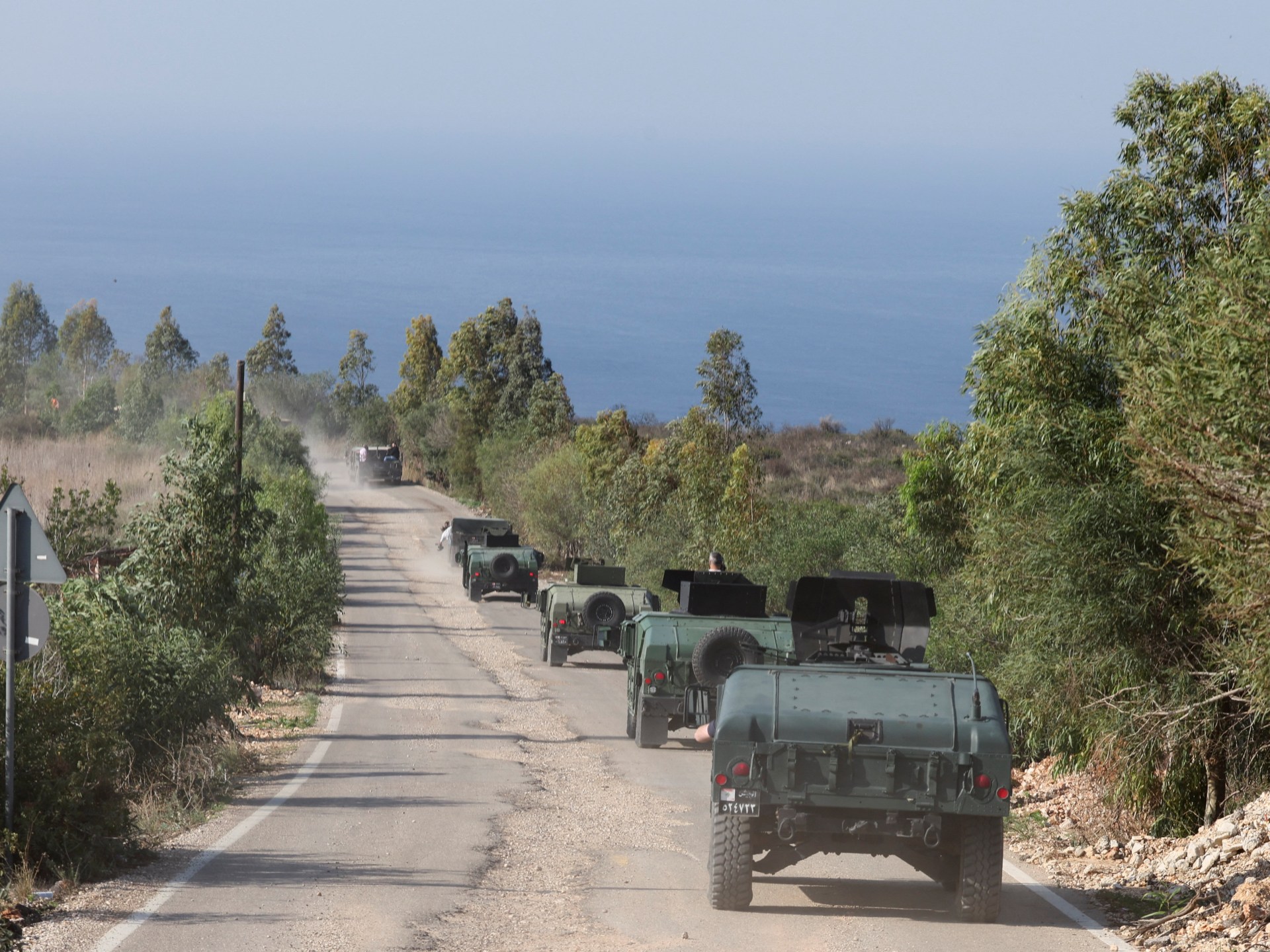

The committee tasked with overseeing a ceasefire agreement between Israel and Hezbollah has held talks in southern Lebanon, as Israel and the United States ramp up pressure to disarm the Lebanese group.
Civilian and military delegations from Israel and Lebanon met in the southern Lebanese town of Naqoura on Friday for closed-door discussions, the 15th such gathering since the truce was signed in November 2024.
- list 1 of 3Moscow’s narrative wobbles as Ukraine takes back Kupiansk
- list 2 of 3‘War on terror’ defence of Trump boat strikes doesn’t hold water: Experts
- list 3 of 3Who was Sharif Osman Hadi; why is Bangladesh on fire over his death?
end of list
The US embassy in Beirut said military participants offered “operational updates” and agreed on the need to strengthen the Lebanese army as a guarantor of security south of the Litani River.
“Civilian participants, in parallel, focused on setting conditions for residents to return safely to their homes, advancing reconstruction, and addressing economic priorities,” the embassy said in a statement.
“They underscored that durable political and economic progress is essential to reinforcing security gains and sustaining lasting peace.”
The talks come as Israel has repeatedly violated the ceasefire with Hezbollah, carrying out near-daily attacks across Lebanon, most notably in the south.
The Israeli military launched a series of air strikes across the country a day before the Friday meetings, claiming in a statement that it was targeting the Lebanese group’s military operatives and infrastructure.
Reporting from Naqoura, Al Jazeera’s Zeina Khodr said the talks were expected to focus on solidifying what has largely been a one-sided truce.
“At least that is what Lebanon wants,” she said. “The Israeli army still occupies more than 10 square kilometres [about 4sq miles] of Lebanese territory along the border.”
After the meetings, Lebanese President Joseph Aoun met Lebanese diplomat Simon Karam, who has been appointed as the country’s top civilian negotiator.
Advertisement
A statement by the Lebanese presidency said Aoun stressed that allowing tens of thousands of Lebanese civilians who have been displaced as a result of Israel’s attacks to return to their villages and homes was “an entry point for addressing all other details”.
Aoun said the committee’s next meeting is scheduled for January 7.
He also welcomed a separate diplomatic agreement reached in Paris between the US, France and Saudi Arabia to organise an international conference in early 2026 to support the Lebanese army and the country’s internal security forces.
Israel’s National Security Council Deputy Director for Foreign Policy Yosef Dreznin represented the country in the civilian talks.
The office of Israeli Prime Minister Benjamin Netanyahu described the meeting as a “continuation of the security dialogue aimed at ensuring the disarmament of Hezbollah by the Lebanese army”.
“During the meeting, ways to promote economic projects were discussed in order to underscore the mutual interest in removing the Hezbollah threat and ensuring sustainable security for residents on both sides of the border,” it said in a statement.
For its part, Hezbollah has rejected the prospect of laying down its weapons while Israel continues to regularly launch attacks on Lebanon and occupy parts of its territory.
Naim Qassem, who became Hezbollah’s secretary-general after his predecessor Hassan Nasrallah and most of the group’s military and political leadership were assassinated by Israel, has accused the Lebanese government of giving concessions without receiving anything in return.
Paul Salem, senior fellow at the Middle East Institute, told Al Jazeera that the talks remain limited at the moment but may, in the future, evolve into broader topics, including a full cessation of hostilities.
“I doubt it will get into anything related to peace, certainly not now,” he said.
Related News
Five killed as US military destroys two more vessels in Pacific Ocean
Japan summons China envoy over ‘fighter jet radar lock’ as tensions surge
Trump expands US travel ban to include Syria, Palestine