‘Fascist, criminal’: Cuba slams Trump bid to ‘suffocate’ island’s economy
 31 January 2026

Cuba’s President Miguel Diaz-Canel has denounced what he called an attempt by his United States counterpart, Donald Trump, to “suffocate” the sanctions-hit country’s economy.
Trump signed an executive order on Thursday threatening additional tariffs on countries that sell oil to Cuba, the latest move in Washington’s campaign of pressure on Havana. The order alleged that the government of communist-run Cuba was an “unusual and extraordinary threat” to US national security.
In a social media post on Friday, Diaz-Canel said that under “a false and baseless pretext”, Trump plans “to suffocate” Cuba’s economy by slapping tariffs “on countries that sovereignly trade oil” with it.
“This new measure reveals the fascist, criminal and genocidal nature of a clique that has hijacked the interests of the American people for purely personal ends,” he said, in an apparent allusion to Secretary of State Marco Rubio, a Cuban American and a known anti-Cuban government hawk.
Cuba, which is suffering rolling electricity blackouts blamed on fuel shortages, was cut off from critical supplies of Venezuelan oil after the US abducted Venezuela’s President Nicolas Maduro and his wife in a bloody military night raid on the capital, Caracas, earlier this month. At least 32 members of Cuba’s armed forces and intelligence agencies were killed in the January 3 attack.
The US has since taken effective control of Venezuela’s oil sector, and Trump, a Republican, has issued threats against other left-wing governments in the region, promising to stop oil shipments previously sent to Cuba.
Advertisement
Cuba’s Foreign Minister Bruno Rodriguez on Friday declared an “international emergency” in response to Trump’s move, which he said constitutes “an unusual and extraordinary threat”.
Venezuela’s government also condemned the measure in a statement on Friday, saying it violates international law and the principles of global commerce.
Reporting from Cuba’s capital, Al Jazeera’s Ed Augustin said Trump’s announcement “is a massive psychological blow”, noting that analysts describe it as the “most powerful economic blow the United States has ever dealt the island”.
Days after Maduro’s abduction and transfer to the US, Trump urged Cuba to make a deal “before it is too late,” without specifying what kind of agreement he was referring to.
In a post on social media, Trump suggested Rubio could become the president of Cuba. “Sounds good to me!” he wrote on his Truth Social platform.
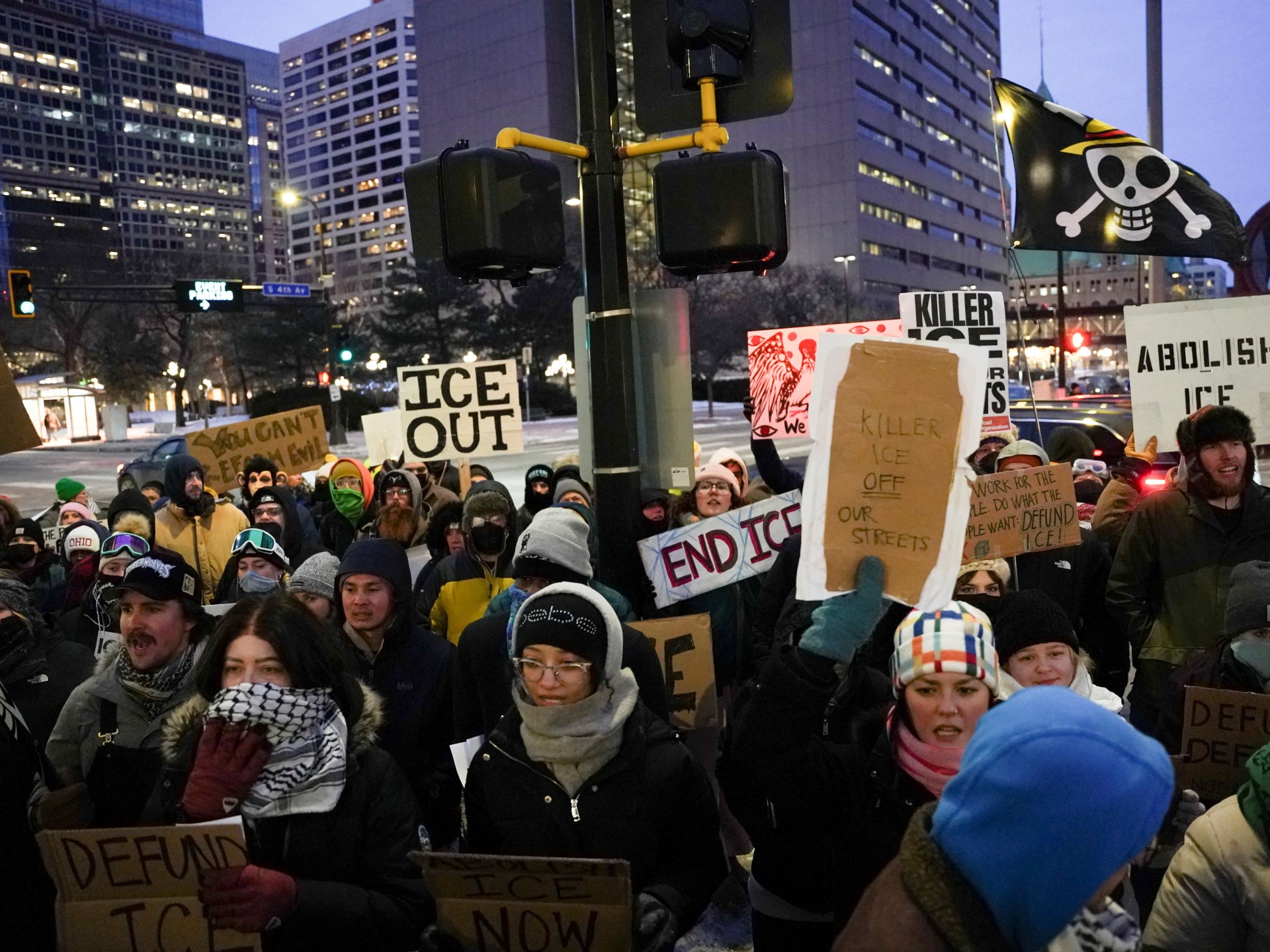
In Havana, residents expressed anger at Trump’s tariff threat, which will only make life harder for Cubans already struggling with an increase in US sanctions.
“My food is going bad. We haven’t had electricity since 6am,” Yenia Leon told Al Jazeera. “You can’t sleep. You have to buy food every day. There’s no solution to the power situation,” she said.
“This is a war,” Lazaro Alfonso, an 89-year-old retired graphic designer, told The Associated Press news agency, describing Trump as the “sheriff of the world” and saying he feels like he is living in the Wild West, where anything goes.

Alfonso, who lived through the severe economic depression in the 1990s known as the “Special Period” following cuts in Soviet aid, said the current situation in Cuba is worse, given the severe blackouts, a lack of basic goods and a scarcity of fuel.
“The only thing that’s missing here in Cuba … is for bombs to start falling,” he said.
Meanwhile, Mexican President Claudia Sheinbaum said she would seek alternatives to continue helping Cuba after Trump’s announcement following a decision this week to temporarily halt oil shipments to the island amid heightened rhetoric from Trump.
Mexico became a key supplier of fuel to Cuba, along with Russia, after the US sanctions on Venezuela paralysed the delivery of crude oil to the island.
Sheinbaum said cutting off oil shipments to Cuba could trigger a “far-reaching humanitarian crisis” on the island, affecting transportation, hospitals and access to food. She did not say whether Mexico would cut shipments of oil or refined products to Cuba, which she said accounted for 1 percent of Mexico’s production.
Advertisement
“Our interest is that the Cuban people don’t suffer,” Sheinbaum said, adding that she had instructed her foreign minister to contact the US State Department to better understand the scope of the executive order.
Mexico supplied 44 percent of Cuban oil imports and Venezuela exported 33 percent until last month, while some 10 percent of Cuban oil is sourced from Russia. Some oil is also sourced from Algeria, according to The Financial Times figures.
In November last year, a senior United Nations expert said the long-running US sanctions on Cuba must be lifted as they are “causing significant effects across all aspects of life”.
The US imposed a near-total trade embargo on Cuba in 1962, with the goal of toppling the government put in place by Fidel Castro after he took power in a 1959 revolution. Castro himself was the target of numerous assassination attempts by the US’s Central Intelligence Agency, or CIA.
Alena Douhan, special rapporteur on the negative impact of unilateral coercive measures on human rights, said the “extensive regime of economic, trade and financial restrictions” against Cuba marks the longest-running unilateral sanctions policy in US history.
She noted that there are shortages of food, medicine, electricity, water, essential machinery and spare parts in Cuba, while a growing emigration of skilled workers, including medical staff, engineers and teachers, is further straining the country.
The accumulative effect has “severe consequences for the enjoyment of human rights, including the rights to life, food, health and development”, Douhan said.
Related News
Photos: Protesters demand immigration agents leave Minneapolis
Syrian army launches strikes against Kurdish-led SDF east of Aleppo
Palestinian child shot dead by Israeli troops in occupied West Bank