Iran warns Iraq against becoming Trump’s ‘instrument’ amid border crackdown
 28 November 2026
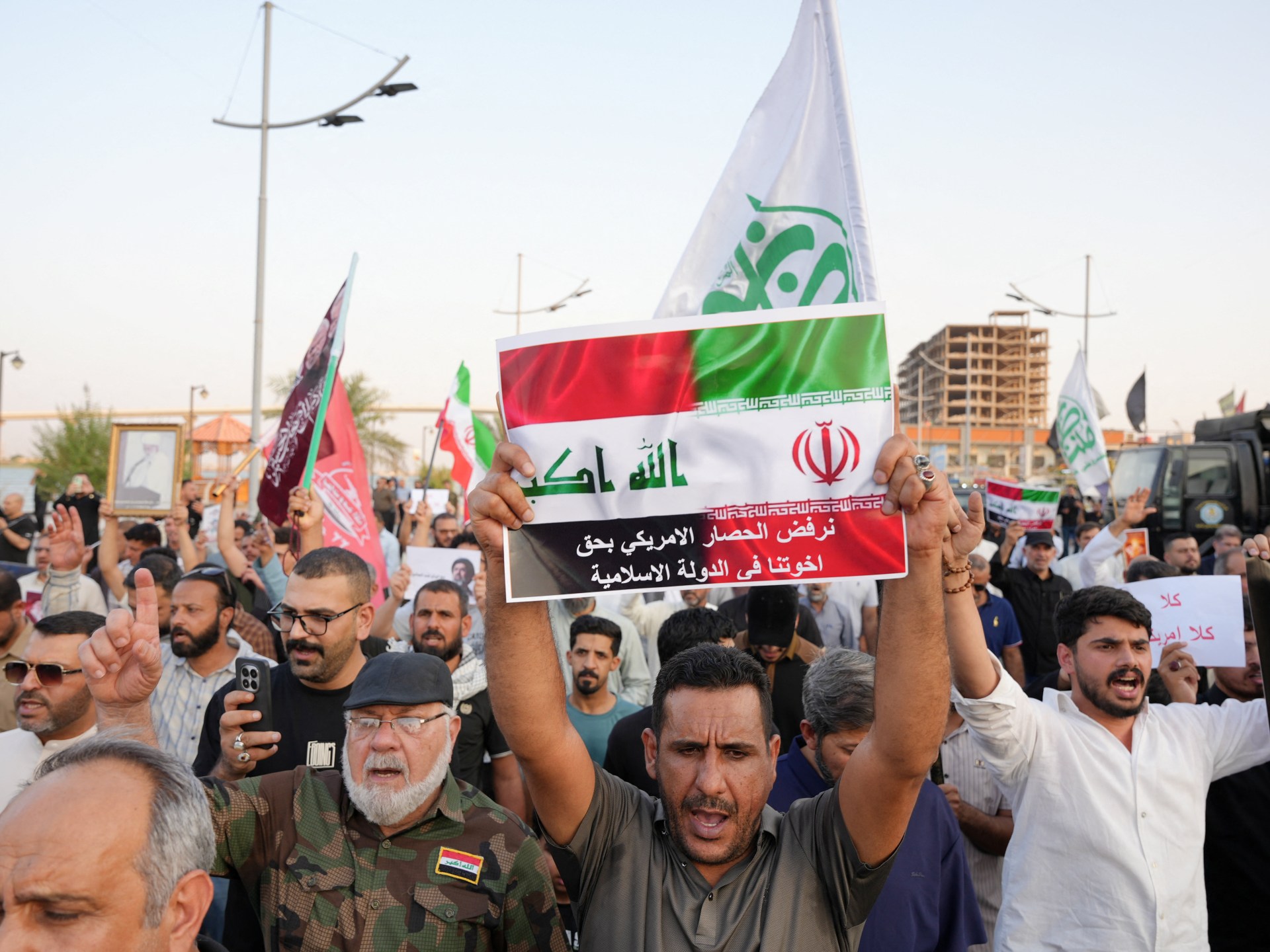

Iran has warned Iraq against allowing the United States to interfere in the two Middle Eastern countries’ economic relations as Baghdad tightens border controls as part of a wider crackdown on oil smuggling.
Mohammad Mokhber, an adviser to Iranian Supreme Leader Mojtaba Khamenei, warned Baghdad on Saturday against becoming an “instrument” of US President Donald Trump, urging Iraqi authorities to remain vigilant over border-related issues.
Recommended Stories
list of 4 items
- list 1 of 4US military says it disabled merchant ship trying to breach Iran blockade
- list 2 of 4US disables ship attempting to breach Iran blockade
- list 3 of 4Why is Trump backing Iraq’s anti-smuggling campaign?
- list 4 of 4Iran points to Europe’s war role after Italians killed in Kuwait strike
end of list
His remarks came as Iraq’s national security adviser, Qasim al-Aboudi, visited Tehran for talks with Iranian security chief Mohsen Rezaei.
“Foreigners should not be allowed to negatively impact Iran-Iraq economic cooperation,” Iranian state media quoted Rezaei as saying. He also said that the bilateral security agreement needed to be fully implemented.
Al-Aboudi reaffirmed Baghdad’s commitment to the agreement, saying Iraq would not allow its territory or airspace to be used for attacks against Iran or other neighbouring countries.
The meeting came amid efforts by Washington to extend the impact of its naval blockade of Iran by restricting the country’s overland trade. Earlier this month, Iraqi Foreign Minister Fuad Hussein told Al Jazeera that the US Treasury had asked Baghdad to close all but two border crossings with Iran.
Reporting from Tehran, Al Jazeera’s Amer Lafi said the prospect of further border closures was a major concern for Iranian officials, given the country’s growing reliance on overland trade.
“Iran has begun to resort to its land crossings as an alternative,” following the imposition of the US naval blockade, Lafi said.
Advertisement
He added that Washington’s request would leave only two crossings open – one in Iraq’s semiautonomous northern Kurdish region and another under the direct control of the federal government.

‘A sovereign matter’
Responding to Mokhber’s remarks, Iraqi government spokesperson Haider al-Aboudi told Al Hadath television that Baghdad respected the sovereignty of neighbouring countries but would not accept interference in its internal affairs.
He said the measures being implemented within Iraqi territory were not directed against neighbouring countries.
The spokesperson added that Prime Minister Ali al-Zaidi’s government had mediated with Washington to maintain commercial crossings and air links with Iran.
“These crossings are a sovereign matter,” he said, adding that Baghdad had the final say over their operation.
He said the Iraqi delegation’s visit to Tehran included discussions on security and the management of the Iraq-Iran border.

Iraq’s oil smuggling crackdown
On Thursday, Iraqi authorities began closing unofficial border crossings with neighbouring countries, including those in the semi-autonomous northern Kurdish region, following orders from al-Zaidi.
The move is part of a broader campaign to combat oil smuggling and bring several oilfields and border crossings previously administered by Kurdish authorities under federal control.
According to an Iraqi intelligence report cited by the INA state news agency, oil was being smuggled from northern Iraq into Iran, where it was blended with Iranian oil to circumvent US sanctions.
An Iraqi official told Al Jazeera that the military had reinforced its presence in parts of the oil-rich Kirkuk province to prevent smuggling through unofficial routes.
Iraq’s Interior Ministry also announced on Saturday that it was building security fortifications along the Iranian border in the Hawizeh Marshes, including a 50km-long (31 miles) earthen barrier and concrete border posts.
The crackdown has drawn support from Trump but sparked tensions between Baghdad and the Kurdistan Regional Government, which has accused federal authorities of unconstitutional actions.
Federal and Kurdish leaders are expected to meet in Baghdad on Tuesday to address the dispute.
Related News
World reacts to ICJ finding Myanmar guilty of genocide against Rohingya
Iran war live: Qatar says US, Iran should not wait to reach a peace deal

Microsoft says services still returning amid widespread outage