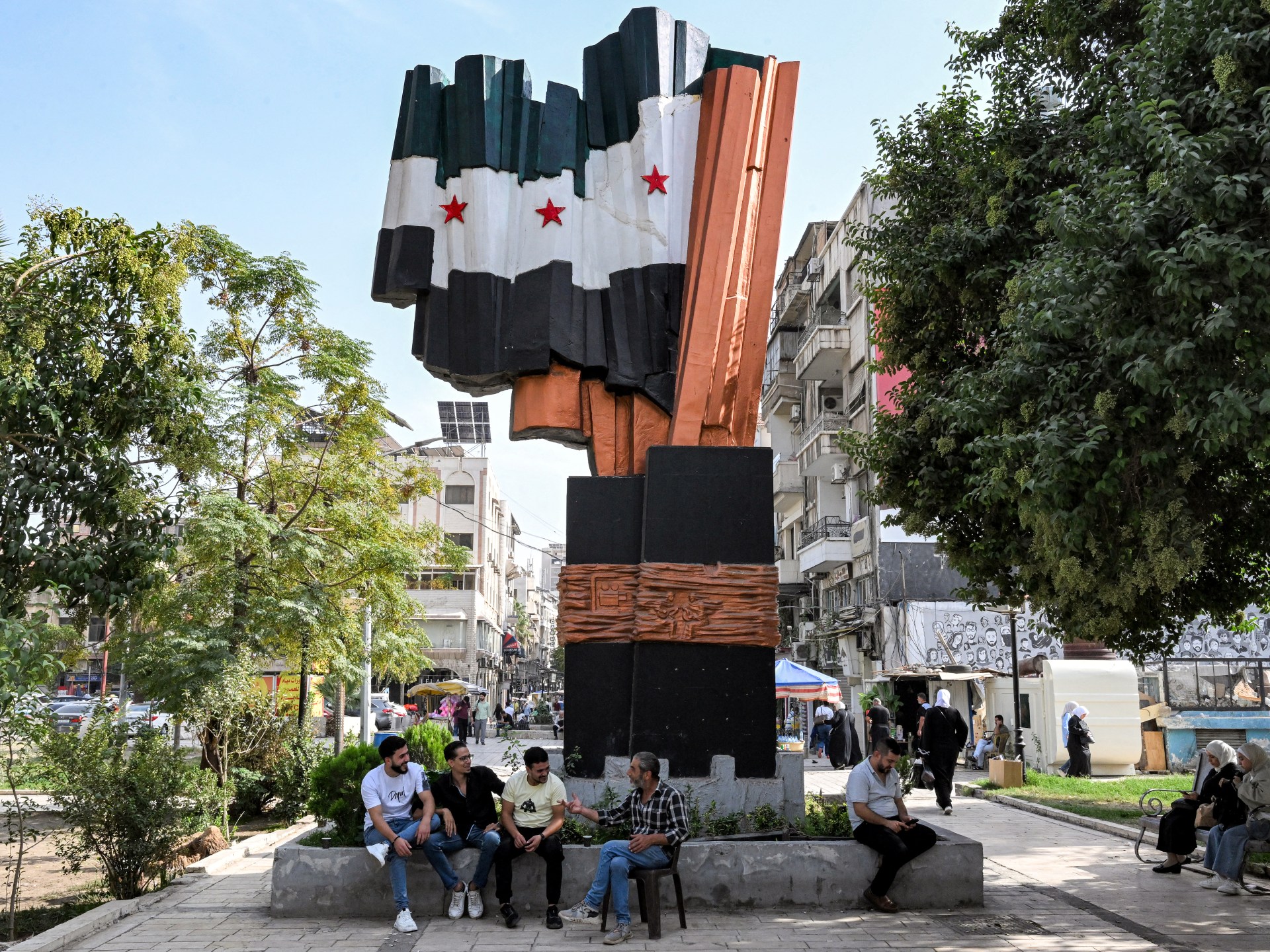

Most Syrians view Israel as the greatest threat to the security of their country and the region, with Iran a distant second, according to a new nationwide survey.
The poll, conducted by the Doha-based Arab Center for Research and Policy Studies and the Arab Center for Contemporary Syria Studies, published its results on Monday.
- list 1 of 3Flash floods kill five in Syria
- list 2 of 3Syria considering entry into Mecca defence pact, says foreign minister
- list 3 of 3Syria says it foiled Hezbollah plot to target Homs oil refinery
end of list
The Arab Opinion Index for Syria 2026 found that 61 percent of respondents named Israel as the main threat to Syria, while Iran was named by 20 percent, Turkiye by 6 percent and the United States by 5 percent.
Asked about the Arab world as a whole, 58 percent of respondents named Israel as the main threat, unchanged from last year. Meanwhile, the share naming Iran as the main regional threat doubled from 12 percent in 2025 to 24 percent.
Some 97 percent said Israel threatens the security and stability of the Middle East, up from 78 percent a year earlier. The percentage of those who said the same about Iran rose from 74 to 93.
Israel has seized territory in southern Syria since the fall of Bashar al-Assad in December 2024. About 96 percent of respondents said Israel is working to destabilise Syria and 86 percent said it is driving separatist tendencies.
Almost 80 percent oppose recognising Israel, up from 74 percent in 2025, and 74 percent oppose any agreement that does not return the occupied Golan Heights. Respondents were split on direct talks between Syrian and Israeli officials: 41 percent said they serve Syria’s interests and 49 percent said they do not.
Advertisement
Al Jazeera interviewed residents on the streets of Damascus ahead of the Israeli elections last month. One of them, Jihad el-Hamwi, said Israel’s approach to Syria was unaffected by the change of government.
“In my opinion, Israeli policy does not change when the ruler changes, because it is an expansionist policy,” he said. “Just as it has expanded into Syria, Palestine, Lebanon and other countries, its aim is expansion, not a change of ruler.”
Another resident told Al Jazeera, “The Israeli elections only ever bring in a ruler who is unjust, who does not even recognise the rights of his neighbours, and who has absolutely no connection to international norms.”
On the US-Israel war on Iran, 80 percent of survey respondents said Iranian missile strikes on Israel were justified, with 74 percent saying Iranian strikes on Arab countries, other than US military bases, were not. Three-quarters said Washington had waged the war on Israel’s behalf.
The survey also points to growing support for pluralism: 76 percent agreed that democracy, despite its problems, is better than other systems, up 16 percentage points from last year. Three-quarters said a democratic system with political pluralism and a separation of powers was best for Syria. No alternative, including rule by Islamic law without elections, drew more than 9 percent.
About 87 percent of respondents said no one should question the patriotism of people who oppose government policy, a 20-point increase.
Views of the country’s direction were mixed. Half said Syria was heading the right way, citing the end of the former government, the release of detainees and the lifting of sanctions, but 35 percent disagreed.
The survey comes nearly two years after al-Assad was toppled in an offensive led by opposition fighters, ending more than five decades of his family’s rule.
Related News

Germany’s Merz vows to fight ‘extremism’ after AfD, far-left election gains
Yemen: Maps show 10 years of changing control
Albania’s PM dismisses calls to resign as student protests spread