
Serbia will hold a snap parliamentary election on October 25 .
The vote is seen as a test of whether President Aleksandar Vucic’s Serbian Progressive Party (SNS) can extend its 14-year grip on power and stave off a student-led movement born out of mass anti-government protests.
Here’s what you need to know:
How did Serbia get here?
In November 2024, the collapse of a concrete canopy at a railway station in Novi Sad killed 16 people. What began as demands for accountability over the disaster grew into a nationwide movement against alleged corruption and the government’s handling of the tragedy.
Students emerged as the movement’s driving force, organising some of Serbia’s biggest demonstrations since the overthrow of Slobodan Milosevic. Their campaign has channelled deep frustration with the SNS, which has governed since 2012, and with a conventional opposition seen as fragmented and ineffective.
The parliamentary election was not due until late 2027. But Vucic resigned from the presidency in September, ahead of the end of his second and final constitutional term, and is leading the SNS campaign for prime minister. The manoeuvre has made the parliamentary contest central to his effort to retain political power before a separate presidential election must be held.
Who is challenging the ruling party?
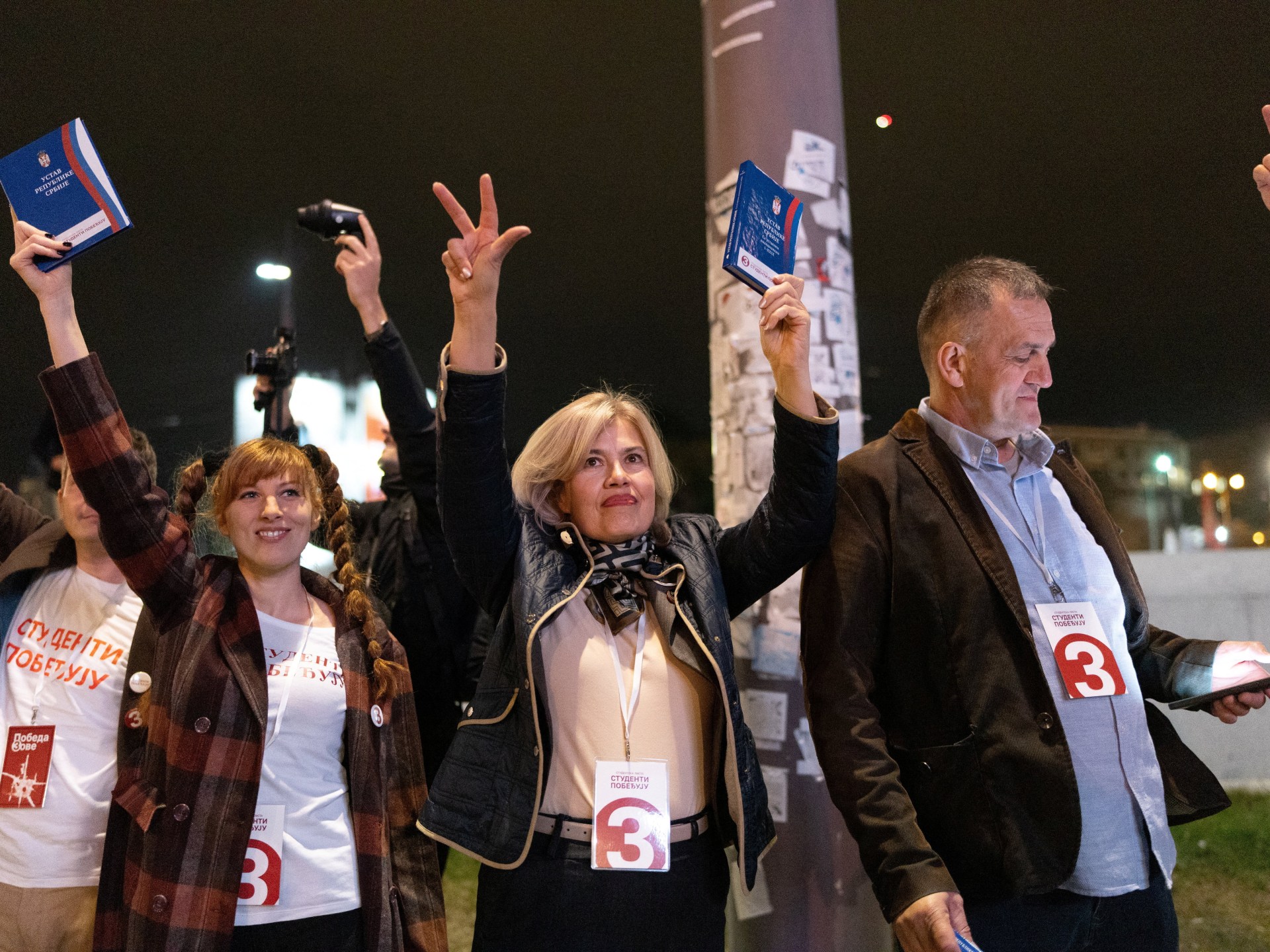
The main challenger is the student-backed Student List–Students Win (Studentska lista–Studenti pobeduju), which brings together candidates with little or no previous political experience, including academics, teachers and other professionals.
Advertisement
It is campaigning on restoring the rule of law, ending corruption and rebuilding institutions, rather than focusing on divisive questions such as Kosovo, European Union membership or relations with Russia.
“The political dynamic has changed from the ground up,” Jelena Vasiljevic, a senior research associate at the University of Belgrade’s Institute for Philosophy and Social Theory, told Al Jazeera.
Young people, long considered the country’s most politically disengaged group, have become the core of its largest social mobilisation in decades, she said.
Some opposition parties have chosen not to run and instead support the student list.
Others are contesting the election but face the prospect of failing to clear the threshold for parliament. As a result, many see the vote as not simply a contest between parties, but a referendum on whether the SNS system should continue.
Why does the election matter?
The outcome will shape whether Serbia attempts to reset institutions that critics say have been hollowed out by years of party control. The SNS rejects allegations of abuse and corruption, but its opponents and rights groups accuse it of putting pressure on independent media, electoral malpractice and using state resources to maintain power.
For Vasiljevic, turnout will be decisive. The SNS retains a disciplined core electorate, supported by a clientelist model of government, in which goods and services are exchanged for political support, she said. The student list must not only unite opposition-minded voters but also mobilise habitual non-voters and the undecided.
A student list breakthrough would also remake the opposition.
Vasiljevic said parliament could contain a large group of politically inexperienced and ideologically diverse student-backed politicians, while traditional opposition parties could be greatly reduced. The result may therefore start a wider reorganisation of Serbia’s political landscape, regardless of who forms the government.
But winning power would be only the beginning.
Srdan Majstorovic, chair of the governing board of the European Policy Centre, said a new government would face the far harder task of rebuilding a democratic system after what he described as 14 years of systematic damage to institutions, the rule of law and public trust, compounded by deep social divisions and rampant corruption.
After years of what critics call a captured-state system, he said, Serbia would need a broad reset of its democratic governance.
What’s at stake for foreign policy?
Serbia’s stalled EU path is a part of the backdrop.
Advertisement
Majstorovic said progress has been blocked by concerns over the rule of law, Serbia’s limited alignment with EU sanctions, including those against Russia, and the stalled normalisation process with Kosovo.
A change in government would not automatically transform foreign policy, he said.
The student movement has avoided detailed commitments, instead treading carefully to unite left, centre and right-leaning voters.

But Majstorovic said democratic reform, judicial independence, free media and tackling corruption could renew cooperation with Brussels and revive the accession process.
Igor Bandovic, director of the Belgrade Centre for Security Policy, said foreign policy remained the biggest unknown in the student list’s programme. Its candidates have taken a hard line on Kosovo, proposed reviewing agreements reached under EU auspices and floated a referendum on EU membership within six months of taking office. They have also signalled continuity in relations with Russia.
Bandovic said a new government would probably face more immediate domestic priorities and the constraints of the Balkans’ security environment. But a referendum on EU membership could slow or halt accession further. If the SNS stays in power, he expects further deterioration in relations with Brussels.
External actors are watching closely.
Bandovic said Moscow has offered explicit support to the government, portraying the protests as a Western-backed “colour revolution”. The United States Congress has voiced concern about democratic standards and Serbia’s ties with Russia, while the US administration has been more restrained.
China, which has commercial interests in Serbia, has avoided public comment but is likely to prefer continuity.
How does the election work?
Voters will elect all 250 members of the National Assembly in a single nationwide constituency.
One ballot is cast for a party or coalition list, with seats allocated proportionally.
Electoral lists generally need at least 3 percent of votes to enter parliament, while recognised minority lists are exempt from the threshold.
The list or coalition able to command a majority in the 250-seat assembly will form a government.
But with the result expected to be close and the campaign taking place amid deep mistrust, the legitimacy of the process may prove as consequential as the final seat count.
Polls will close on Sunday at 8pm local time. Preliminary results are expected about two hours later.
Related News
Ex-UK army chef jailed for ‘terror’-related offence
Nobel medicine prize honours US and German scientists for optogenetics work
Several hundred thousand people gather for Pope Leo’s mass in Paris