
United States President Donald Trump has stated on his social media platform Truth Social that he will not attack Iran before the November 3 midterm elections.
But he also told a Republican convention in September that the conflict “is going to end immediately after the elections”, and the US military has been sending more forces to the region in recent weeks.
Meanwhile, Iranian attacks on shipping in the Strait of Hormuz have surged to their highest level since the war began, with an Iranian official telling the Reuters news agency that Tehran has begun using different offensive tactics against vessels it considers to violate its restrictions.
As control of the Strait of Hormuz remains central to the US-Iran conflict, what military options does Trump have left, and what would each cost?
Al Jazeera spoke to military analysts to find out more:
Where does the US-Iran war stand?
Deadlocked.
The US and Israel first launched an attack on Iran on February 28, triggering counterattacks by Iran against US military assets and other infrastructure in Gulf countries and Jordan in the following months.
Iran also closed the Strait of Hormuz, which carried at least 20 percent of global crude and liquefied natural gas (LNG) supplies before the war, sending global energy markets into chaos. The price of Crude Oil – the global benchmark – rose from about $72 a barrel the day before the war began to a high of nearly $120 a barrel earlier this year. On Thursday, it was trading at about $104.
A June ceasefire agreement collapsed over control of the strait, and Washington has kept up a naval blockade on Iran’s southern ports while Iran has continued to attack ships attempting to pass through. Indirect talks via Pakistan and Qatar continue – along with the exchange of various proposals from each side – but Trump rejected Iran’s latest offer to reopen the strait last month.
Advertisement
The US has “enormous military capability that Iran can’t match”, but it has not delivered the outcomes Washington wants, Afzal Ashraf, a visiting fellow in international relations and security at Loughborough University in the United Kingdom and a former senior Royal Air Force officer who served in Iraq, told Al Jazeera.
What forces does the US have in the Middle East right now?
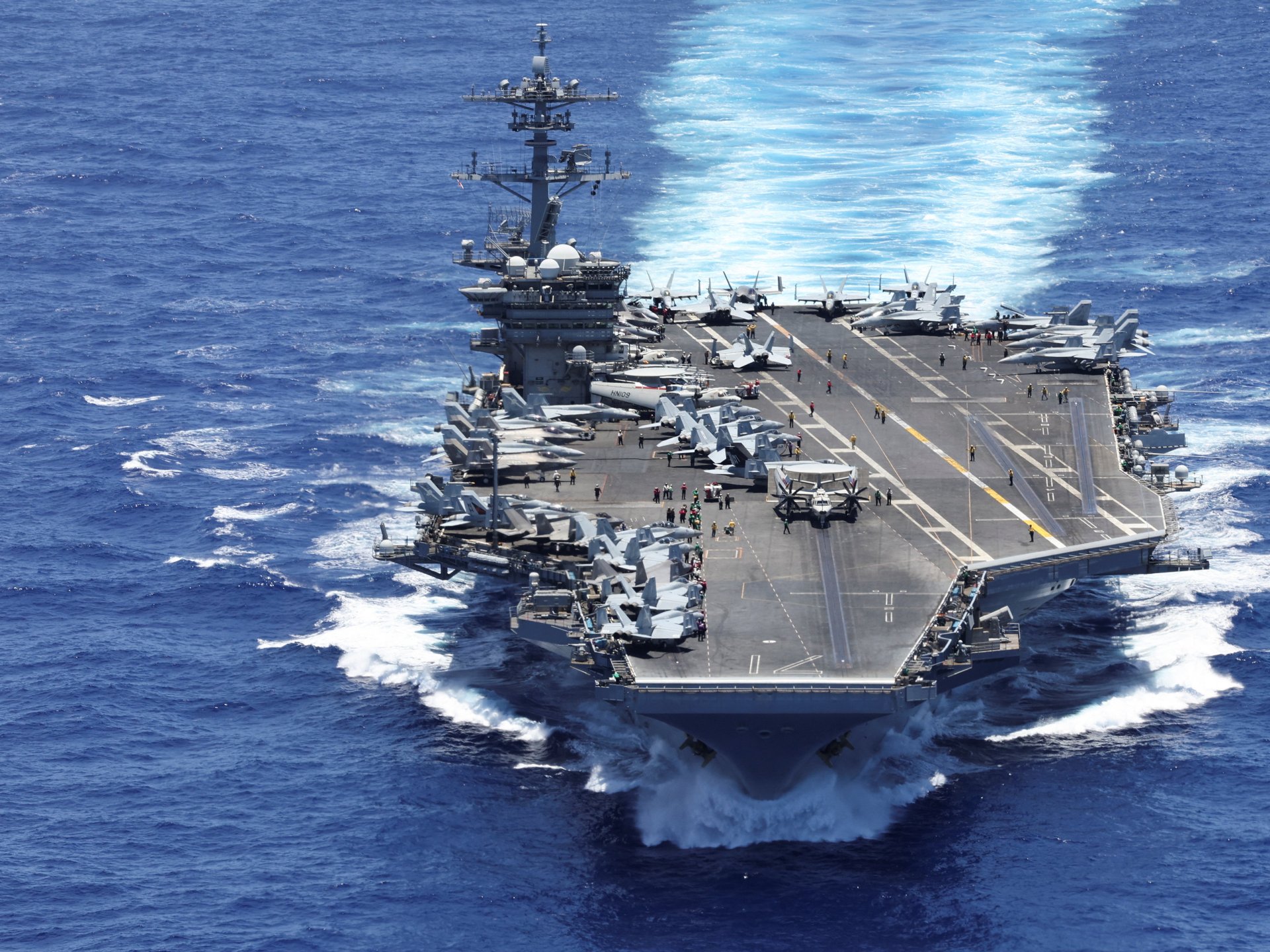
It has at least three aircraft carrier strike groups in the Gulf, or heading towards it.
The USS Theodore Roosevelt carrier strike group, carrying about 7,000 sailors and 2,000 Marines, is sailing to the Middle East to join the carriers already there.
The US also maintains a host of military assets and about 50,000 soldiers at different bases in Middle East countries.

What are Trump’s military options?
Keep squeezing Iran
The US naval blockade on Iranian ports and the naval escorts for commercial ships it has been providing through the Strait of Hormuz are the status quo, which it can continue. This is the most likely course of action, Patrick Bury, a senior associate professor at the University of Bath and former NATO research analyst, told Al Jazeera.
Before the war began, the Strait of Hormuz typically handled about 125 large commercial vessels a day, carrying an average of 17.1 million barrels of oil. This collapsed with the closure of the strait in March.
In recent weeks, with the help of US Navy escorts, Gulf oil flows through Hormuz – excluding Iran’s – had recovered to more than 81 percent of pre-war levels in September, according to maritime tracking firm Kpler. However, this has again reversed with Iran’s recent stepping up of attacks on ships in the strait. According to Kpler, only 2.9 million barrels of oil were carried through the waterway on October 11, the lowest level this month.
Washington is trying to maintain patrols and surveillance over the southwestern side of the strait, “enough to give ships some sort of protection to get out”, Bury said. Increasingly, drones do the grunt work of feeding intelligence and carrying out attacks, which is cheaper than keeping aircraft on long sorties. “I mean, it’s been somewhat effective,” he said, adding that high oil prices and crew bonuses mean “people are willing to take some risk.”
But now, Iran has changed tactics.
The UK Maritime Trade Operations (UKMTO) centre recorded 15 attacks on ships between October 6 and 14. Iran appears well prepared, Bury said, pointing to “the asymmetry of costs”. “By dint of its geography”, he explained, Iran still enjoys “a kind of easier starting point.”
Resume air and missile attacks
This is another option.
Advertisement
Trump has said it may be “possible” to ramp up bombing after the elections, but has not given details.
If the situation does escalate, however, Bury said he expects “further strikes in fairly limited packets” against targets on Iran’s coastline and further inland.
A new campaign could “actually achieve a lot less” than the hits earlier this year, Ashraf said, because Iran has adapted. “They have fewer, but they can conceal them better,” he said of its weapons.
The costs would also be high for the US, which has already depleted much of its stockpile of very expensive defensive missile systems.
Each relatively cheap Iranian drone or missile can force the US to fire “an interceptor of a million [dollars] or more”, he said, and “the United States is running out of missiles for its own defence.”
Furthermore, the US has fired more than 1,000 Tomahawk cruise missiles at Iran during the course of the war. Fully restoring its pre-war inventory could take until the end of 2030, according to estimates from the Center for Strategic and International Studies (CSIS).
Getting back to pre-war levels across key munitions would take “three to four years”, Bury said. “The problem is to solve that issue takes a long time, even when you press Go with the money.”
Tehran has also promised to hit back harder. Parliament Speaker Mohammad Bagher Ghalibaf declared last month that the era of “proportionate responses” was over.
Renewed attacks could also cost Washington access to some Gulf bases, Ashraf said.
Iran’s recent retaliation has targeted Jordan, Kuwait and Bahrain, sparing other Gulf states that Ashraf said may have reached an understanding with Tehran to stay out of the fighting.

Could a US ground operation against Iran be an option?
It is very unlikely, experts say.
One target could be Kharg Island, 26km (16 miles) off Iran’s coast, which handles about 90 percent of Iran’s exports.
Joseph Votel, a former US Central Command (CENTCOM) commander, has said 800 to 1,000 soldiers could take it, but they would be highly exposed to fire from the mainland, according to Reuters.
Ashraf said US forces could launch a limited invasion, likely preceded by electronic warfare to blind Iranian defences.
But Iran would then attack the island itself. “They don’t need very much in the way of targeting information, once they know the island is occupied by American forces,” he said. “And the appetite for casualties is low in a war that is already very unpopular.”
Iran could also hit oil infrastructure across the Gulf in return, he warned, concluding that the seizure of Kharg Island would be “the most irrational of the irrational decisions”.
Is a full-scale US invasion of Iran possible?
This is also highly unlikely.
Trump has largely ruled out a ground offensive, while Secretary of State Marco Rubio said in March that ground troops would not be needed to achieve the administration’s goals.
Advertisement
“I don’t think they’re going to do it anyway,” Bury said, adding, “I don’t think they can do it, to be honest with you.”
Why does the timing matter?
This war is deeply unpopular with the US public, and Trump is facing mid-term elections in a matter of weeks.
About 65 percent of Americans disapprove of Trump’s handling of it, according to the Pew Research Center.
Bury argued that the bigger question is whether the US can rebuild its military strength in a short amount of time. “Can America over the next few years regenerate that as a military power?” he said.
The task would outlast Trump’s term, he added, as “the next president would need to do the same thing anyway.”
The longer the war goes on, Ashraf warned, the greater the risk of unrest across the region, arguing that “we should not divorce the military options from the enormous capacity for political instability.”
On Sunday, Iran’s security chief Mohsen Rezaei said Tehran had been striking vessels in the US-backed shuttle through the Strait of Hormuz every night for weeks.
“You are smuggling,” he said, “but the strait is under Iran’s control.”
Related News

British police arrest UK-Iranian national over airbase incident
Morocco’s PJD: what has the party learned from its dramatic fall
US sanctions International Criminal Court itself in latest escalation