‘Cockroach stir stripped Modi’s carefully confected image’: Arundhati Roy
 06 October 2026
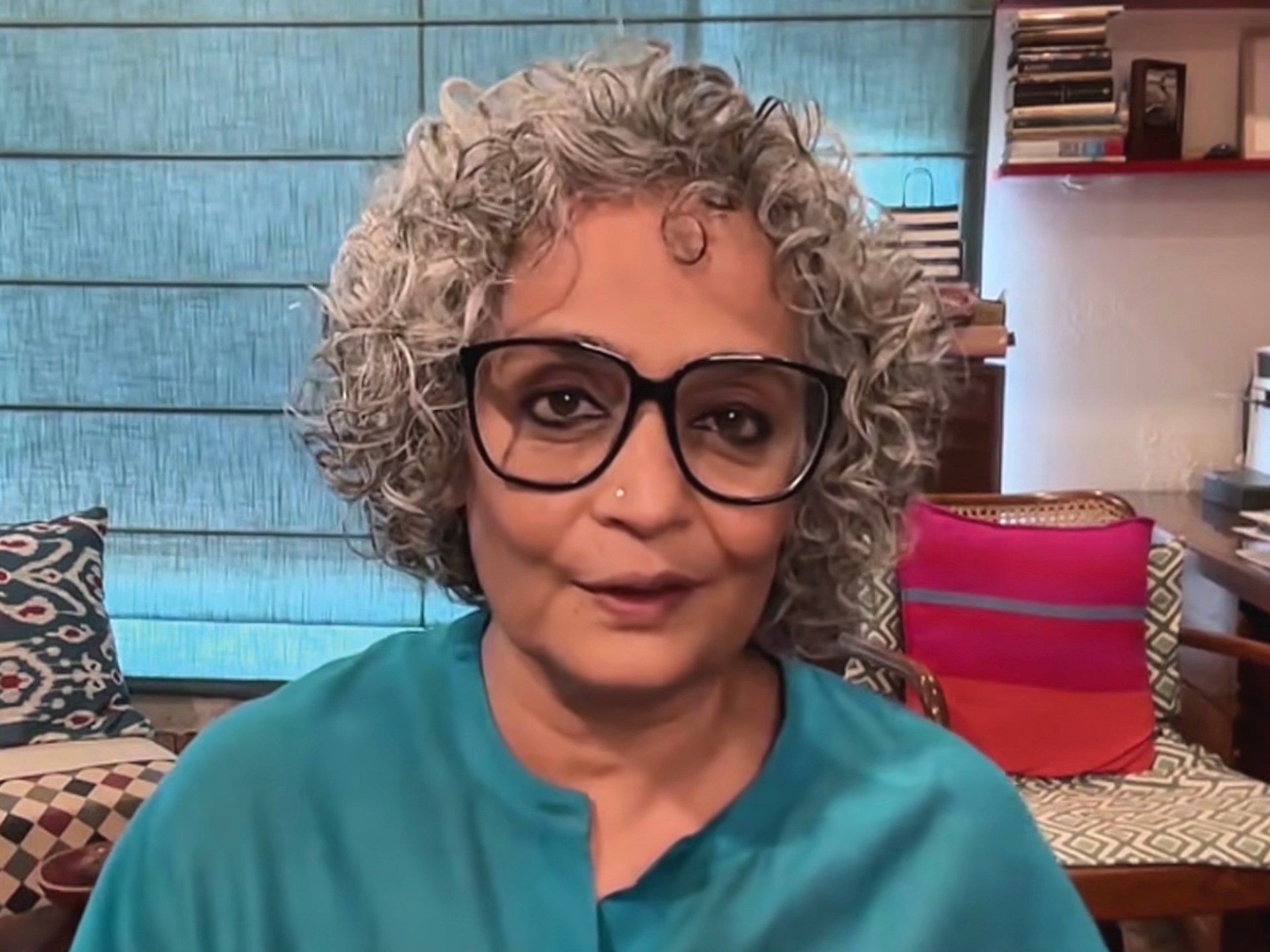

Award-winning Indian author Arundhati Roy says the ongoing protests against Prime Minister Narendra Modi’s government – mainly led by the satirical Cockroach Janta Party (CJP) – have stripped the right-wing Hindu nationalist leader of his “carefully confected image” propped up by India’s corporate-owned news channels and the governing Bharatiya Janata Party’s (BJP) control over social media.
Speaking with Al Jazeera’s Imran Khan on a range of issues, including the Gen Z-led antigovernment protests and allegations of vote theft against Modi’s government, the 64-year-old Booker Prize-winning writer says she hopes the political climate in the world’s most populous democracy is about to change.
- list 1 of 4‘If I didn’t write what moved me, it’d be like putting myself in prison’
- list 2 of 4Arundhati Roy ‘shocked’ by jury’s Gaza remarks, quits Berlin film festival
- list 3 of 4Why does India hate Arundhati Roy?
- list 4 of 4India’s ‘million mutinies’ are puncturing Modi’s aura of invincibility
end of list
“I do feel that something is boiling just under the surface. Something is going to happen,” she said. “The emperor has been called out, and he has lost his power.”
Here’s the interview Roy gave to Al Jazeera TV, edited for brevity.
Arundhati Roy, thank you for talking to Al Jazeera. Your debut novel won the prestigious Booker Prize. Since then, you have written acclaimed novels, hard-hitting political pieces, and collections of essays. How would you describe yourself: novelist, writer or a political activist? Or you don’t really think about those boundaries?
Roy: Well, I actually refrain from describing myself. I will leave that to other people because, you know, why should we describe ourselves? And categorise ourselves? That’s for other people to do.
One of the things that links all of your different aspects is this idea of satire. You are not chiefly a satirist, but in The God of Small Things and in The Ministry of Utmost Happiness, you have used satire to devastating effects. But it always seems to be about politics. Is that a deliberate choice?
Advertisement
Roy: I don’t think so. I mean, in some ways it depends on how you define what politics is, right? To me, even a fairy tale is in some ways political, but not let-me-hit-you-on-the-head-with-a-hammer or let-me-display-my-manifesto type of politics. I am not. From my books and from the way I grew up, possibly the answer to your question is that there is no difference between the personal and the public space.
Let’s talk about India and its political climate. You wrote about the CJP movement. Now that’s a grassroots movement fuelled by young people who took an insult – of being called a cockroach – and owned it. And you started your essay with when hope seemed lost, in came these young roaches riding in the rain, “the progeny of the unholy union between a judge and a joke”, which is a brilliant line. What drew you to this particular movement?
Roy: Well, ironically, as we speak at this moment, there is a huge crisis brewing, and the cockroaches are back, saying they are going to be protesting all over the country in a few days because of the scandal exposed by a particular newspaper about the fact that India’s elections are completely compromised – which is something we have known and have written about for years. But now there is a sort of concrete proof. So what drew me to it was this young people’s movement, which was full of joy and unusual humour – this new way of messaging with their [Instagram] reels and so on. It stripped Prime Minister Narendra Modi’s very carefully confected image.
Is this a miscalculation on his part? Not understanding social media, not understanding young people’s use of technology? And is it going to have an effect on India?
Roy: No, I don’t think it’s a misunderstanding at all. He and the BJP were the first to wade into the field of social media, so they have been there before anybody else. But I just think there were too many things happening, one after another. And somehow this movement sort of broke. It was the straw that broke the camel’s back. It started out with the fact that in 2024 [election], Modi did not win a full majority… There’s scandals around elections. There’s scandals around the paper leak in exams. There’s massive unemployment. So it all sort of came together to create this sort of irreverent but serious explosion.
India publicly says we are an economic success story, a climate leader. But what is modern India to you?
Roy: Well, modern India is a very rich country full of very, very, very poor people. I mean, I don’t think there are many countries in the world where people live in such deep poverty, in such conditions of humiliation. And it’s a shame for people to boast about this being a super economic power, because, as I keep saying, it’s super poor. Surely, there are extremely rich people, extremely rich industrialists who control everything, but very little of that seeps down to the poor… So it’s a scandal to call India a superpower or an economic force, when the people are so disempowered.
Advertisement
But a lot of these problems are often blamed on British colonialism. Do you have any sympathy with that argument?
Roy: Not any more. There was a point at which it was true. But now we are watching a government just making everything much worse, including the idea of freedom. I was talking to some young people yesterday, and I said that what [Mahatma] Gandhi and [Bhimrao] Ambedkar and Maulana [Abul Kalam] Azad and [Jawaharlal] Nehru and all these people said and wrote during the British times, today, nobody can say those things because they would be put into prison. There are a lot of people, a lot of students, a lot of activists, lawyers in and out of prison constantly. We are threatened with the antiterrorism law. This Independence Day, from the ramparts of the Red Fort, Modi said the most dangerous people are “dimaghi Naxal”, which means intellectual Maoists, which includes all of us, of course. And that we must be isolated and so on. So I think that’s a tired horse to whip now.
I am glad you mentioned the Maoists. Earlier this year, India declared the six-decade-long Maoist insurgency effectively over. But all the problems that the Naxalites were fighting for still remain, don’t they?
Roy: Well, yes. I mean, who are the Naxalites? What were they fighting? And the fact is that they keep declaring the end of it, but then it resurfaces somewhere, somehow, because you can’t just hold so many people down and devastate their lives. Some people are going to take things into their own hands. So we are used to these declarations, you know.
During the Congress rule, I think it was around 2012 or 2013, the prime minister [Manmohan Singh] had signed over the homelands of indigenous people to big infrastructure companies. There were many MoUs signed. And then they declared something called Operation Green Hunt. They flooded the forest with security forces. Village after village was being burned down; women were being raped, villagers could not live in their houses for fear that they would be surrounded and burned down. And the media was calling all these poor people “terrorists”… What do you do when a thousand security personnel come and surround your house in the middle of the jungle? And they were brutally put down.
People who sort of crumbled and quivered under the Modi regime are suddenly finding a couple of vertebra, if not a spine, and it's creating little spaces.
You have always rejected the idea that writers should remain apolitical. Your stance on Kashmir, calling it not an integral part of India, comes to mind. I want to talk to you about the personal cost of being so forthright. How do you deal with that?
Roy: Well, after 2019, one cannot say that because it has been made an integral part of India. And that section of the Indian Constitution has been read down. But honestly, I am not a person who makes rules for writers and says they should be political or shouldn’t be or how they should be. I don’t have a prescription for that. I just know that if I didn’t write what I am really moved to write, then it would be like putting myself into prison before they put me into prison.
Advertisement
As I said in my memoir, it’s like a dance on a mined dance floor. One doesn’t know when the bombs will go off. But I do what I have to do, and I’m not the only person. There are so many people who stand up so bravely and who have paid huge prices. For what? For doing or saying what they believe in. So I don’t want to make a martyr of myself here.
But is there an intellectual movement in India that has a strong voice that is being listened to, or is it being drowned out by the shoutings of the politics?
Roy: Actually, that movement has always existed. It has been extremely strong, even though since 2014, it has been hammered down by these 24-hour television news channels owned by various corporations who try and shout everyone down. So, every time Modi wins an election, he comes out and tries to demonise us.
Is India still the world’s largest democracy – something to be celebrated? Or do you think it’s a democracy in sham?
Roy: This is exactly where the axe has fallen. The Modi government reconstituted the way in which the election commission is chosen. He appointed a chief election commissioner. The opposition [parties] and the chief justice normally had a voice in selecting the chief election commissioner, but they don’t any more. Now, there has been an absolute scandal about how the elections have been conducted. From the 2024 elections to the [regional] elections in Maharashtra, Haryana, West Bengal, Bihar, and Goa. You are finding a situation where thousands of electoral officers who are supposed to have the voter data with them have been locked out, and it’s all been controlled from New Delhi. And voters, especially minority voters or supposedly BJP-unfriendly voters, have been simply not allowed to vote. And I am talking about the numbers in the millions… We always say that elections are not proof of democracy. You need a constitution, you need other institutions, you need checks and balances. All of those were hollowed out. Now the election itself is impugned. And you will watch and see in the next few months, there is going to be big trouble in this country as we inch closer to the 2029 election.
So where are you landing right now? Is there hope for democracy, true democracy in the way that you see it in India?
Roy: Well, one of my collections of essays was dedicated to those who have learned to divorce hope from reason. I will always be hopeful that something will change here. And I do feel that something is boiling just under the surface. Something is going to happen. How that plays out, I can’t say because we are up against a pretty ruthless set of people.
What you’re seeing in India, after this “cockroach” uprising, is that everybody has been put on notice. So all the people who sort of crumbled and quivered under the Modi regime are suddenly finding a couple of vertebrae, if not a spine, and it’s creating little spaces. There’s a lot of protests in all kinds of places. As I said, one of the biggest things that’s happened is that the emperor has been called out, and he has lost his power. He is not even showing up publicly. His home minister is ducking and diving. Neither of them showed up even once for the entire [monsoon] session of Parliament last time when the cockroach movement was on. So there’s something changing. And I think they are running scared. Let’s see what happens. Certainly, I am more optimistic now than I was three months ago.
Before this interview, I was speaking to another writer friend of mine who is based in Israel. He said one of the questions you must ask Miss Roy is the fact that artificial intelligence (AI) and the weaponisation of social media is fuelling anti-democratic movements and government authoritarianism. Where do you land on that?
Advertisement
Roy: I think it’s the end. And I think it’s privatisation of human endeavour and civilisation. How it works in defence and in politics and in personal life, and the shiny gifts it offers with the darkness behind them, is something we need to think about. It’s something I am writing about.
Is there anything about modern India, about the world, that gives you hope?
Roy: Well, absolutely. As I have said, India is a country with such a deep culture of resistance, of intellectual thinking, of unusual thinking, of unusual kinds of dissent. So how can you not have hope? It’s a wonderful thing to see.
Related News
Iraq probes drone strikes on Saudi Arabia, shuts three crossings to Iran
Russia’s drones threaten Kyiv-bound Western officials as war effort stalls

Moscow attacked by more than 1,000 Ukrainian drones