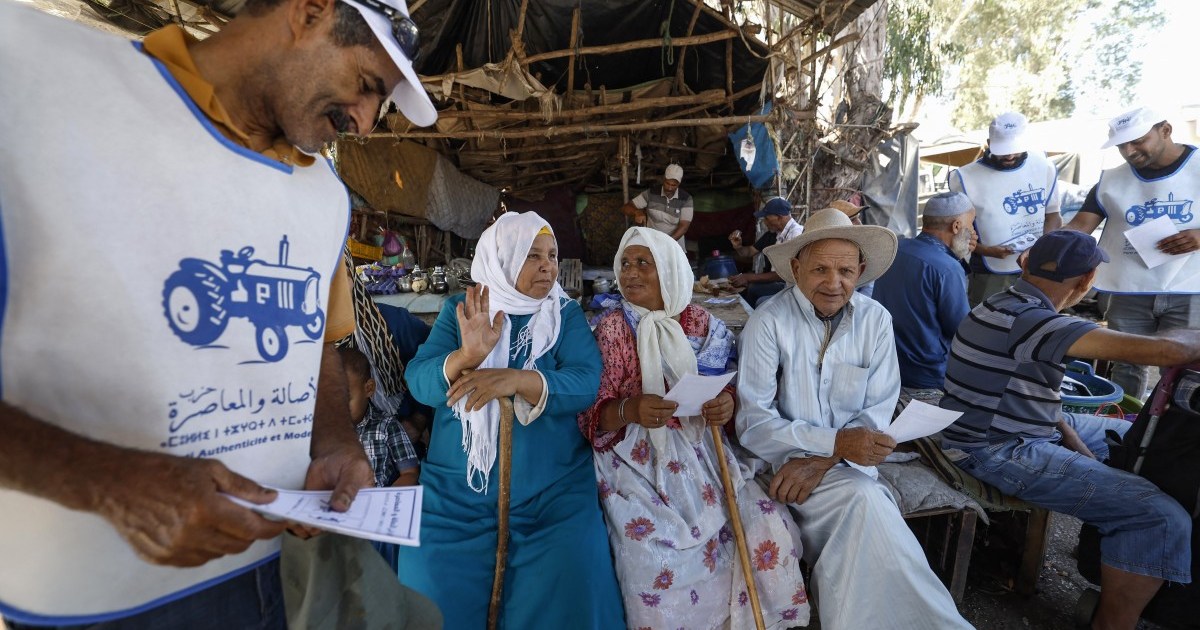

Rabat, Morocco – Morocco’s parliamentary election campaign began on September 10, with 27 political parties competing for 395 seats in the House of Representatives. More than 15.8 million voters are registered for the September 23 vote, which will determine Parliament’s composition and play a central role in forming the next government.
But beyond the competition between parties, the election raises a deeper question: whether citizens believe the political system can respond to the problems shaping their daily lives.
That question is particularly important for younger Moroccans. An Afrobarometer survey published in March found that roughly a third of Moroccans aged 18 to 35 expressed trust in Parliament, the head of government and political parties. At the same time, young people were more likely than older Moroccans to post political content on social media and participate in demonstrations.
That does not necessarily mean young Moroccans are disengaged. The more important issue is whether they see electoral politics as an effective way of addressing the problems they face.
An election within a distinctive system
Morocco’s electoral politics operate within the constitutional framework established in 2011. The constitution defines Morocco as a constitutional, democratic, parliamentary and social monarchy and establishes a separation and balance of powers while preserving the monarchy’s central institutional role.
Under Article 47, the king appoints the head of government from the political party that comes first in elections to the House of Representatives. The king also presides over the Council of Ministers, while the government exercises executive power and Parliament exercises legislative and oversight functions.
Advertisement
Winning the largest number of seats, therefore, matters for forming the government, but the parliamentary result does not by itself determine the full distribution of political power.
A younger electorate, an older political system
The age profile of the electorate makes the question of political engagement more consequential.
![Women walk past electoral symbols used by political parties in Morocco’s legislative election in Rabat on September 14, 2026 [Abdel Majid BZIOUAT / AFP]](https://www.aljazeera.com/wp-content/uploads/2026/09/AFP__20260914__C8B29EH__v2__MidRes__TopshotMoroccoPoliticsVote-1789565331.jpg?w=770&resize=770%2C513&quality=80)
Official figures show that voters aged 18 to 24 account for 4 percent of those registered, while people aged 60 and above account for 29 percent. But those figures describe the electoral roll, not turnout, but they show how heavily the registered electorate is weighted towards older citizens.
Morocco also faces a substantial youth employment problem. The IMF estimates that unemployment stood at 13 percent in 2025, while unemployment among 15-to-24-year-olds reached 37.3 percent. It estimates that 25.2 percent of young people were not in employment, education or training in the third quarter of 2025. The IMF also points to skills mismatches, limited private-sector dynamism and pronounced gender disparities in labour-market participation.
For young people struggling to enter the labour market, promises about growth, jobs and purchasing power are not abstract campaign issues. They are measures of whether the political system can deliver opportunities visible in everyday life.
When economic frustration becomes political
Those pressures have also surfaced outside formal electoral politics.
In late July, roughly 60,000 people entered the autonomous Spanish city of Ceuta from Morocco in the largest such surge in recent history, according to the news agency Reuters. The report linked the crossings to economic hardship, social unrest and misinformation circulating on social media, alongside migration aspirations and false expectations about Spanish court rulings.
While this episode may not have been a direct measure of electoral opinion or evidence of a single political cause, it illustrated how economic expectations, migration aspirations and perceptions of opportunity can intersect.
That provides a wider context for the election’s economic debate: whether Morocco’s recent growth and major development projects are producing opportunities that younger citizens can see in their own lives.
The economy has been growing strongly. The IMF estimates that real GDP grew by 4.9 percent in 2025 and projects growth of 4.4 percent in 2026. Yet high unemployment, particularly among young people, has remained a significant challenge.
Advertisement
Strong growth has not translated into sufficient job creation.
What the parties are promising
Employment and purchasing power feature prominently in the programmes of the three parties that have formed the governing coalition since 2021: the National Rally of Independents (RNI), the Authenticity and Modernity Party (PAM) and Istiqlal.
The RNI’s 2026–2031 programme promises one million jobs and a gradual increase in the minimum wage to 5,000 dirhams (about $530) per month. PAM has pledged at least one million jobs and put the cost of its five-year programme at 350 billion dirhams ($37.1bn). Istiqlal has placed purchasing power and public services at the centre of its campaign, alongside proposals on healthcare, housing, employment, water management and food security.
The programmes differ in emphasis, but their common focus is revealing: Employment, household purchasing power and public services have become central measures of political credibility.
The challenge for the next government will be turning investment and growth into more productive jobs and higher living standards.
The PJD tries to recover
The Justice and Development Party (PJD), led by former head of government Abdelilah Benkirane, enters the election seeking to rebuild support after its dramatic losses in 2021.

The party fell from 125 seats in the previous parliament to 13. In the September 2021 election, the RNI won 102 seats, followed by PAM with 87 and Istiqlal with 81. The three parties subsequently formed the governing coalition.
The PJD has presented a programme built around five axes and 467 measures covering institutional, economic, social and foreign policy. The programme emphasises concrete reforms and measures rather than extensive numerical targets, covering areas including public services, employment, purchasing power and institutional reform.
Its return adds another dimension to the contest as the governing parties defend their record since 2021 and the PJD attempts to rebuild its electoral base.
What the election will test
The election will test whether Morocco’s political system can maintain a credible connection between an ambitious development agenda and the expectations of citizens who want to see its benefits in everyday life.
For younger Moroccans, the relatively low trust in political institutions alongside very high youth unemployment points to traditional electoral politics facing competition from other forms of political expression at a time when employment and living standards are increasingly important.
At a time when employment and economic standards are central to political party platforms, economic researcher Nouh El Harmouzi argues that the challenge extends beyond what parties can promise during an election campaign.
“Morocco’s economic problems are fundamentally structural and cannot be resolved through short-term electoral promises.”
Advertisement
Related News
Turkiye, Somalia forces frees cargo vessel hijacked by pirates
Israel’s Ben-Gvir lauds harsh conditions for Palestinian female prisoners
Marco Rubio says US seeks more economic and security ties in Latin America