Leaders of Scotland, Wales, Northern Ireland unite for self-determination
 14 September 2026
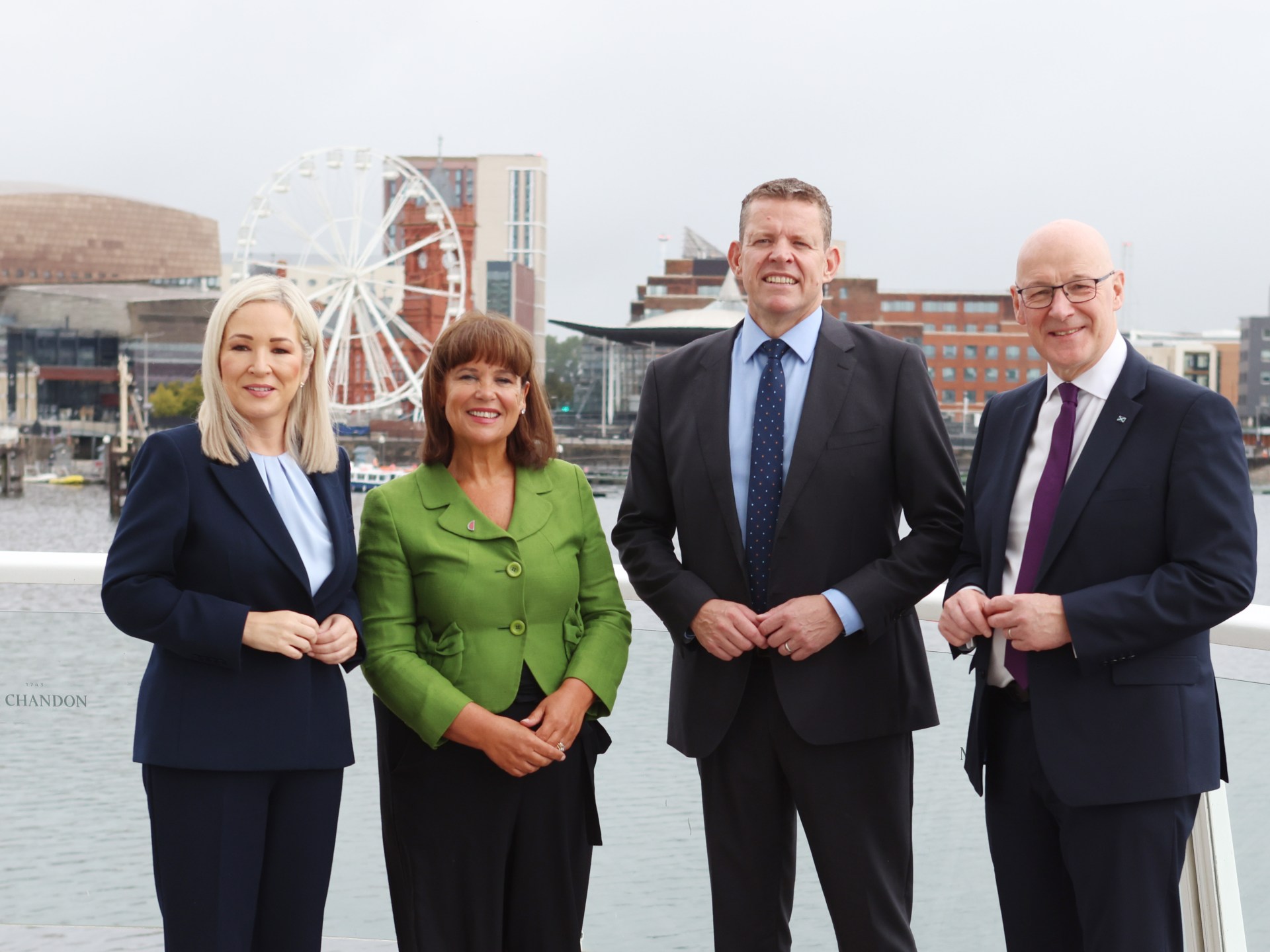

The leaders of the main political parties in Scotland, Wales and Northern Ireland have declared their right to “self determination” in a joint agreement signed at a rare meeting in the Welsh capital, Cardiff.
All three parties – the Scottish National Party (SNP), Plaid Cymru in Wales and the pro-Irish unity Sinn Fein in Northern Ireland – want greater autonomy and eventually independence from the UK, but have different views on issues such as referendums and timelines.
- list 1 of 3‘War on terror’: How 9/11 changed the language of conflict
- list 2 of 39/11 at 25: How the ‘War on Terror’ helped mainstream Europe’s far right
- list 3 of 3Trump says a unified Ireland would be ‘fantastic’ during Irish visit
end of list
The SNP’s John Swinney, Sinn Fein’s Michelle O’Neill and Plaid Cymru’s Rhun ap Iorwerth attended in their capacity as party leaders, rather than as officials in their respective governments.
Laura McAllister from Cardiff University told Al Jazeera that the wording of the agreement was “deliberately” couched in the broader “constitutional language of self-determination”.
“This is the first time that the nations of the United Kingdom are attempting to drive the constitutional question,” she said. “They also covered some of the more practical policy areas where they may wish to share stances, such as renewable energy, relationships with Europe, economic development.”
What does the three-party joint agreement say exactly?
“Our nations have the right to self-determination. No Westminster government has the right to block democracy or undermine the principle that our people will decide their own future,” they said on Monday, referring to the UK-wide parliament in London.
“For the first time ever, people across these islands have first ministers in Scotland, in Wales and in the North of Ireland who are all committed to independence from the United Kingdom,” the memorandum of understanding continued.
Advertisement
“The future of our nations belongs in the European Union … For people watching across these islands – for people watching around the world – there could be no clearer sign that Westminster’s time is coming to an end.
“Momentum is behind our movements; we believe that constitutional change is coming,” the agreement said.
What has the UK PM said on pro-independence movements?
Sinn Fein wants Northern Ireland to leave the United Kingdom and join a united Ireland.
The forum happened after US President Donald Trump weighed in on a potential breakup of the UK. He told reporters during a visit to Ireland on Saturday. “Now the UK will have something to say about it … but I think it would be a great thing,” he added.
Indeed, Prime Minister Andy Burnham had something to say on Trump’s comment – that his position on Irish unification remained unchanged.
On August 27, Britain’s newly-elected leader said a referendum on Northern Ireland leaving the UK was “off the table”.
Burnham also dashed hopes among some for a second vote on Scottish independence, saying recently that another referendum was “off limits”.
Constitutionally, the UK has four constituent countries: England, Wales, Scotland, and Northern Ireland. Within these four jurisdictions there are three legal systems:
- England and Wales have a combined legal system.
- Scotland operates as a distinct legal system based on Scots law.
- Northern Ireland has its own distinct, independent legal system based on English common law and its own legislation.
Power is shared in a system known as devolution, unlike in the federal system of the United States or Germany. It means power is not constitutionally divided on an equal basis between a central government and the four nations.
Elected institutions have some powers with their own legislatures and governments, but defence and foreign affairs, among other issues, remain controlled by London.
Crucially, none of the states has the right to unilaterally leave the UK.
Scotland held an independence referendum in 2014 after Westminster gave the green light. Independence was rejected by 55 percent to 45 percent. Wales similarly has no existing legal mechanism allowing the Senedd (Welsh parliament) to call an independence referendum on its own.
For Northern Ireland, the rules are different. Under the terms of the 1998 Good Friday Agreement, the British government must call a referendum if the UK secretary for Northern Ireland believes it is “likely” that a majority would vote for a united Ireland.
Advertisement
Has the mood for greater autonomy grown?
Recent polling points to significant, though varying, support for constitutional change.
A Survation poll found 47 percent backing Scottish independence, while a University of Liverpool survey found 36 percent in Northern Ireland would vote for Irish reunification.
In Wales, a Survation poll put support for independence at 32 percent.
“Plaid Cymru was elected with heavy emphasis on avoiding the issue of independence,” explained McAllister. “The situation in Scotland is very different” and “fundamentally” so in Northern Ireland and the Irish Republic, she added, describing Monday’s meeting as “very tactical and very strategic”.
Related News
Vanuatu pushes France to accept ICJ jurisdiction in Pacific islands dispute

CCTV captures terrifying mudslide engulfing Nepal-China border

‘Attacks will be fully autonomous’: Russia, Ukraine race towards AI warfare