
Live on television, President Donald Trump, sitting in the Oval Office, told reporters on Wednesday that the United States has been sneaking millions of barrels of oil out of the Strait of Hormuz despite tensions defying Iran’s restrictions on transit through the waterway.
That is why, Trump claimed, oil prices have hovered around $90 a barrel in recent days, instead of staying above $100 a barrel as was the case in the early weeks of the US-Israel war on Iran.
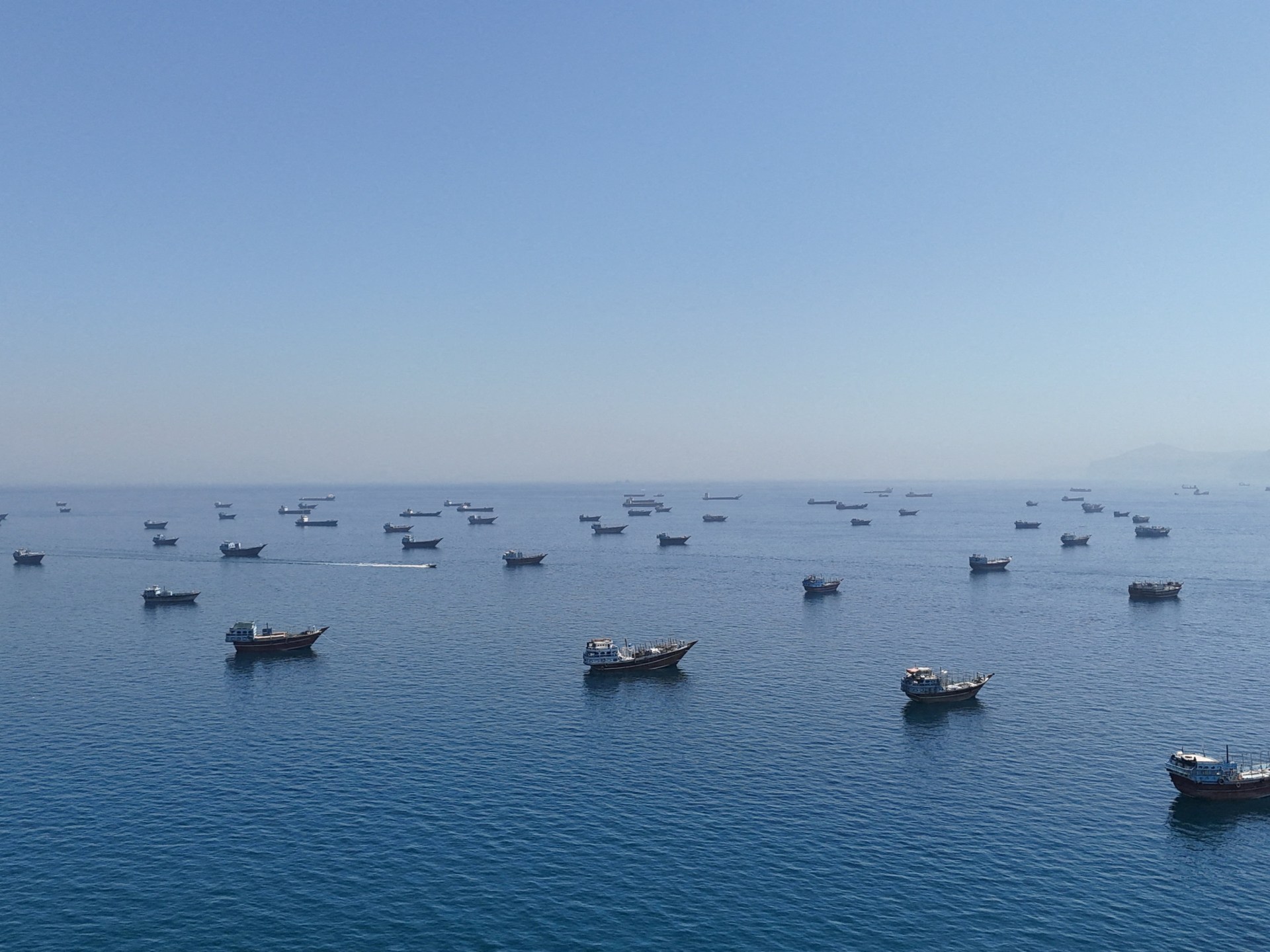
The narrow, strategic waterway — which hosts 20 percent of the world’s energy flows — has largely been shut since early March after the US and Israel attacked Tehran.
In early March, Iran said it would not allow passage to any ships through the strait. Then it agreed to allow limited ships from select “friendly” countries through, on the condition that they negotiated their transit with Iran. On April 13, five days after agreeing to a ceasefire with Tehran, the US imposed a naval blockade on Iranian ships and ports.
With the US naval blockade on one side and the Iranian authorities on the other, only a few ships have been able to cross the Strait of Hormuz.
Against that backdrop, has the US indeed been able to get ships carrying millions of barrels of oil out of the strait without Iran’s permission?

What has Trump claimed?
On Wednesday, at the White House, Trump said the US has “been taking out millions of barrels of oil. Nobody knows it”.
Advertisement
He added that Iran was blindsided by the US moves. “We took out the other night 22 ships late at night with no lights, because they don’t have any radar, because we blasted the crap out of it [Iran’s strategic infrastructure].”
The president said he was choosing to talk about this so-called secret mission because Tehran had figured it out.
Later, he repeated the claim on his Truth Social platform, saying he directed the US military last month to undertake the “secret mission to support Oil Tankers and other Commercial Ships through the Strait of Hormuz”.
He added that this effort has led to the movement of 100 million barrels of oil, transiting the strait.
“More than 200 Commercial Ships have safely traveled through the Strait. This wildly successful effort is because the UNITED STATES of AMERICA CONTROLS the Strait of Hormuz — NOT Iran,” Trump wrote.
“Their military is defeated, and their economy is lost. It’s over for Iran!”
However, Trump’s energy secretary, Chris Wright, told a congressional hearing the same day that he was not aware of the US taking millions of barrels of oil out through the Strait of Hormuz, though he added that the military helped to get some oil out of the narrow passage.
Wright clarified that the vessels making it through the strait were not Iranian.
The Gulf countries, including Saudi Arabia, the United Arab Emirates and Qatar, use the waterway to export supplies.

Did the US manage to sneak past Iran?
Let us put Trump’s claim in context. In his social media post, the president claimed the military pushed out 100 million barrels of oil through the Strait of Hormuz.
Before the war broke out in the Gulf waters, about 140 vessels, including oil tankers, transited the chokepoint passage daily, sandwiched between the coasts of Iran and Oman. The passage hosted about 20 million barrels per day before tensions.
The president’s claim of 100 million barrels of oil is roughly equal to five days of pre-war output — compared with some two billion barrels that should have transited through the Strait of Hormuz over the duration of the war, if not for the ongoing conflict.
But even five days of pre-war maritime traffic through the strait would amount to about 700 ships.
And while, as Trump claimed, vessels being guided by the US military in the waterway have at times turned off their transponders, there is no evidence so far that the volume of traffic passing through the strait during the war is enough to support his claims.
Shipping tracking and intelligence companies offer differing numbers of vessels that crossed the strait since tensions began. That is because their criteria differ on what constitutes a transit.
Advertisement
Windward recorded nearly 80 commercial ships leaving the Gulf in the last five weeks; Lloyd’s List estimates 142 vessels have left the waters since March; and Kpler puts that number at its highest, recording 264 ship transits.
Even Kpler’s figure falls well short of the level of maritime traffic that, before the war, would have amounted to 100 million barrels of oil passing through the Strait of Hormuz.
Many of the ships that have passed through the strait have transited with Iranian authorisation — paying tolls to the Islamic Revolutionary Guard Corps (IRGC) — rather than through a US scheme that kept Tehran in the dark.

Who controls the Strait of Hormuz?
The US military’s role in aiding ships is not clear. Tim Hawkins, a Central Command (CENTCOM) spokesperson, said in a statement that the forces “communicate and coordinate” with commercial ships in the area without delving into details.
In the face of the US’s economically punishing naval blockade against Iran’s ports, the IRGC maintains a firm grip over the strategic waterway.
Countries friendly to Tehran — like Pakistan, India and Russia — have negotiated a transit for some of their vessels, carrying essential energy supplies. Some ships also reportedly made payments in yuan, the Chinese currency, to secure a passage.
Iran has come around to see the Strait of Hormuz as an economic lifeline in post-war times, and has introduced insurance-like charges to authorise transits. The US has opposed this imposition, and critics have said it is essentially an illegal toll booth in an international waterway.
Tehran says the Strait of Hormuz is not in international waters, but shared exclusively between Iran and Oman.
“Iran appears to be attempting to convert its geographic leverage into financial leverage,” said Oscar Seikaly, CEO of NSI Insurance Group, based in Florida, US. “The underlying idea is old: Control the chokepoint, then charge for access.”
As Al Jazeera has reported earlier, Seikaly too argued that it works out cheaper — in the long run — for ships to pay Iran a fee rather than stay stranded in the strait.
Seikaly said a very large crude carrier — also known as a VLCC tanker — would cost nearly $100,000 per day, and a 100-day delay would amount to $10m.
“That is before you even account for cargo financing, insurance complications, crew, bunkers, security, contractual penalties,” he told Al Jazeera. “In a stressed market, the real economic loss can be materially higher.”
However, paying Iran is not an option many ships opt for because “it can create sanctions exposure, legal risk, reputational risk, and insurance problems”, Seikaly said.
Related News
Belgian NGO urges India to arrest Israeli reservist over alleged war crimes
Pakistan military helicopter crashes in Kashmir, all on board killed
China’s Xi Jinping arrives in North Korea on rare state visit