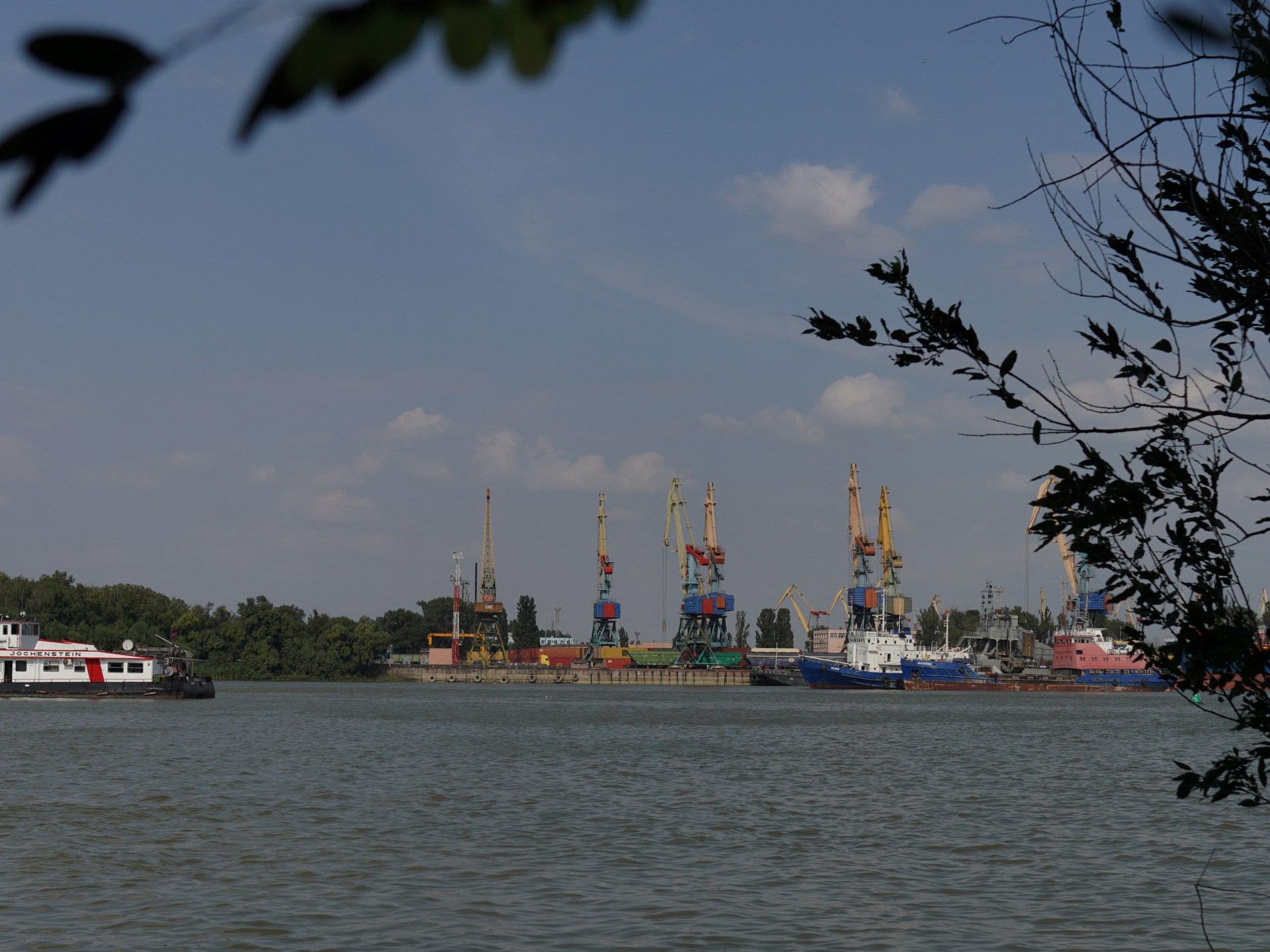

A Russian attack has damaged port infrastructure in Ukraine’s Danube River port city of Izmail, a vital grain-export hub, while Russian authorities said they had downed four Ukrainian drones headed towards Moscow, as peace efforts remain stalled and both sides continue reciprocal attacks.
Izmail, in the Odesa region, is a frequently targeted logistical centre and was hit in the early hours of Tuesday. It is Ukraine’s largest port on the Danube.
- list 1 of 3Zelenskyy vows response after Russian strike kills 24 in Kyiv
- list 2 of 3Ukrainian drone attacks on Russia kill at least five
- list 3 of 3Russian drone hits Chinese ship off Ukraine before Putin meets Xi Jinping
end of list
According to the Odesa Regional State Administration, Ukrainian air defence weapons destroyed almost all the Russian UAVs over open territory outside the populated areas of the Izmail district, limiting risks to civilians. The attack lasted from about 1am to 3am (22:00 to 00:00 GMT), with firefighters battling a blaze in a building with blown-out windows.
This followed another Russian attack on port infrastructure in Izmail on the night of May 2.
In Kharkiv, two people were rescued, and one may remain trapped under the rubble after a Russian drone attack, Mayor Ihor Terekhov said on Telegram.
In Russia, Moscow Mayor Sergei Sobyanin said on Telegram that four drones heading for the capital had been downed and emergency services deployed. This follows a heavy Ukrainian drone attack on Moscow over the weekend, after which Russia struck Odesa and Dnipro, damaging residential buildings and injuring dozens.
In the Russian Kursk region bordering Ukraine, a woman was killed and two people were wounded in a Ukrainian attack on Monday evening, the Kursk operational headquarters said on Telegram.
Advertisement
Russia’s southern Rostov region and Yaroslavl, northeast of Moscow, which hosts oil refining infrastructure, also reported drone attacks. Yaroslavl Governor Mikhail Yevrayev warned drivers heading towards Moscow of drone threats.
The fighting comes despite a US-brokered three-day ceasefire agreed by Russia and Ukraine earlier this month, which included a planned 1,000-for-1,000 prisoner swap. Both sides accused each other of violations during and after the truce.
Meanwhile, Russian President Vladimir Putin is set to arrive in Beijing on Tuesday evening for a two-day state visit to meet Chinese President Xi Jinping, marking the 25th anniversary of the 2001 Sino-Russian Treaty of Friendship and focusing on energy ties, including the proposed Power of Siberia 2 gas pipeline.
The Russian Ministry of Defence announced that Russian armed forces are conducting an exercise from 19-21 May to prepare for the deployment of nuclear forces. More than 64,000 personnel and 7,800 pieces of military equipment will be involved in the drills, which will see ballistic and cruise missiles launched from test sites on Russian territory, the ministry said.
Ukrainian President Volodymyr Zelenskyy said Russian refining capacity has dropped by 10 percent in recent months due to drone and missile attacks, adding: “Putin has, of course, built a war chest, but certainly not enough to fight indefinitely.”