
Tehran, Iran – Foreign Minister Abbas Araghchi says Iran remains ready to resume direct military conflict with the United States, if negotiations fail to produce acceptable results.
In a stream of state-orchestrated messaging to both domestic and foreign audiences, Araghchi also warned that despite the damage the US-Israel war on Iran has done to the region, it is also impacting ordinary American households.
US energy and inflation costs have increased significantly since the conflict began on February 28, resulting in the effective closure of the Strait of Hormuz, where around a fifth of the world’s oil and gas is normally shipped.
“Americans are told that they must absorb rocketing costs of war of choice on Iran,” Araghchi wrote on X, coupled with an image of rising yields on US Treasury bonds.
“Put aside gas price hike and stock market bubble, real pain begins when US debt and mortgage rates start to jump. Auto loan delinquencies are already at 30+-year high.”
Inflation in the US
Araghchi’s message to Americans was essentially that inflation in the US will continue so long as the threat of war is maintained, predicting that the pressure will soon translate into higher borrowing costs, leading to a potential recession.
Mohammad Bagher Ghalibaf, the parliament speaker who led the first round of talks with the US in April, also highlighted the financial cost of the war for Americans, albeit with a more mocking tone.
“So, you’re funding [Pete] Hegseth the failed TV host at rates unheard of since 2007, so he can cosplay as Secretary of War in our backyard in Hormuz?” Ghalibaf posted on X on Thursday, referring to the US defense secretary.
Advertisement
“You know what’s crazier than $39 trillion in debt? Paying a pre-GFC [global financial crisis] premium to fund a LARP [live-action role-playing] and all you’ll get is a brand new GFC,” the post said.
The comments followed the US government’s auction on Wednesday of $25bn worth of 30-year bonds at a five percent yield, which has not been done in nearly two decades.
On Friday, benchmark 10-year Treasury yields hit their highest in about a year, with traders anticipating potential interest rate increases by the Federal Reserve to counter rising inflation on global energy markets caused by the Hormuz blockade.
A key sticking point in negotiations between the US and Iran has been the future of the strait. Iranian officials insist that any agreement with Washington must grant Tehran sovereignty over the waterway – a demand rejected by other Gulf states which have highlighted its international status.
Ebrahim Azizi, the head of the Iranian parliament’s National Security Commission, said on Saturday that Tehran has “prepared a professional mechanism to manage traffic in the Strait of Hormuz along a designated route, which will be unveiled soon”.
“In this process, only commercial vessels and parties cooperating with Iran will benefit from it,” he said, adding that vessels would have to pay fees, and that supporters of Washington’s ‘Project Freedom’ would be denied access.
Iran’s economic hit
The mounting costs for Iranian households have been even more significant, with official figures indicating that food inflation hit 115 percent in the first Persian calendar month, ending in late April, with many staples – such as cooking oil, rice and chicken – tripling in price over the past year.
In recent weeks, prices for food, medicine, electronics, cars and petrochemical products have risen to new heights.
The general impact on the Iranian economy appears evident with the rial at about 1.8 million to the US dollar in the open market in Tehran on Saturday. That is close to the all-time low registered earlier this month.

Iran has said that a lack of trust with the United States has been a major obstacle to achieving tangible results during negotiations, as seen last month when talks in Islamabad failed to end the war.
But in light of Donald Trump’s visit to China, and meetings with President Xi Jinping, Araghchi told reporters at a BRICS meeting in New Delhi on Friday that Tehran welcomes mediation from Beijing.
Advertisement
Guns on television and in the streets
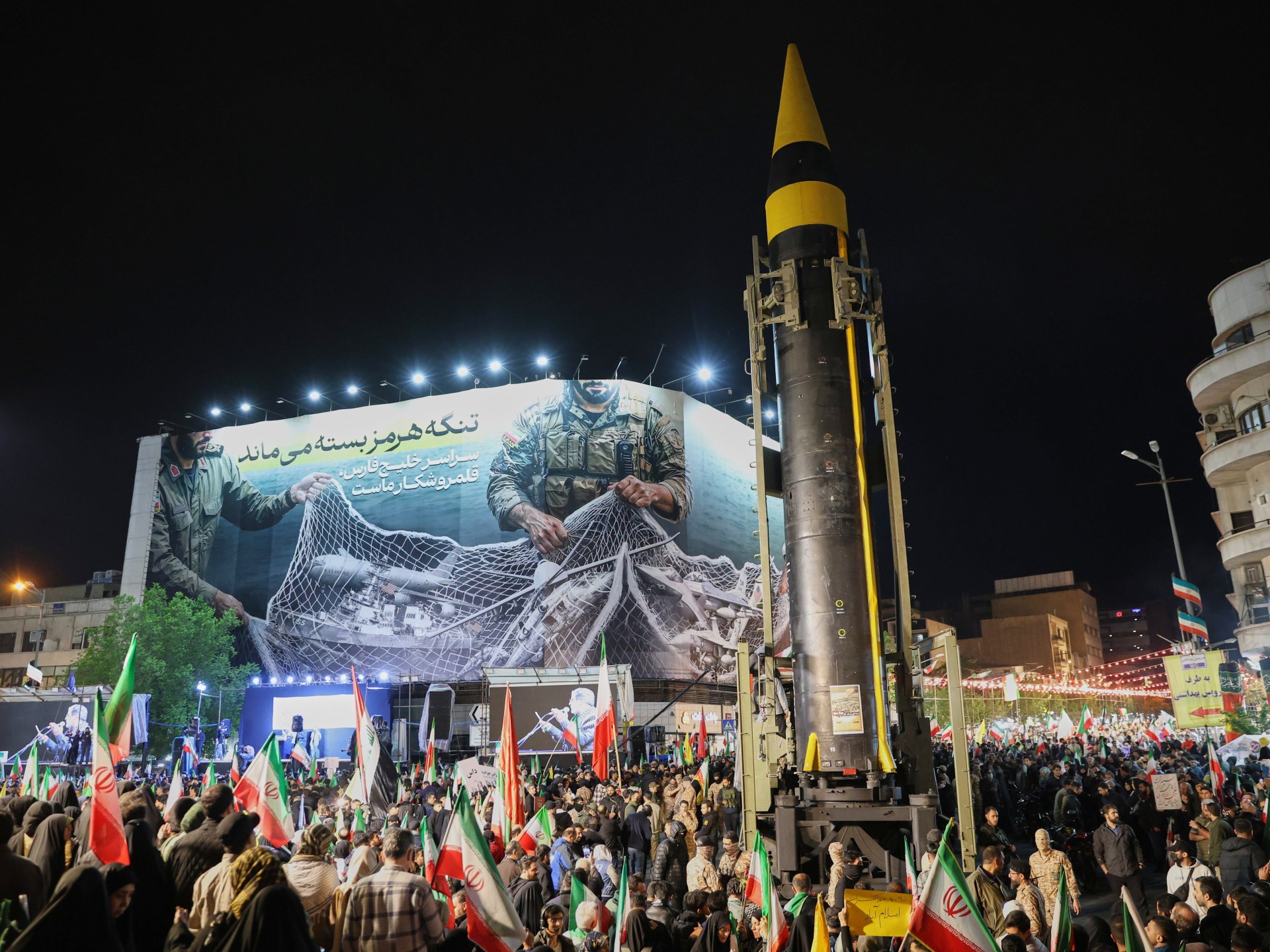
As the fragile ceasefire holds, Iranian authorities have called on supporters to take to the streets every night, framing the mobilisation as an essential component to ensuring “victory” against the US.
State television intensified its messaging on Friday evening, with multiple channels broadcasting hosts brandishing assault rifles, with rumours circulating that the war might restart.
The state-run Ofogh channel hosted a masked commander of the Islamic Revolutionary Guard Corps (IRGC), who instructed viewers on how to load a variant of an AK-47 assault rifle, and invited them to visit booths set up during pro-government rallies to receive weapons training
The segment concluded with the host firing a rifle into the ceiling before aiming one shot at a flag of the United Arab Emirates, amid simmering tensions with the Gulf state.
On Channel 3, host Mobina Nasiri held an assault rifle during a speech and said she was ready to “sacrifice” her life for Iran, part of a state-orchestrated call to arms during the war.
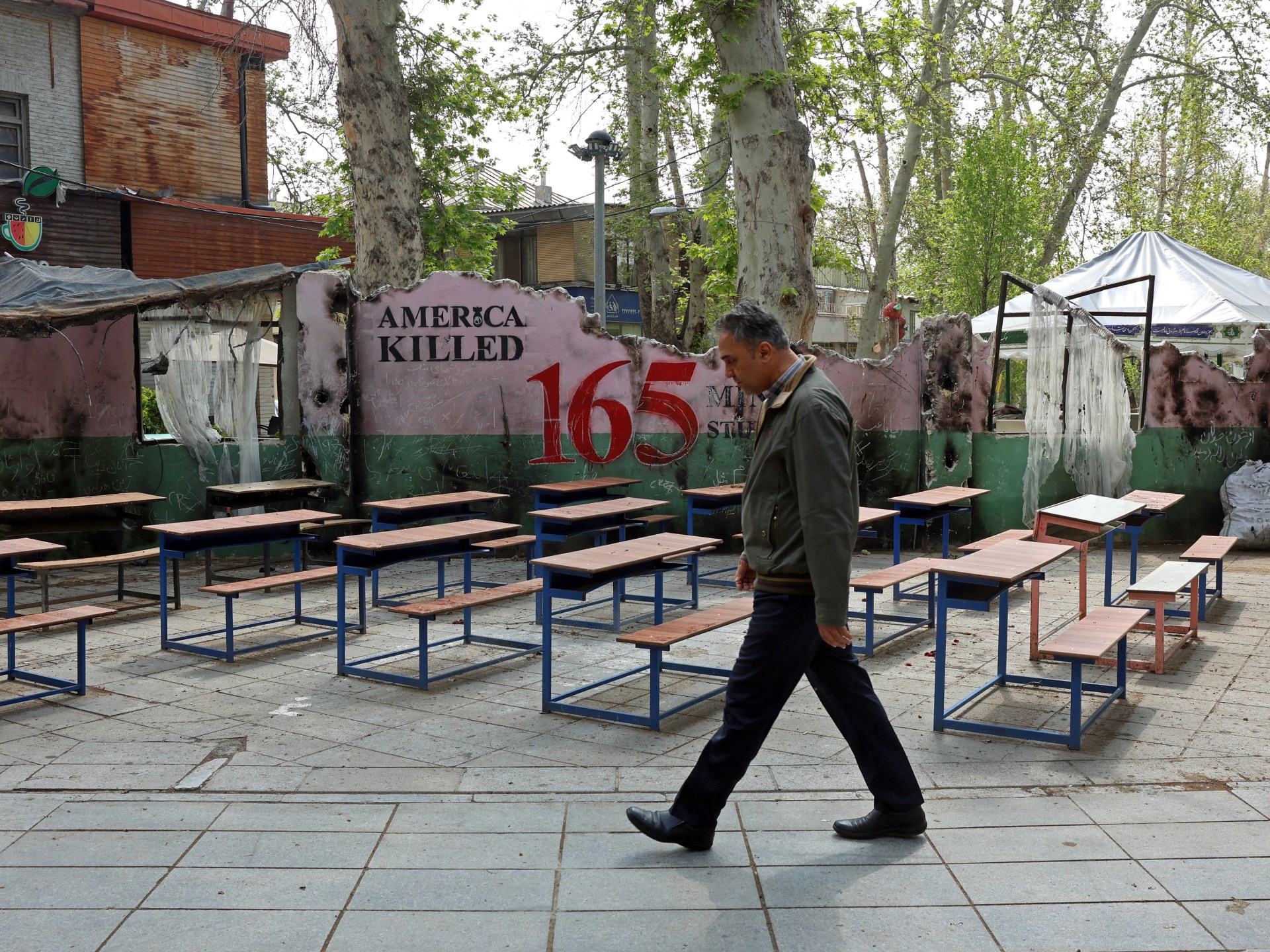
Major squares and streets in Iranian cities remain filled with armoured vehicles and checkpoints controlled by masked armed men, the same personnel who guard the demonstrations by supporters of the Islamic Republic at night.
It comes after thousands of anti-government protesters were killed during nationwide protests in January, which authorities described as a “coup attempt” orchestrated by the US and Israel.
Iranian authorities have imposed a near-total internet shutdown for 78 days, whilst promoting a state-operated tiered-access plan for limited services. The judiciary has announced the executions of alleged dissidents on a near-daily basis during the war, highlighting to all Iranians the high price for opposing the government.
Related News
Mahmoud Khalil calls for deportation to be halted in light of new evidence
UAE comes under Iranian attacks for second consecutive day
‘I can’t feel my leg’: Israeli gunfire disables teenagers in West Bank