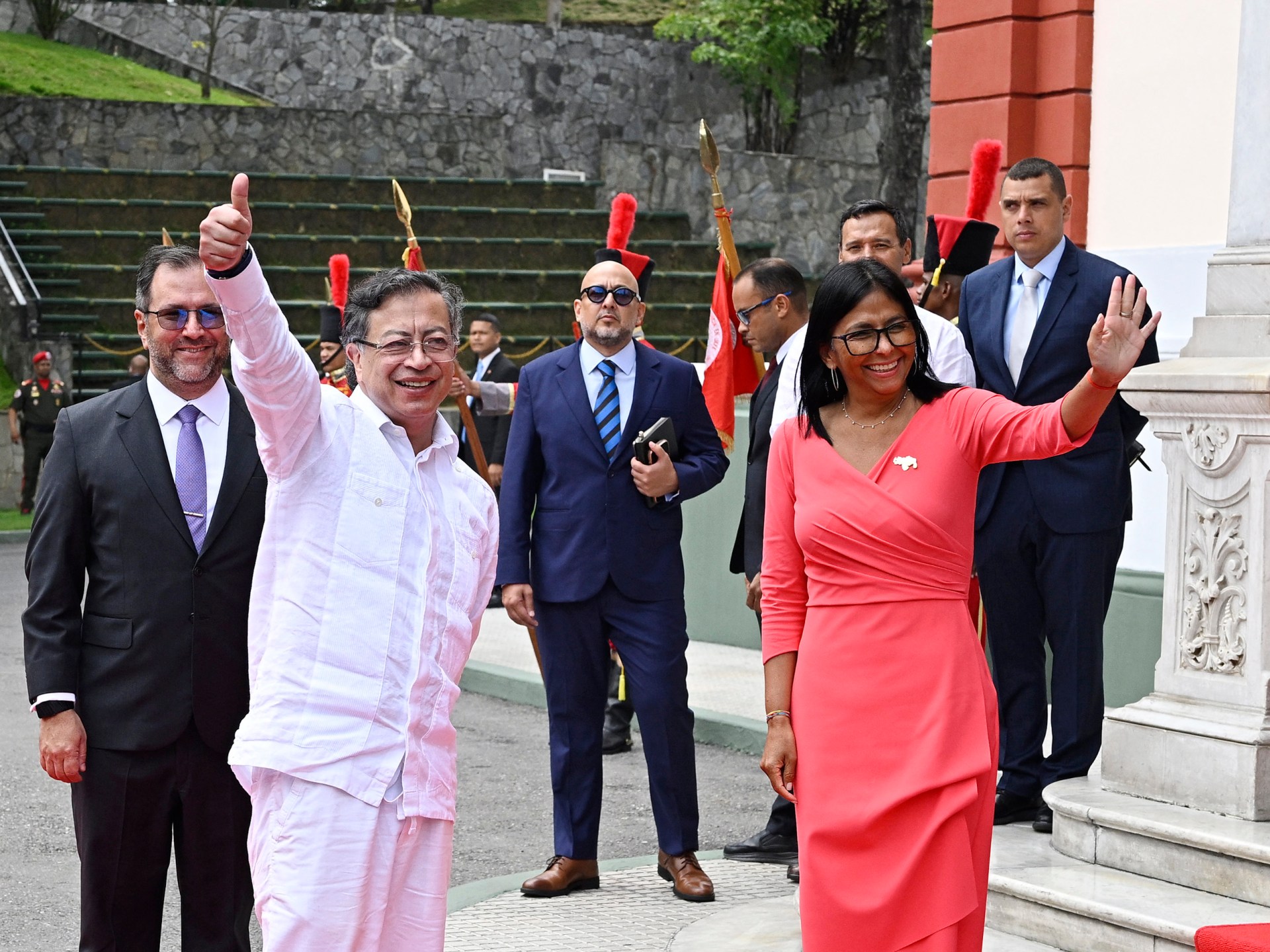

Colombian President Gustavo Petro has become the first foreign leader to visit Venezuela since the United States military abducted Nicolas Maduro on January 3.
On Friday, Petro was greeted by Venezuela’s interim President Delcy Rodriguez at the Miraflores Presidential Palace in Caracas. Their visit comes after a previously scheduled meeting in the Colombian border town of Cucuta was abruptly cancelled in March.
- list 1 of 3Venezuela’s Maduro set to appear in US court months after abduction
- list 2 of 3Historic but not enough? Colombia’s Gustavo Petro defends cocaine seizures
- list 3 of 3Suspect in slaying of Colombian presidential hopeful arrested in Argentina
end of list
The pair embraced and waved before heading inside the palace. Their meeting is expected to be dominated by issues of security, as the two countries share a 2,200-kilometre (1,367-mile) border.
While the border region is a significant area of trade, it is also a major migration route as well as home to criminal drug smuggling and paramilitary groups.
Previous Colombian governments had accused Maduro, Venezuela’s former president, of working with those criminal groups.
Those claims, in part, formed the basis for the US criminal charges against the longtime leader, who is awaiting trial in US detention. He had served as the leader of Venezuela since 2013.
Gustavo became Colombia’s first left-wing leader in 2022. He became an important ally to Maduro, with the pair agreeing to increase the military presence along the border.
Petro has been a vocal critic of the US abduction of Maduro, which he called an “assault on sovereignty” in Latin America. The US operation has also been decried by legal experts as a flagrant violation of international law.
Washington maintained the abduction was necessary as a law enforcement operation to bring Maduro to justice. It also does not recognise Maduro as the legitimate leader of Venezuela, following a series of contested elections.
Advertisement
In addition, Petro has also condemned the ongoing US strikes on alleged drug-smuggling boats in Latin America, which have killed Colombian nationals.
Petro’s criticism has prompted threats from US President Donald Trump, who floated possible strikes on Colombia’s territory. He has also called the Colombian president a “sick man who likes making cocaine and selling it to the United States”.
The US-Colombia tensions have since calmed following a White House meeting between Trump and Petro in February.
Rodriguez has also walked a fine line with Trump since Maduro’s abduction.
Formerly Maduro’s vice president, Rodriguez has cooperated with several US demands, including stopping oil exports to Cuba, opening Venezuela’s state-owned oil industry to foreign companies, and releasing political prisoners.
She has sought to do so without alienating Maduro loyalists in the country, including the influential leaders of the military and the interior security apparatus.
The Rodriguez administration has sought to attract investors in oil and mining to Venezuela, in an effort to heal the country’s economic crisis, including sky-high inflation.
But Rodriguez has also pushed the US to lift sanctions on the Venezuelan economy that she says are impeding long-term investments.
She said she accepted an invitation to meet Trump in the US, but no date has been set for the trip.
She has previously met CIA Director John Ratcliffe, US Interior Secretary Doug Burgum and US Energy Secretary Chris Wright when they visited Caracas earlier this year.
On Thursday, a new US envoy, John Barrett, also arrived in Caracas. He has been tasked with overseeing a US plan for the country, meant to culminate in new elections.
Related News
Trump says he opposes extending Iran ceasefire amid talks uncertainty
Pope Leo urges justice reform in Equatorial Guinea’s prisons

Anger in Lebanon as Israel launches deadly strikes despite diplomatic drive