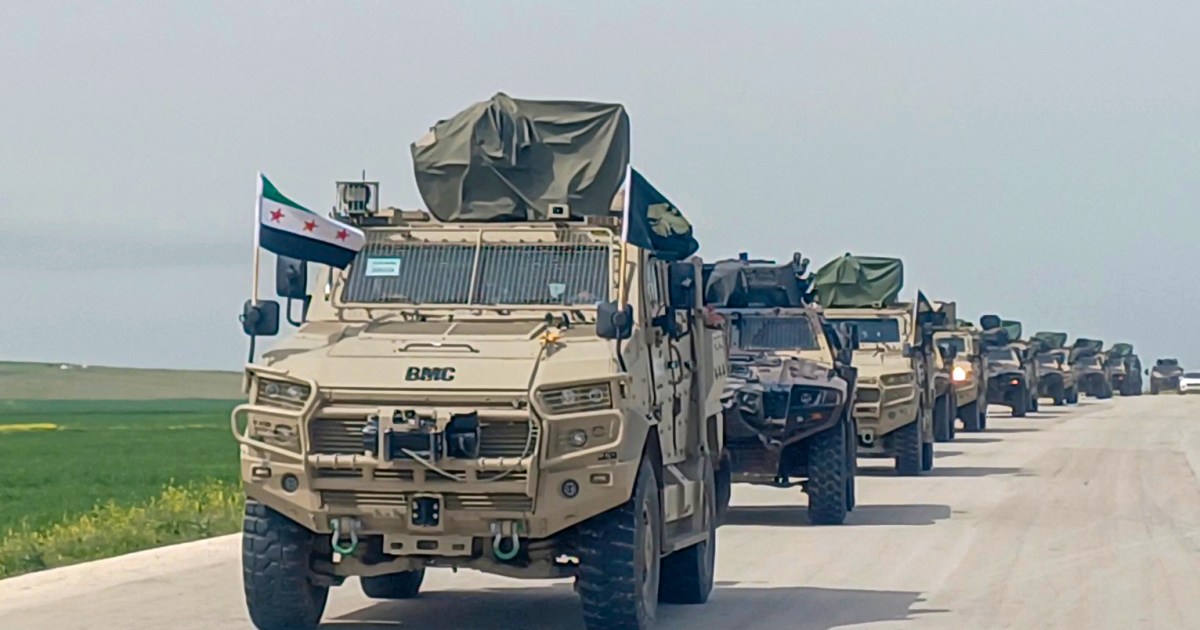

Syria has taken full control of all military sites where US forces had previously been deployed, completing a handover that Damascus says reflects the successful absorption of Kurdish-led fighters into national structures.
The announcement on Thursday comes after the final convoy of US soldiers and equipment departed Qasrak air base, located in the northeastern governorate of Hasakah, ending a military presence that began in 2014 when US forces entered the fight against ISIL (ISIS) alongside Kurdish fighters who went on to lead what became known as the Syrian Democratic Forces (SDF).
- list 1 of 3US begins withdrawing from its largest military base in Syria
- list 2 of 3Who is Yechiel Leiter, Israel’s US envoy leading talks with Lebanon?
- list 3 of 3French cement giant Lafarge guilty of financing ISIL in Syria
end of list
Syrian President Ahmed al-Sharaa received the two most senior figures in the SDF, its military commander, Mazloum Abdi, and the head of its political wing, Ilham Ahmad, in Damascus on Thursday.
Foreign Minister Asaad Hassan al-Shaibani and the presidential envoy overseeing the integration process were also present.
Syria’s Ministry of Foreign Affairs and Expatriates welcomed the completed handover of the bases, saying it reflected the government’s efforts to bring the country under a single state authority, including border areas and the northeast, which had long operated outside Damascus’s control.
The ministry said the transfer had been carried out in full coordination with the US, pointing to what it described as a constructive relationship that has developed since al-Sharaa met US President Donald Trump at the White House in November.
US Central Command, which is responsible for US troops in the Middle East, told the news agency AFP that US forces “have completed turning over all of our major bases in Syria as part of a deliberate and conditions-based transition”.
Advertisement
The handover follows a deal struck in January between Damascus and the SDF, which had governed large swaths of northern and eastern Syria with tacit US backing.
Syrian government forces fought a brief conflict with the SDF and seized control of much of the territory the group controlled before both sides came to a new agreement in March.
Under that deal, Kurdish fighters are being brought into the Syrian national army, Syrian security forces have deployed to the city centres of Hasakah and Qamishli, and control of border crossings and civilian institutions has transferred to Damascus.
Syria joined the international coalition against ISIL in November, a milestone that recast Damascus as a partner rather than an obstacle and fundamentally altered the rationale for a continued US military presence in Syria.
According to Syria analyst Charles Lister, the last soldiers and equipment were routed overland through Jordan rather than Iraq to reduce exposure to potential attacks by Iranian-backed armed groups operating in the region.
Related News
Trump deletes image of himself as Jesus-like savior after backlash
How long will Artemis II take to reach the moon, and what happens next?
Colombia responds to Ecuador’s tariff hike with 100-percent import tax