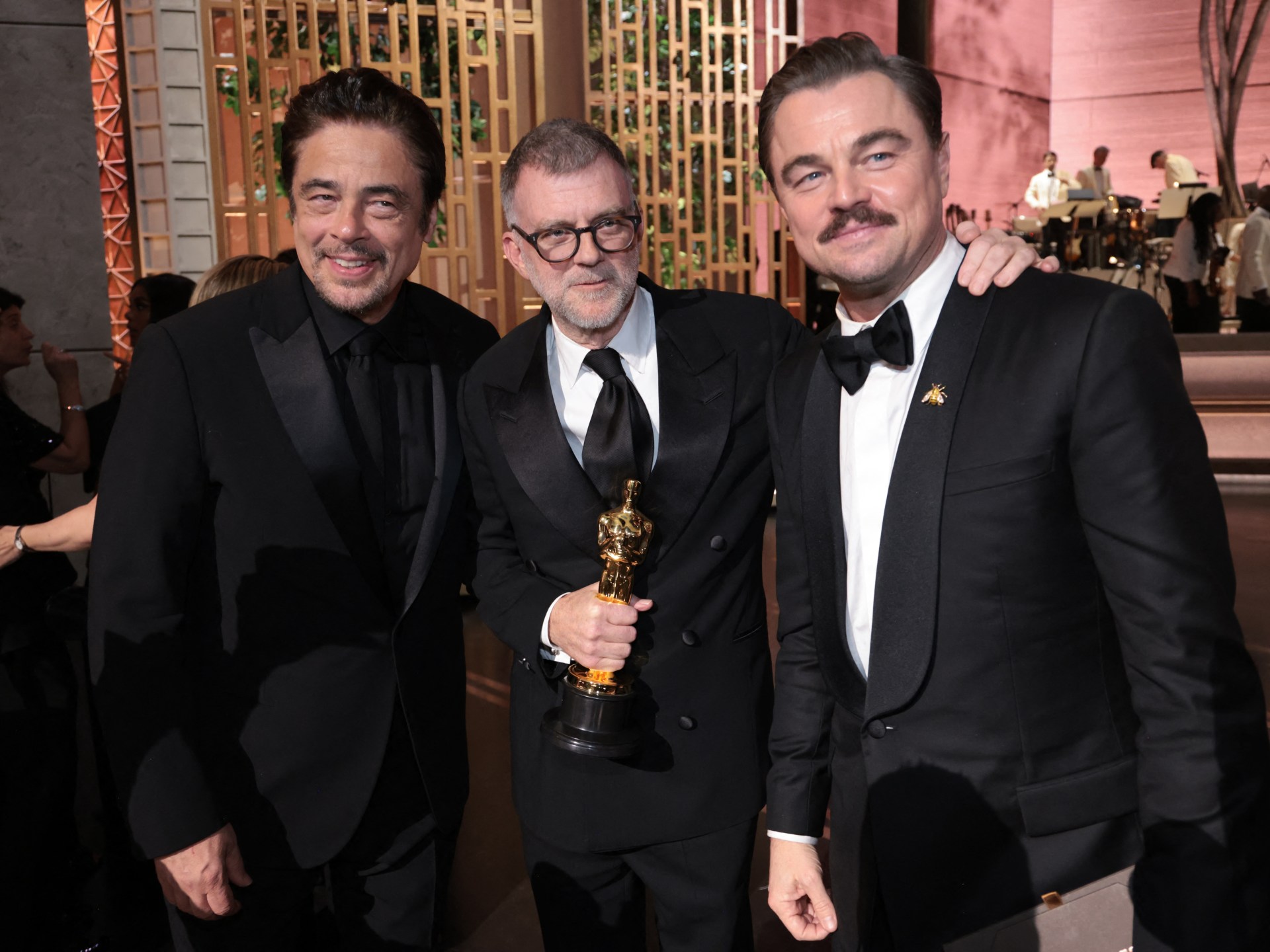

As anticipated, it ended up being One Battle After Another’s night at the 98th annual Academy Awards, with the political thriller carting away six Oscars out of a total of 13 nominations.
But while Paul Thomas Anderson’s magnum opus continued its march towards award-season domination, there were moments of genuine surprise and subversion in Sunday’s ceremony.
- list 1 of 3Hopes for justice rise as The Voice of Hind Rajab heads to Oscars
- list 2 of 3Stars at Oscars 2026 call for end to war in Gaza and Iran
- list 3 of 3Oscars 2026: Full list of winners
end of list
Some of those moments had to do with the current political climate in the United States.
Host Conan O’Brien and his fellow presenters deftly avoided mentioning President Donald Trump by name, but their barbs took direct aim at his policies since returning to office.
Other surprises came from within the filmmaking community itself. For only the seventh time in Oscar history, a tie was announced: Two films had gotten an equal number of votes for Best Live Action Short.
As a result, both the surrealist thriller Two People Exchanging Saliva and the moody bar-room drama The Singers shared the Academy Award.
Here are six key takeaways from the night.
A two-horse race between Sinners and One Battle
The vampire film Sinners came into Sunday night’s ceremony with a record 16 Oscar nominations. But the big question of the night was: How many nods could it actually convert into wins?
Its biggest competition was, of course, Anderson’s One Battle After Another, which had the second highest tally of nominations.
Sinners director Ryan Coogler and Anderson were in direct competition in several top categories, including Best Picture and Best Director.
Advertisement
In both cases, Anderson came out ahead, though he acknowledged how fickle such awards can be.
“ I just want to say that, in 1975, the Oscar nominees for Best Picture were Dog Day Afternoon, One Flew Over the Cuckoo’s Nest, Jaws, Nashville and Barry Lyndon,” the four-time Best Director nominee said, listing films now considered to be Hollywood classics.
“There is no best among them. There is just what the mood might be that day.”
In the categories for Best Supporting Actor and Best Film Editing, One Battle After Another also triumphed, as well as for the inaugural award for Best Casting.
But in a sign of how well matched their two films were, both Coogler and Anderson emerged from the night with writing Oscars.
Anderson picked up Best Adapted Screenplay award for his use of the Thomas Pynchon novel Vineland, while Coogler made off with the Best Original Screenplay Oscar for Sinners, a work inspired by his uncle’s love of the blues.
Jordan dunks on Chalamet in Best Actor race
Sinners, which won four Academy Awards overall, earned some of the most emotional, nail-biting victories of the night.
In the Best Cinematography category, for instance, Autumn Durald Arkapaw became the first woman to top the field.
It was her first nomination and first win, with Arkapaw besting veteran cinematographers like Marty Supreme’s Darius Khondji and Frankenstein’s Dan Laustsen, both multiple nominees.
Another big win for Sinners came in the form of Michael B Jordan, the actor whom Coogler has cast in every film since his directorial breakout in 2013’s Fruitvale Station.
Jordan, 39, was in a tight race for Best Actor with another young performer, 30-year-old Timothee Chalamet of the 1950s ping-pong drama Marty Supreme.
But Chalamet’s aggressive campaigning may have ultimately sabotaged his prospects. Multiple cracks were taken throughout the night at Chalamet’s recent comments disparaging opera and ballet.
“Nobody cares anymore” about either art form, Chalamet said in an interview last month.
“We can change society through art, through creativity, through theatre and ballet and also cinema,” director Alexandre Singh said pointedly during his acceptance speech for Best Live Action Short.
O’Brien, meanwhile, acknowledged the backlash with a joke about heightened security at the night’s Oscar ceremony.
“I’m told there are concerns about attacks from both the opera and ballet communities,” O’Brien said, before turning to Chalamet. “They’re just mad you left out jazz.”
A conga line of snubs
Given the dominant performances from Sinners and One Battle After Another, plenty of critically acclaimed films left empty-handed, or nearly so.
Advertisement
Guillermo del Toro’s Frankenstein, as expected, earned three wins in technical categories, including Best Production Design, Best Costumes and Best Hairstyling and Makeup.
Netflix’s smash hit KPop Demon Hunters, meanwhile, also fulfilled expectations that it would dominate in its categories, Best Animated Feature and Best Original Song.
But then there were former frontrunners like Hamnet that failed to generate much traction, including for director Chloe Zhao, a past Oscar winner. Out of eight nominations total, it only came away with one win: a Best Actress trophy for Irish performer Jessie Buckley.
Marty Supreme and the Brazilian film The Secret Agent fared worse, however. Despite having nine nominations and being considered an early shoo-in for Best Actor, Marty Supreme scored no wins.
The Secret Agent, which swept the Best Actor and Best Director categories at the 2025 Cannes Film Festival, also earned nothing at this year’s Oscars.
Same was true for the quirky kidnapping drama Bugonia, from Oscar darling Yorgos Lanthimos.
The ceremony, however, did occasionally veer away from the competition between the films to discuss issues facing the film industry and the country as a whole.
Among those was the creeping growth of artificial intelligence (AI) in the creative sector.
In the weeks leading up to the 98th Oscars, an AI-generated video clip had gone viral, appearing to show Hollywood icons Brad Pitt and Tom Cruise in a rooftop brawl worthy of a James Bond movie.
The clip had been generated through AI software developed by the Chinese firm ByteDance, and Hollywood leaders quickly denounced it as a threat to their livelihood, not to mention a copyright infringement.
Those concerns reverberated on the Oscar stage on Sunday, with O’Brien and others addressing the growing use of AI.
“Tonight we are celebrating people, not AI, because animation – it’s more than a prompt,” actor Will Arnett said emphatically as he introduced the animation awards.
O’Brien, meanwhile, joked that, by next year, his hosting gig would be taken by “a Waymo in a tux”.
Trump skewered for threatening free speech
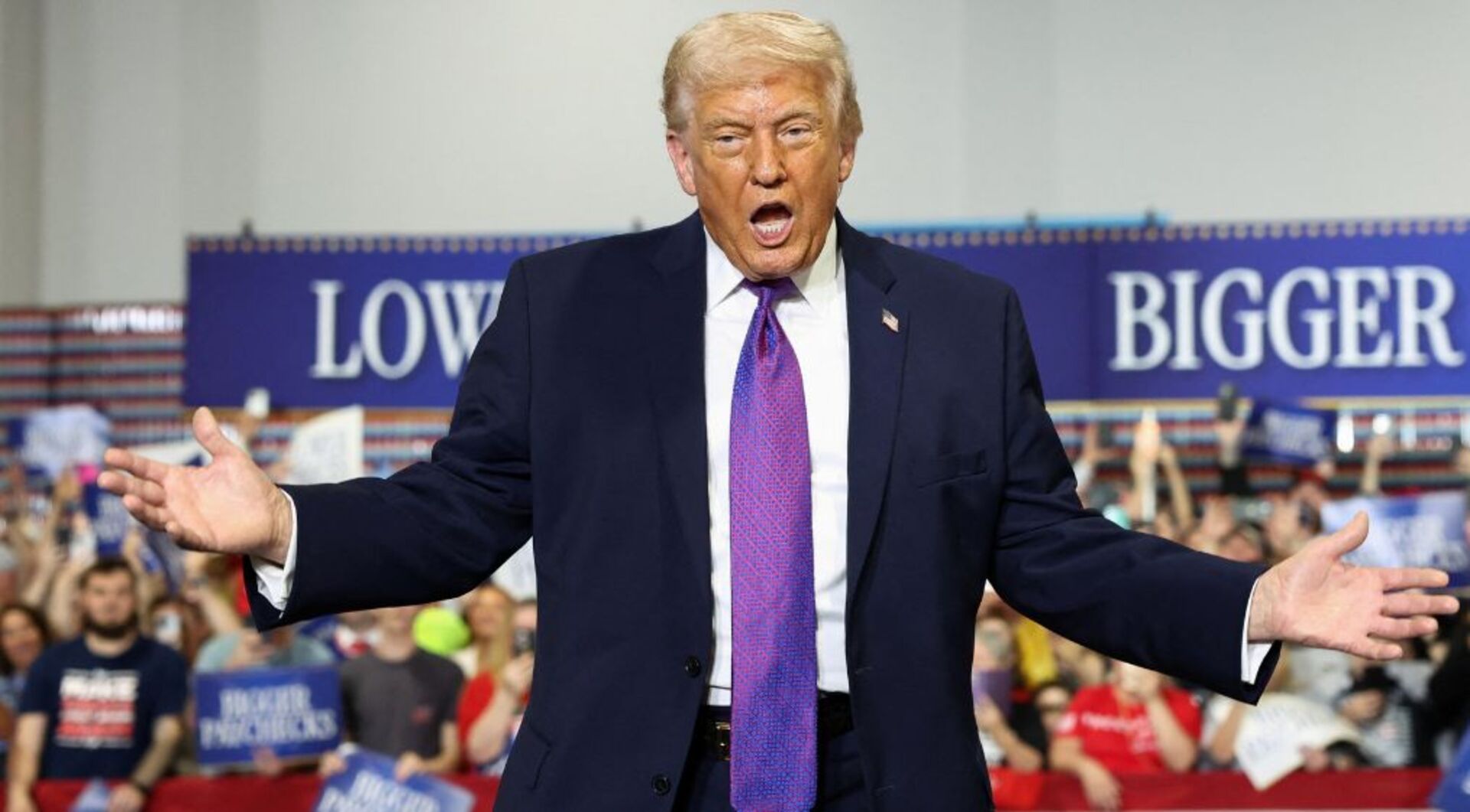
Another concern looming over the night’s Oscar ceremony came in the form of President Donald Trump, who has courted controversy by launching deadly military attacks in Venezuela and Iran, as well as leading a violent immigration crackdown in the US.
At no point was Trump mentioned by name. But his leadership was alluded to throughout the night.
O’Brien, the host, set the tone early on with his oblique jabs at the Republican president in his opening monologue.
“When I hosted last year, Los Angeles was on fire,” the two-time Oscar emcee said in remarks dripping with sarcasm. “But this year, everything’s going great.”
Fellow comedian Jimmy Kimmel was even more direct. Last September, his show was briefly suspended after Trump criticised the comedian.
The head of the Federal Communications Commission, a Trump appointee, subsequently threatened the broadcasting license of the TV channel Kimmel performs on.
Advertisement
“There are some countries whose leaders don’t support free speech. I’m not at liberty to say which. Let’s just leave it at North Korea and CBS,” Kimmel quipped, referring to another channel that cancelled a fellow late-night comedy show.
Several filmmakers honoured at the Oscars likewise waded into the controversies surrounding Trump.
Best Documentary Feature winner David Borenstein, for instance, implied a parallel between his film — an exploration of authoritarianism in Russia — and what is currently happening in the US.
“Mr Nobody against Putin is about how you lose your country,” Borenstein explained.
“What we saw when working with this footage is that you lose it through countless small little acts of complicity: when we act complicit, when a government murders people on the streets of our major cities, when we don’t say anything, when oligarchs take over the media.”
Political speeches avoid mention of Iran war
The Oscars come roughly seven months ahead of the pivotal midterm elections in the US, which could see Trump’s Republican Party lose its majorities in Congress.
But while several filmmakers did hint at their anti-Trump stances, few explicitly denounced his policies.
For example, Norway’s Joaquim Trier, the winner of the Best International Feature category, veiled his criticism in a James Baldwin quote about the duty to protect children.
“Let’s not vote for politicians who don’t take this seriously into account,” Trier said.
No artist during the night referenced the US and Israeli war against Iran, either, though its effects were felt among the participants of this year’s Oscar crop.
Writer-director Jafar Panahi, whose work was up for two Oscars on Sunday, has already said he plans to return to his native Iran after the awards season concludes.
Meanwhile, Iranian politician Sara Shahverdi — the subject of a nominee in the Best Documentary Short category — was prevented from attending the Oscars at all due to Trump’s ban on visas for 39 countries.
Palestinian actor Motaz Malhees, star of the Oscar nominee The Voice of Hind Rajab, likewise told media outlets he could not be present at the ceremony due to the travel ban.
The most pointed acknowledgement of the US-led and US-backed conflicts in the world was brief. When Spanish actor Javier Barden took the Oscar stage to present an award, he offered up six words, “No to war, and free Palestine!”
But by and large, the Oscar winners and presenters kept their remarks vague, emphasising global unity over political criticism.
“If I can be serious for just a moment, everyone watching right now around the world is all too aware that these are very chaotic, frightening times,” O’Brien told the audience at the outset of the night.
“It is at moments like these that I believe that the Oscars are particularly resonant. Check it out. Thirty-one countries across six continents are represented this evening, and every film we salute is the product of thousands of people speaking different languages.”
Cinema, he and others argued, transcended borders. The talent on stage was not the US’s alone.
Related News
Spain baulks at Trump’s threat to cut off all trade over NATO, Iran stance
War against Iran: How far will it go?

UAE president says prepared to confront ‘threats’ as Iran attacks continue