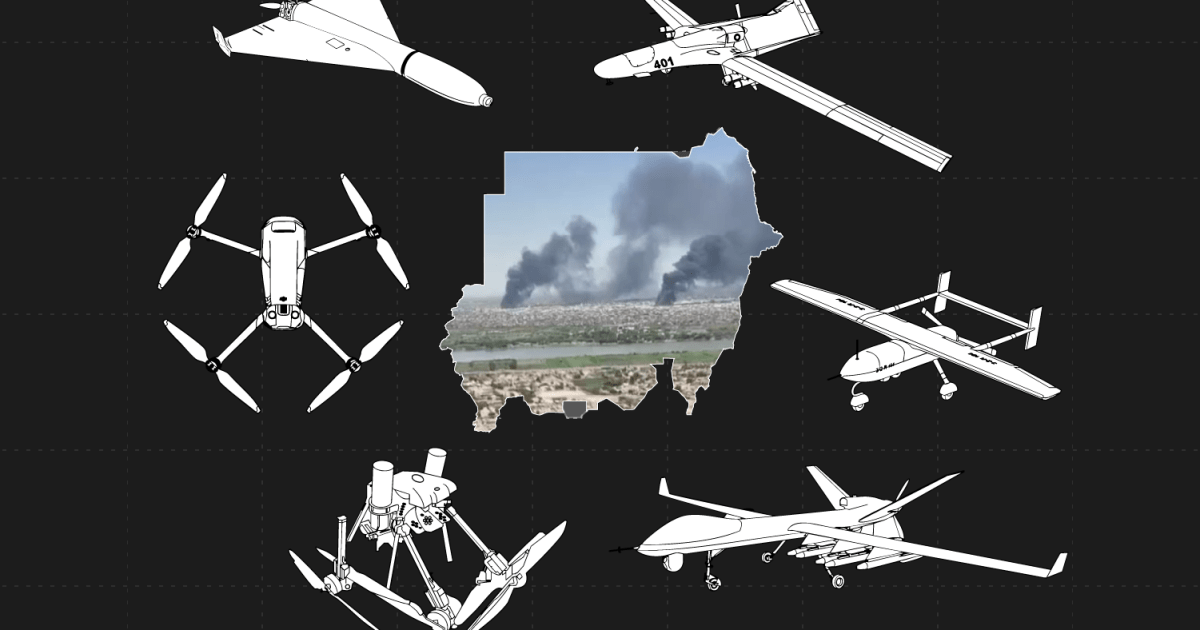

During Sudan’s civil war, which erupted in April 2023, both sides have increasingly relied on drones, and civilians have borne the brunt of the carnage.
The conflict between the Sudanese armed forces (SAF) and the Rapid Support Forces (RSF) paramilitary group is an example of war transformed by commercially available, easily concealable unmanned aerial vehicles (UAVs), or drones.
Modular, well-adapted to sanctions evasions and devastatingly effective, drones have killed scores of civilians, crippled infrastructure and plunged Sudanese cities into darkness.
In this visual investigation, Al Jazeera examines the history of drone warfare in Sudan, the types of drones used by the warring sides, how they are sourced, where the attacks have occurred and the human toll.
Janjaweed to RSF: The evolution of warfare
The RSF traces its origins to what at the time was a government-linked militia known as the Janjaweed. Sudan’s government mobilised it during the Darfur conflict in the early 2000s to suppress a rebellion in the western region.
The United Nations accused the Janjaweed of war crimes and crimes against humanity for its tactics, including burning villages, mass killings and sexual violence.
In 2013, the Sudanese government under President Omar al-Bashir, who was overthrown in 2019 after sustained popular protests, officially formalised the Janjaweed militias into the RSF under the command of General Mohamed Hamdan "Hemedti" Dagalo.
In 2015, Sudan joined the Saudi-led coalition in Yemen to fight the Houthis, who had seized the capital, Sanaa. In addition to regular soldiers, Sudan sent thousands of RSF fighters, allowing Hemedti to establish direct relationships with leaders in Riyadh and Abu Dhabi.

In the beginning, the Janjaweed relied on light weapons and trucks. Then as the RSF, it adopted heavy artillery and eventually drones, allowing it to strike from a distance.
On April 15, 2023, longstanding tensions between Army Chief Abdel Fattah al-Burhan and RSF Leader Mohamed Hamdan "Hemedti" Dagalo escalated into war. This conflict was primarily ignited by disagreements regarding the integration of the RSF into the regular army, a key step in the planned transition to civilian rule.
The introduction of drones shifted the balance of power away from the Sudanese army, which used to control the skies with its fighter jets.
What drones do the SAF and RSF have?
Sudan’s flat terrain and limited cover make it well-suited to drone strikes and surveillance, according to the open-source intelligence initiative Critical Threats.
Since the war began, the SAF and RSF have used drones spanning from short-range systems to those with a range of up to 4,000km (2,485 miles), capable of reaching any target in Sudan.
Sudan measures 1,250km (775 miles) from north to south and 1,390km (865 miles) from east to west, distances easily covered by RSF drones like the Chinese-made Wing Loong II and Turkish Bayraktar TB2.
SAF drones
The Sudanese army’s drones, which it uses for reconnaissance and precision attacks, mainly come from Iran, like the Mohajer-6 combat UAV, which was supplied to the SAF in late 2023.
It can carry a multispectral surveillance payload and/or up to two precision-guided munitions with a maximum ordnance of up to 40kg (88lb) and a range up to 2,000km (1,243 miles)
The video below, verified by Al Jazeera’s Sanad verification team, shows RSF drones targeting the Sidon fuel depot in Atbara, River Nile State, in April, according to Sudan War Updates.
RSF drones
Even though the RSF has no air force, according to a 2024 Amnesty International report, its allies have armed it with UAVs, including Chinese- and Serbian-manufactured drones.
One example, according to the Reuters news agency, is Chinese kamikaze drones reportedly used in high-profile RSF strikes with a range of up to 2,000km (1,243 miles) and a payload of 40kg (88lb). This long reach allows the RSF to strike as far east as Port Sudan from areas it holds in the west.
It is also deploying heavier FH-95 drones with a 200kg to 250kg (440lb to 550lb) payload that can drop laser-guided bombs. FH-95s have been spotted by humanitarian organisations at Nyala Airport in South Darfur in late 2024.
A video published in April appears to document an RSF suicide drone that crashed into a home in al-Dabba in Northern State. The post said it killed six people from one family, including two children.
Another weapon in the RSF fleet is a Serbian-made Yugoimport VTOL drone. The four-rotor drone can take off vertically and has reportedly been modified to carry mortar shells as dumb bombs.
What makes these drones significant is their ability to deliver artillery-level firepower without needing personnel on the ground.
The TikTok video below appears to show RSF fighters using a quadcopter drone, often made from commercial components and capable of carrying mortar shells.
These makeshift, lightweight drones with 120mm mortar rounds explode on impact, making them particularly indiscriminate.
Andreas Kreig, associate professor at the School of Security at King’s College London, told Al Jazeera: “On RSF adaptations, yes, there is ingenuity, and it is exactly what you would expect from a decentralised force with external supply options.
“The RSF appears willing to weaponise commercial quadcopters, repurpose agricultural or logistics drones, and modify platforms beyond their original design.”
The tactical logic is pragmatic: Drones are used to harass, distract and strike targets of symbolic or economic value, not necessarily to deliver consistently precise battlefield effects.”
“That kind of adaptation thrives in militia structures because approval chains are shorter and the appetite for improvisation is higher. It is also consistent with external enabling. The more a group is plugged into a transnational support network, the more it can experiment with components, munitions and techniques until something works.”

Supply chains: Who is supplying drones? And how?
Most drones in Sudan are smuggled in by a network of foreign backers via land, sea and air, bypassing official embargoes, as foreign states exploit the situation to their advantage.
The SAF is believed to have drone technology and military support from Egypt, Russia, Iran and Turkiye, using Eritrea as a transit hub to Port Sudan, according to Krieg and Critical Threats, a project established by the American Enterprise Institute to analyse national security threats globally.
According to Reuters, the SAF has received Iranian drones and parts with Iranian Mohajer-6s reportedly arriving in late 2023 and 2024, often via cargo flights arriving in Port Sudan, which the army has not confirmed. Turkiye has provided Bayraktar drones via Egypt, according to Critical Threats.
Critical Threats and the Royal United Services Institute defence think tank have found that several of the foreign actors supplying drones to the SAF, such as Iran and Russia, have done so in exchange for a regional presence. Iran reportedly hopes to secure a Red Sea naval base while Russia is said to have switched from supporting the RSF via the Kremlin-funded Wagner Group to supporting the SAF in 2024 in exchange for reinstating a 2017 agreement for a Red Sea naval base.
The RSF, on the other hand, has reportedly received drone technology and military support from the UAE through various transit points, including eastern Chad, South Sudan, southeastern Libya, northeastern Somalia and the Central African Republic.
Sudan's UN ambassador, Al-Harith Idriss al-Harith Mohamed, has repeatedly and publicly accused the UAE at the UN Security Council of arming the RSF. While Abu Dhabi denies these claims, open-source analysis has documented dozens of UAE-operated cargo flights flying into eastern Chad since April 2023. According to Reuters, at least 86 UAE flights suspected of carrying weapons for the RSF landed at Chad’s Amdjarass airstrip.
“The UAE sits at the hub because it can combine procurement capacity, permissive commercial infrastructure, aviation connectivity and a dense layer of intermediaries that can move dual-use systems without a clear state signature,” Krieg said.
“From there, the spokes run through jurisdictions that offer cover, weak oversight or useful geography.”
Krieg said Amdjarass matters because of its proximity to Darfur and its mix of humanitarian and commercial traffic that provides cover.
According to Reuters, satellite images showed UAE-branded pallets being unloaded near RSF supply routes. From Chad, arms are trucked into Darfur or through areas controlled by eastern Libya military commander Khalifa Haftar. The RSF is also said to operate out of Somalia with Bosaso airport, located in Somalia’s semiautonomous Puntland region, being developed by the UAE. However, the UAE has denied this.
Eastern Libya is another route, drawing on Haftar-aligned networks already experienced in smuggling and convoy protection. Further afield, hubs like Bosaso and Entebbe, Uganda, are staging points where shipments can be broken down, redocumented and moved onwards in smaller consignments, “preserving plausible deniability”, according to Krieg.
“The drones themselves rarely need to travel as complete aircraft. The most resilient model is modular transport: airframes, engines, datalinks, optics, batteries, ground control components and munitions moving separately under commercial cover.
“When you add the commodity layer, especially gold, the network becomes self-financing. The same corridors that move drone parts can move bullion, cash and high-value goods back out [of Sudan],” he said.
Related News

Nigerian police confirm gunmen abducted villagers, after initial denials
Shipping giant Maersk to take over Panama Canal ports after court ruling

Campaign to boycott Israel looks to future after Gaza ‘ceasefire’