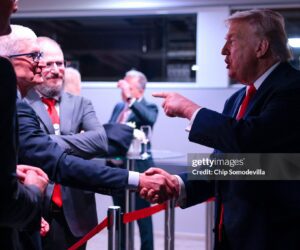

News Americas, Toronto, Canada, Thurs. Jan. 29, 2026: Donald Trump’s political approach has not been defined by a consistent commitment to long-term institutional stewardship – either domestically or internationally. To assume otherwise risks attributing to him a degree of altruism or strategic coherence that his record does not clearly support.
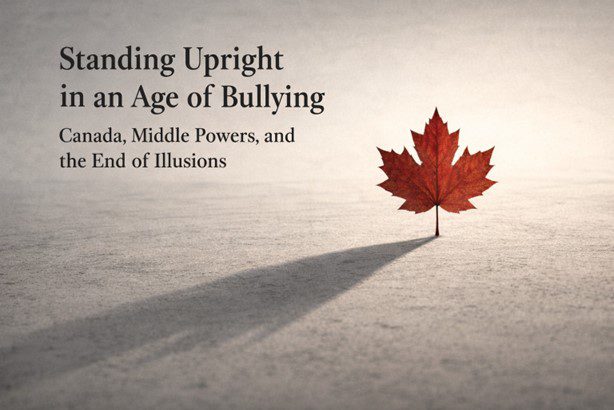
Mark Carney’s responsibility, by contrast, is narrowly defined: to safeguard Canada’s interests. That is what he has sought to do. Faced with erratic threats, the use of tariffs as leverage, and diminishing regard for rules-based cooperation, Canada’s choices have narrowed: acquiesce and absorb repeated shocks, or chart a more deliberate course grounded in clarity, discipline, and resolve.
It would be reassuring to believe that these challenges will fade with a change in U.S. leadership. But Trump is better understood not as an aberration, but as a prominent manifestation of a broader American political current – one increasingly skeptical of alliances, resistant to external constraints, and prepared to deploy economic power coercively. That current is unlikely to vanish overnight. Expectations of a simple return to earlier norms therefore risk confusing nostalgia with strategy.
Binding Agreements Strained — Treaties Treated as Contingent

Recent years have underscored a difficult reality for Canada:
- Agreements, even when formally ratified, can be reinterpreted or disregarded.
- Treaty commitments may be suspended through executive action.
- Stability can erode not because rules cease to exist, but because one party signals that compliance is optional.
The central question is no longer whether the United States will formally withdraw from the USMCA, but whether its conduct increasingly resembles partial disengagement – through tariffs, contested justifications, and the politicization of border administration.
In practice, many Canadian businesses and policymakers already operate on that assumption.
Tariffs are no longer confined to conventional trade disputes; they have become instruments of political signaling. The long-standing belief that economic interdependence would reliably constrain political behavior appears less certain. In some cases, political imperatives now drive economic decisions.
A Watershed Moment in the Global Order
For decades, the United States benefited from an international system reinforced by reserve-currency status, deep capital markets, and broad geopolitical trust. There are growing indications that aspects of that system are being reassessed.
What is unfolding is not collapse, but adjustment. Some countries have chosen to diversify reserve holdings, including through increased domestic custody of gold. Gold prices reflect this broader uncertainty. Holdings of U.S. Treasuries are being reduced incrementally – not in panic, but as part of longer-term risk management. Few actors seek a disorderly outcome that would undermine assets they still hold.
This is how systemic change often appears: gradual rather than dramatic, cautious rather than declarative.
The Limits of Negotiating with a Bully
There has been a persistent belief that Trump could be effectively constrained through negotiation alone. Experience has called that assumption into question.
When tariff threats were linked to geopolitical demand such as pressure surrounding Greenland several countries declined to comply, responding instead through coordinated diplomatic resistance. Figures such as Carney emphasized collective resolve rather than bilateral concession.
Subsequent U.S. messaging shifted, with references to prospective frameworks lacking clear institutional endorsement. Observers differed on interpretation, but the episode reinforced a recurring pattern: pressure applied, resistance encountered, narrative adjusted.
History suggests that coercive bargaining rarely stabilizes relationships. Concessions offered under pressure often invite further demands. Durable outcomes, by contrast, tend to emerge from clear limits combined with consistent engagement.
History’s Warning
Historical analogy should be used with care, but certain lessons recur.
In 1938, Neville Chamberlain returned from Munich asserting that concessions would secure peace. Within months, further territorial expansion followed, culminating in a broader European war.
Appeasement, in retrospect, did not preserve stability.
It weakened deterrence.
Contemporary disputes – whether involving Panama, Colombia, Greenland, Venezuela, Iran, or even close partners such as Canada, differ profoundly in context and scale. Yet the underlying logic of pressure and response remains familiar.
Canada as a Trading Nation
Canada is fundamentally a trading nation. Beyond exporting goods, it depends on durable commercial relationships and deeply integrated supply chains.
For many years, Canadians assumed that the U.S. relationship, unequal but fundamentally pragmatic, rested on shared economic self-interest. Highly integrated economies, it was believed, would avoid actions that imposed disproportionate harm on themselves.
That assumption now warrants re-examination.
The Risks of Escalatory Economic Threats
Threats of sweeping tariffs, such as a hypothetical across-the-board increase tied to Canada’s pursuit of diversified trade, would carry serious risks for both economies.
Such measures could disrupt housing, automotive manufacturing, energy markets, and cross-border supply chains with unusual speed and severity.
Canada is not a great power. But it is a capable one: resource-rich, institutionally stable, and deeply embedded in global markets. Treating it as economically subordinate would not only strain bilateral relations; it would undermine shared economic resilience.
What Middle Powers Must Do
So what course remains for Canada?
The one middle powers have historically taken under pressure.
Stay calm.
Stay strategic.
Stay firm.
Avoid panic.
Avoid theatrics.
Avoid reflexive concession.
There is a difference between compromise and capitulation. Between diplomacy and dependency. Between reducing risk and institutionalizing vulnerability.
Geography is immutable. The United States will remain Canada’s closest neighbor and largest trading partner. Abrupt disengagement is neither realistic nor desirable.
But neither can Canada accept a condition of recurring economic coercion – where each political cycle introduces renewed uncertainty.
That is not partnership.
It is not stability.
It is not free trade.
Canada cannot control the direction of U.S. domestic politics. But it can reduce its exposure to their volatility. Success will not be measured in rhetoric or applause, but in whether Canada becomes, over time, more resilient – harder to pressure, harder to isolate, harder to threaten economically. That is stability.
Not submission.
EDITOR’S NOTE: Ron Cheong, born in Guyana, is a community activist and dedicated volunteer with an extensive international background in banking. Now residing in Toronto, Canada, he is a fellow of the Institute of Canadian Bankers and holds a Bachelor of Science degree from the University of Toronto. His comments are his own and do not reflect those of News Americas or its parent company, ICN.
Related News
St. Vincent and Grenadines New Government Lays Out New Budget
When Immigration Policy Meets Tourism Economies: The Caribbean’s New Reality

The UWI Toronto Benefit Awards Announces This Year’s Honorees