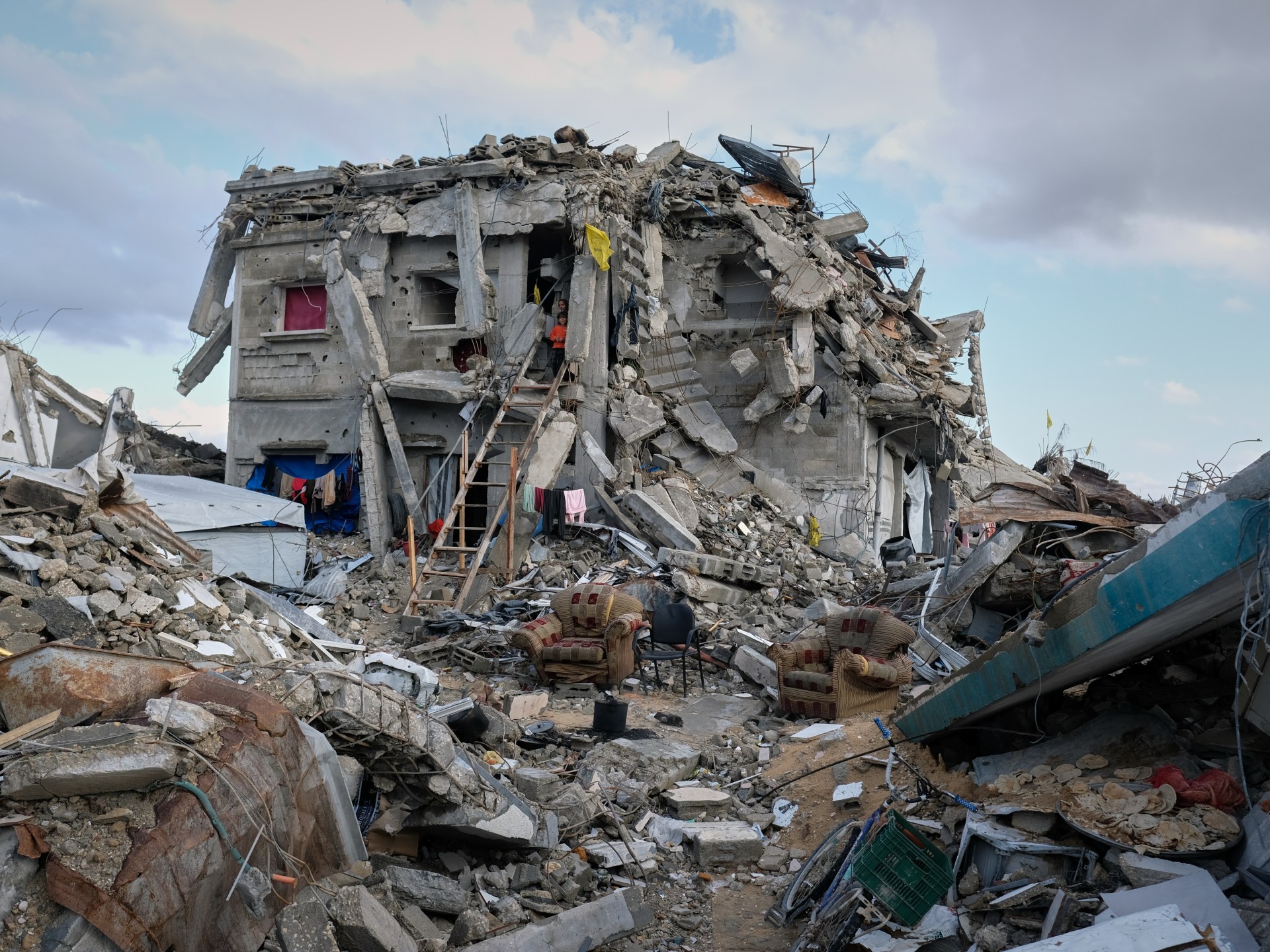

The Halawa family’s building still stands two storeys above the rubble in Gaza City, a rare survivor after two years of nonstop Israeli air attacks that levelled buildings across the besieged Palestinian enclave.
One section has collapsed, with bent metal rods protruding from where a roof once existed. The family built a narrow set of creaking wooden steps to access their home, though these makeshift stairs threaten to give way at any moment. Yet amid the destruction, it remains home.
Israel’s genocidal war on Gaza has killed more than 70,000 Palestinians, destroyed or damaged more than 70 percent of the buildings, and displaced most of the territory’s 2.3 million residents.
In October, Israel reached an agreement to cease fire, but its attacks have not stopped. It has killed more than 400 Palestinians since then, in violation of the truce agreement. It has also not allowed the full entry of aid.
Reconstruction has not begun and is projected to take years, as Israel has kept total control over what goes in and comes out of the enclave. This means families like the Halawas are struggling to rebuild their lives.
The family abandoned their home three months after the war began on October 7, 2023. They returned during the fragile calm established by the truce. Like many others, this family of seven found living in their damaged residence preferable to tent life, particularly as winter rains flooded tent shelters over the past weeks.
In one damaged room, Amani Halawa brewed coffee in a small tin over a fire while thin rays of light filtered through concrete fragments. Amani, her husband Mohammed, and their children have made repairs using concrete scraps, hanging backpacks from exposed metal rods and arranging pots and pans across the kitchen floor.
Advertisement
The home’s walls feature a painted tree and messages to family members separated by the conflict.
Throughout damaged apartments in Gaza City, daily life persists, even as families lie awake fearing their walls might collapse. Health officials report that at least 11 people died from building collapses in a single week in December.
In her home, Sahar Taroush swept dust from carpets placed over rubble. Her daughter Bisan’s face glowed in the light of a computer screen as she watched a movie beside gaping holes in the wall.
On another building’s cracked wall, a family displayed a torn photo of their grandfather on horseback from his time serving in the Palestinian Authority’s security forces during the 1990s. Nearby, a man reclined on a bed precariously balanced on a damaged balcony, scrolling through his phone above the devastated al-Karama neighbourhood.
Related News
Civilians, soldiers killed in renewed fighting along Cambodia-Thai border
Syrian army, Kurdish-led SDF agree to stop deadly fighting in Aleppo
Trump touts achievements, attacks immigrants in White House address